

 Preview
 Send
Send Share
Share
 Details
 Guide
Guide

 Download
 Similars
 X-Ray
X-Ray Diaporama
 Stats
StatsAmerican Gothic
 Oil On Board
- WallArt
- Regionalism
 1930
1930- Modern
 74.0 x 62.0 cm
 Art Institute of Chicago
 Read More
Purchase a high-resolution, enhanced digital image, far superior to the online preview.
Each file is meticulously prepared by our in-house specialists using advanced tools and expert manual retouching. We ensure every image has exceptional clarity, precise color accuracy, and fine detail.
The final file is delivered via email within 72 hours, optimized for immediate use in professional, editorial, and print environments. This is the same quality trusted by top-tier design studios, publishers, and galleries.
Digital Image
Download a high-resolution file for personal display, printing, and creative projects. ( Switch to Print Buy Hand Made Painting)
Included in Every Digital Image Order
Expert Digital Delivery, Guaranteed
When you choose OriginalUniqueArt.com, you're not just getting an image - you're receiving a professionally enhanced digital artwork, crafted with precision and backed by a satisfaction guarantee. Here's everything that comes with your order, automatically:

Fast Email Delivery
Your high-resolution digital image file will be emailed to you within 72 hours of ordering - ready for immediate use.

AI-Enhanced Digital File
Your artwork is professionally optimized using advanced AI tools and manual editing, ensuring maximum detail, clarity, and color accuracy.

Free Lifetime Re-Delivery
Accidentally deleted or lost your file? No worries - we'll resend it to you anytime, free of charge.

No Import Fees - Ever
Enjoy your artwork instantly with zero customs, duties, or delivery fees - digital downloads are always tax-free.

Color Accuracy Guarantee
We ensure your digital image reflects the original colors as closely as possible using professional tools and color management.

100-Day Satisfaction Guarantee
If you're not satisfied with your digital image, we'll revise it or refund 100% within 100 days - no questions asked.

100% Money-Back Guarantee
Not satisfied? Get a full refund within 100 days of receiving your digital file - no questions asked.

Bulk Order Discounts
Buy 3 images, save 10% - Buy 5, save 15% - Buy 10+, save 20%. Great for creative projects, galleries, and agencies.
The Sharp Edge of the Pitchfork
A three-pronged pitchfork catches the light, its vertical lines mirrored in the stitching of a man's overalls and the rigid structure of a window frame. The farmer stands with a heavy, upright posture, his face etched with a quiet, stoic gravity. Beside him, a woman stares forward, her expression caught between strength and constraint. They are positioned before a white farmhouse, a Carpenter Gothic structure with a pointed window that reaches upward like a small, wooden cathedral. The scene is built from geometric precision: the rectangle of the house, the oval of a face, and the sharp triangle of the tool held in hand.
The paint sits smooth upon the beaverboard, applied with a meticulous clarity that recalls the Flemish masters. Every texture is rendered with photographic intent, from the coarse fabric of the man's suit jacket to the delicate colonial print of the woman's apron. The palette remains muted and somber, relying on earth tones—browns, grays, and pale blues—to ground the figures in a landscape of rolling hills and distant barns. There is no movement here, only the stillness of a moment frozen in oil.
A Vision of the Heartland
Created in 1930, this work emerged from a period of profound national anxiety during the Great Depression. While some saw a satire of rural backwardness, the intention was to offer a sense of reassurance through the depiction of enduring American values. The figures, modeled after the artist's sister and a local dentist, carry the weight of a generation seeking stability. Even the botanical details—the mother-in-law’s tongue and beefsteak begonia resting on the porch rail—connect the domestic space to personal, intimate histories.
The composition relies on a deliberate flattening of space, creating a sense of formal restraint. The verticality of the Gothic window and the pitchfork creates a rhythmic repetition that binds the human subjects to their architectural backdrop. It is a study of resilience found in the simple, unyielding lines of a Midwestern life.
The light is diffused and soft.
Questions & Answers
Who created "American Gothic"?
"American Gothic" is attributed to Grant Wood.
Can I see "American Gothic" by Grant Wood under different lights?
The X-Ray page of "American Gothic" by Grant Wood is an interactive viewer that lets you slide through eleven optical layers of the artwork's image, including an X-ray style view.
Where is the portrait format of "American Gothic" recommended to be displayed?
The portrait format of "American Gothic" by Grant Wood is recommended for a living room. Format and space together guide the placement of a reproduction.
Artist Biography
Early Life and Career
Grant DeVolson Wood, an American painter, was born on February 13, 1891, in rural Iowa. His life changed dramatically after the death of his father in 1901, when his mother relocated the family to Cedar Rapids. Wood began his artistic journey as an apprentice in a local metal shop before enrolling at the Handicraft Guild in Minneapolis in 1910—an art school notable for being run by women and focused on the Arts and Crafts movement.
Artistic Influences and Style
Wood’s art was deeply influenced by Jan van Eyck, the 15th-century Flemish master renowned for his precise and luminous technique. This meticulous clarity became a hallmark of Wood’s own style, best exemplified in his most celebrated work, American Gothic. As a leading figure in the American Regionalism movement—a style emphasizing the realistic depiction of rural and small-town America—Wood developed a uniquely American voice that combined European craftsmanship with Midwestern authenticity.
Notable Works and Contributions
American Gothic (1930): A defining image of 20th-century American art, often compared to Leonardo da Vinci’s Mona Lisa and Edvard Munch’s The Scream for its cultural resonance. The Stone City Art Colony (1932): Founded by Wood near his hometown, the colony provided vital support for artists during the Great Depression. University of Iowa School of Art (1934–1941): As a teacher, Wood inspired a generation of artists to find beauty and meaning in the familiar landscapes of the American Midwest.
Legacy and Later Life
Grant Wood passed away on February 12, 1942, at the age of 51, due to pancreatic cancer. His estate was left to his sister, Nan Wood Graham—immortalized as the female figure in American Gothic. Today, his personal belongings and many of his works are preserved at the Figge Art Museum in Davenport, Iowa. Wood’s devotion to portraying the dignity of everyday American life continues to influence artists and scholars worldwide.
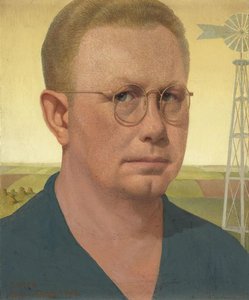
Grant Wood
1891 - 1942 , United States of America
Quick Facts
- Full Name: Grant DeVolson Wood
- Nationality: American
- Date Of Birth: 1891
- Date Of Death: 1942
- Place Of Birth: Anamosa, United States of America
- Notable Artworks:
- American Gothic
- Portrait of Nan
- The Appraisal
- Spring In Town
- Artistic Movement Or Style: American Regionalism
- Artists Who Influenced This Artist: ['Jan van Eyck']
- Artists Or Movements Influenced By This Artist: ['Regionalism']