 Read More


 For artworks or reproductions larger than 105 cm (approximately 41 inches) on any side, the frame will be shipped as a kit, disassembled. This method ensures safe delivery and prevents damage during transport.


More about this painting
Text size

() ·
A painting made for you, by hand
Hand Made Oil Reproduction
Hand-painted oil on canvas in your size and frame, made to order by our artists. ( Switch to Print Switch to Digital Image)
Artist Biography
Giuseppe Pellizza da Volpedo (1868-1907) was a pivotal Italian Divisionist painter known for his socially conscious realism & iconic work, 'The Fourth Estate.' Explore his neo-impressionist style and lasting impact on progressive art.
from ·
Chapter 1
How large should it be?
Slide to change the size; the picture on the left shows the frame at its real width. The proportions of the original are kept.
Standard
custom
CM
INCH
Pick from our preset sizes that match the artwork's original proportions.
Loading sizes...

width
height
Type the width and the height you need, to fit your frame or your wall. This is hand-painted, so for a size with a different shape the artist can paint a bit more around the picture, or cut a bit — you choose. We send you a digital mockup to approve before the painting starts. The picture shown on this page does not show the real result — only the mockup does.
Chapter 2
How should it arrive?
Choose the edges of the stretched canvas
Choose your frame

White $1

Blurside $1

Extended $1

P118B $10

P118H $10

P118W $10

P438Z $10

P508JH $12

P508YH $12

P805H $10

P805Z $10

P919BZ $10

P919G $10

P919XJ $10

P959ZH $10

P968JZ $12

W106C $8

W218G $10

W218JH $8

W218Y $10

W307PJ $10

W316G $10

W316PJ $8

W316Y $10

W398PJ $8

W4111J $10

W500HY $15

W500JH $15

W692G $12

W849H $8

W940BG $15

W953PJ $8

H24-GOLD $30

H24-SILVER $30

H36-GOLD $45

H36-SILVER $45
Framed
Moulding: . Overall size with the frame: .
Chapter 3
Who paints it, and should anything change?
Examples of what can be changed: Replace face with customer photo; Add pet (e.g., replace cat with dog); Include hidden message in background; Change background landscape or elements.
After order, OriginalUniqueArt.com team will email client for instructions and provide a mockup preview
After order, OriginalUniqueArt.com team will email client for instructions and provide a mockup preview
Worldwide Delivery () in 3/4 weeks instead of standard 5 weeks. (31 October). No compromise on quality.
Chapter 4
The finishing touches
A nameplate, as in a museum?
Engraved Bronze Plaque Details
This elegant plaque features the artist's name and the title of the artwork, finely engraved for a timeless presentation.
It is made from bronze with a refined, elegant finish. The text is precisely laser-engraved for a sharp and permanent result. Measuring 9x2 cm, the plaque is compact yet easy to read. It's built to be durable and scratch-resistant, offering a professional, museum-quality look. Mounting is simple thanks to the included adhesive backing.
Transparent Acrylic Plaque Details
The plaque includes essential engraved details such as the artist's name, the title of the artwork, the date it was created, the type of media used-like oil on canvas or watercolor-a brief description of the piece, and a QR code that links to the complete artwork information.
It is crafted from clear acrylic, offering a sleek, modern appearance. The text is UV-engraved in black to ensure strong visual contrast. With a size of 10x15 cm, it ensures optimal readability. It comes equipped with two metal hooks for secure wall mounting. The plaque is designed to be weather-resistant, making it suitable for various environments, and it includes interactive features that work seamlessly with smartphone scanning.
Black Acrylic Plaque Details
This elegant plaque includes engraved information such as the artist's name, the title of the artwork, the date it was created, the type of media used (like oil on canvas or watercolor), a short description of the artwork, and a QR code for quick access to more information.
The plaque itself is made from refined black acrylic with a premium finish. The text is laser-engraved in white for high contrast and readability. Its size is 10x15 cm, designed to be easy to read. It comes with two metal hooks for professional mounting. The design is sleek and fits any interior style. It is also weather-resistant and durable, with built-in digital integration for mobile compatibility.
A protective varnish?
When do you need it?
Chapter 5
Your painting, as you ordered it
Field in Bloom
Reproduction Medium
Reproduction Size
-
Elite Senior Artist
More detail, finesse, and extra production time
-
Reproduction Frame
-
-
For artworks or reproductions larger than 105 cm (approximately 41 inches) on any side, the frame will be shipped as a kit, disassembled. This method ensures safe delivery and prevents damage during transport.
Professional assembly required - this is not a DIY product.
The kit must be assembled and the canvas stretched by an experienced professional framer, using wood glue (not supplied), a canvas stretching plier and clamps to hold the bars square while the glue dries. Incorrect assembly or uneven canvas tension can permanently damage the artwork and is not covered by our warranty.
All solid wood bars are included, precisely cut to size.
Assembled with the screws provided, plus wood glue for the corner joints, which is not supplied and must be sourced by your framer.
Professional tools are required and not included: a canvas stretching plier (tensioner) and clamps to hold the bars square while the glue dries.
Important:
The corner joints require wood glue, the bars must be held with clamps until the glue is fully dry, and tightening the canvas on the assembled frame requires a canvas stretching plier. None of these are included in the kit. Please arrange an experienced professional framer before ordering this size.
Nameplate
-
-
Protective Varnish
Glossy Varnish (enhances colors, protects against light/moisture)
-
Customize My Artwork
Examples of what can be changed: Replace face with customer photo; Add pet (e.g., replace cat with dog); Include hidden message in background; Change background landscape or elements.
-
Urgent
Worldwide Delivery () in 3/4 weeks instead of standard 5 weeks. (31 October). No compromise on quality.
-
Express Shipping
Worldwide Delivery () in 5 weeks. (7 November).
Included
Total Price
$ 300
Glass option is only available in size under 110 CM
Included with every order
- Free Worldwide Express Shipping
- High-Quality Linen Canvas
- Full Shipping Insurance
- Customs Tax Refund Guarantee
- True Color Matching Guarantee
- 100-Day Return Policy (Defects Only)
- 100% Money-Back Guarantee
- Bulk Discount Offer
 Preview
 Send
Send Share
Share
 Details
 Guide
Guide

 Download
 Similars
 X-Ray
X-Ray Diaporama
 Q&A
Q&A Stats
StatsIn numbers
- 29frames to choose from
- standard sizes, in its own proportions
- 5weeks to paint and deliver it
About the original

Giuseppe Pellizza da Volpedo
1868 - 1907
Quick facts about Giuseppe Pellizza da Volpedo
- Artistic Movement Or Style: Divisionism
- Artists Who Influenced This Artist: ['Pio Sanquirico']
- Date Of Birth: 1868
- Date Of Death: 1907
- Full Name: Giuseppe Pellizza da Volpedo
- Nationality: Italian
- Notable Artworks:
- The Fourth Estate
- Portrait of a Man
- The Statue of Villa Borghese
- Love of Life
- Place Of Birth: Volpedo, Piedmont
Artist Biography
The Luminous Vision of Giuseppe Pellizza da Volpedo
Giuseppe Pellizza da Volpedo stands as a singular figure in the tapestry of Italian art history, a painter who masterfully fused technical innovation with a profound sense of social consciousness. Born in 1868 in the small village of Volpedo, within the Piedmont region, his journey from a wealthy peasant family to the forefront of the Divisionist movement is a testament to his dedication to both aesthetic excellence and progressive ideals. His life, though tragically cut short by suicide at the age of 39, left behind an oeuvre that continues to resonate with its uncompromising realism and symbolic depth, capturing the very heartbeat of a changing era.
The foundations of Pellizza’s artistry were laid under the guidance of Pio Sanquirico, a mentor who instilled in him a rigorous commitment to observing the natural world. This early training emphasized meticulous rendering and an acute sensitivity to light, principles that would later evolve into his signature style. Unlike many of his contemporaries who sought the grandeur of mythic narratives, Pellizza found profound beauty in the mundane. He turned his gaze toward the everyday lives of the working class, finding dignity in rural landscapes and the quiet rhythms of labor. This focus on the tangible reality of human existence was deeply informed by the burgeoning influences of Impressionism and Neo-Impressionism, yet he infused these movements with a uniquely Italian soul and a political urgency.
The Science of Light and the Divisionist Revolution
Pellizza’s most significant contribution to the art world was his sophisticated embrace of Divisionism. Inspired by the pioneering methods of Georges Seurat and Paul Signac, Pellizza moved away from the traditional blending of pigments on a palette. Instead, he adopted a revolutionary technique of juxtaposing small dots or strokes of pure, unmixed color directly onto the canvas. This method relied on the science of optical mixing, where the viewer's eye performs the work of blending the colors at a distance. The result was an ethereal luminosity, an almost vibrating quality of light that captured the subtleties of atmosphere and sun-drenched landscapes with unprecedented precision.
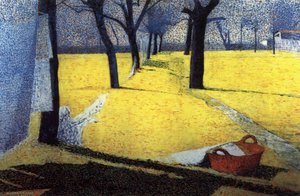
This technique was far more than a mere stylistic choice; for Pellizza, it was a philosophical stance. Through the meticulous application of color, he sought to achieve a clarity of vision that mirrored his desire for social truth. In works such as Washing in the Sun, one can witness this mastery, where the warmth of the light and the texture of drying laundry are rendered with a brilliance that feels both physically present and spiritually uplifting. His ability to manipulate light allowed him to transform simple scenes of domesticity into monumental studies of existence, where every stroke of pigment contributed to a larger, more luminous whole.
Social Consciousness and a Lasting Legacy
Beyond the technical brilliance of his brushwork, Pellizza da Volpedo is remembered as an artist of deep political and social conviction. His work often served as a visual manifesto for the progressive ideals of his time, most notably in his iconic masterpiece, The Fourth Estate (Il Quarto Stato). This painting, which depicts a resolute group of workers advancing forward, became a powerful symbol of the rising consciousness of the proletariat. Through his art, Pellizza elevated the struggles and triumphs of the common people to the level of high art, demanding that the viewer acknowledge the strength and agency of the working class.
The historical significance of Pellizza’s work lies in this rare intersection of scientific technique and social realism. He did not merely document the world; he interpreted it through a lens of hope and structural change. His influence extended far beyond the canvas, as his works were frequently reproduced in socialist magazines, reaching a wide audience and cementing his role as a voice for the marginalized. Today, we remember Giuseppe Pellizza da Volpedo not just as a master of light and color, but as a visionary who used the very particles of paint to illuminate the path toward social justice and human dignity.
Explore artworks organized by themes, styles, and characteristics.




![Group of workers. Study for the Fourth Estate. Group of figures [3]](/media/artworks/images-thumb/ee/62/ee628a162d653da75b840176a166beab.jpg)


