- Home

- Print on canvas
- giuliano amedei
- Frontispiece
 Buy Painting
 Send
Send Share
Share
 Details

 Download
 Similars
 X-Ray
X-Ray Diaporama
Frontispiece
 1465
1465 341.0 x 244.0 cm
 Biblioteca Comunale degli Intronati
 Read More
Giclée / Art Print
Museum-quality giclée or canvas print with fast production and flexible finish options.




































Pick from our preset sizes that match the artwork's original proportions.

You may enter your own dimensions to fit a specific frame or space. If your selected size does not match the original image's proportions, we will either crop the artwork or extend the image with a mirrored or solid-fill edge. A digital mockup will be sent for your approval before production begins.
Please note that the on-screen preview does not reflect the actual cropping or extension. Only the mockup will accurately show the final composition.
While custom sizes are available, we recommend selecting a dimension from the predefined list to preserve the original proportions.
Worldwide Delivery () in 2 weeks instead of standard 4/5 weeks. (20 July)

Free Worldwide Express Shipping

High-Quality Linen Canvas

Full Shipping Insurance

Customs Tax Refund Guarantee

True Color Matching Guarantee

60-Day Return Policy (Defects Only)

100% Money-Back Guarantee

Bulk Discount Offer
 Glass option is only available in size under 110 CM

Frontispiece
Giclée / Art Print
Reproduction Size
-


Total Price
-
Artist Biography
Giuliano Amidei: Florentine Illuminator and Renaissance Collaborator
Giuliano Amidei (c. 1446 – 1496), born in Florence, Italy, stands as a pivotal figure within the vibrant tapestry of fifteenth-century Florentine art and illuminated manuscript production. Though overshadowed by contemporaries like Piero della Francesca and Fra Angelico, Amidei’s contribution to Renaissance aesthetics—particularly his masterful frontispieces and collaborative work on prestigious altarpieces—solidifies his place as an artist deeply embedded in the intellectual currents of his time. His legacy resides not merely in individual artworks but also in shaping artistic dialogues and upholding humanist ideals within the ecclesiastical sphere.Early Life and Artistic Training
Information regarding Amidei’s formative years remains scarce, primarily due to the limitations of surviving biographical records from the period. However, scholarly consensus suggests he was born around 1446 in Florence, inheriting a familial tradition of craftsmanship—likely connected to the textile industry prevalent in the city—that would prove instrumental in shaping his artistic inclinations. Crucially, Amidei’s artistic education unfolded under the tutelage of Fra Angelico, whose workshop at Santa Maria degli Angeli served as a crucible for humanist ideals and innovative stylistic experimentation. This formative influence instilled within him a profound appreciation for disegno (drawing) and perspectiva (linear perspective), techniques that would become hallmarks of his oeuvre.Collaborative Achievements: The Misericordia Altarpiece Predella
Amidei’s artistic reputation ascended dramatically through his involvement in the ambitious project of decorating the predella of the Madonna della Misericordia altarpiece, commissioned by Monsignor Giovanni Battista Ciuffagni for Sansepolcro Cathedral. Alongside Piero della Francesca—a partnership that exemplifies the collaborative spirit characteristic of Renaissance art—Amidei undertook to depict scenes from the Passion of Christ with unparalleled sensitivity and technical virtuosity. The predella’s chromatic palette, meticulously crafted by Piero, captivated observers and established Amidei as a pioneer in exploiting innovative color harmonies—a stylistic breakthrough that anticipated developments championed by artists like Giovanni Battista Pinturicchio and Andrea Mantegna. This collaborative endeavor cemented Amidei's position as one of the foremost illuminators of his era.Frontispiece Design: A Symbol of Renaissance Intellectual Engagement
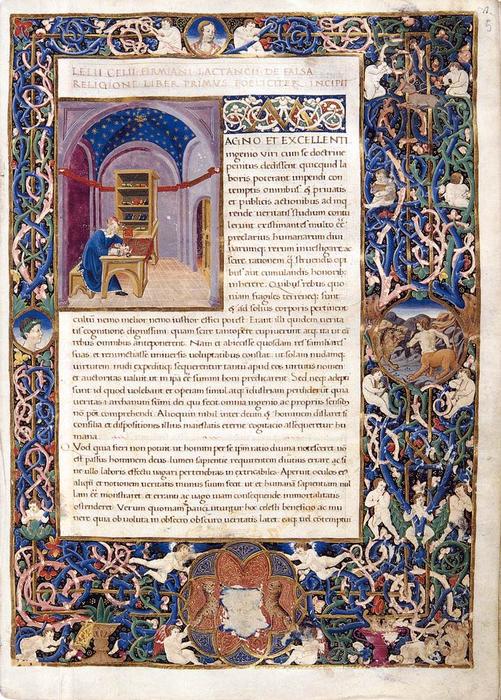
Amidei’s artistic prowess extended beyond altarpiece decoration into the realm of frontispiece design—a genre that served as a crucial vehicle for disseminating humanist ideas and visual narratives within illuminated manuscripts. His contribution to the Codex Aureus Florentinus, commissioned by Lorenzo Medici, exemplifies his ability to synthesize classical motifs with Christian symbolism—resulting in an image replete with references to Greek mythology and imbued with profound moral contemplation. The meticulous execution of Amidei’s frontispiece underscores his commitment to upholding humanist principles and engaging viewers intellectually—a characteristic that distinguishes him from many of his contemporaries who prioritized decorative splendor over conceptual depth.Legacy and Historiographical Assessment
Despite the paucity of biographical details, Giuliano Amidei's artistic output continues to inspire admiration among scholars and connoisseurs alike. His predella for the Madonna della Misericordia stands as a testament to the transformative power of collaborative artistry—demonstrating how intellectual exchange could propel stylistic innovation and elevate artistic expression. Furthermore, his frontispiece designs exemplify the humanist ethos that permeated Renaissance Florence—affirming Amidei’s enduring significance as an artist who championed both visual beauty and intellectual engagement. Ongoing research into surviving manuscripts and archival documents promises to illuminate further facets of Amidei's life and work—solidifying his place as a cornerstone of Florentine art history.
giuliano amedei
1446 - 1496 , Italy
Quick Facts
- Artistic Movement Or Style: Renaissance
- Artists Or Movements Influenced By This Artist:
- Ghirlandaio
- Perugino
- Artists Who Influenced This Artist:
- Fra Angelico
- Piero della Francesca
- Date Of Death: 1496
- Full Name: Giuliano di Amadeo
- Nationality: Italian
- Notable Artworks:
- Misericordia Altarpiece predella
- Frontispiece
- Place Of Birth: Florence, Italy


