
 Preview
 Send
Send Share
Share
 Details
 Guide
Guide

 Download
 Similars
 X-Ray
X-Ray Diaporama
 Stats
StatsThe Last Judgment


 Read More
Get a print-ready file that goes far beyond the web preview. Every digital image we sell comes from a high-resolution master in our stock database — usually 5,000 to 15,000 pixels wide — so you can print large, crop tightly, or reproduce fine detail with confidence.
No file leaves our studio untouched. A digital expert checks the colors against the original painting and corrects them if needed, then improves clarity and detail with professional retouching tools — always staying faithful to the artist's brushwork and style. The result is an image that looks like the painting, not like a filtered scan.
You approve before you're done: our expert sends the image by e-mail within 72 hours for your review. Not satisfied? Ask for improvements or corrections, or request a refund if the quality falls short.
This is the quality relied on by publishers, design studios, galleries and print shops.
Digital Image
Download a high-resolution file for personal display, printing, and creative projects. ( Switch to Print Buy Hand Made Painting)
Included in Every Digital Image Order
Expert Digital Delivery, Guaranteed
When you choose OriginalUniqueArt.com, you're not just getting an image - you're receiving a professionally enhanced digital artwork, crafted with precision and backed by a satisfaction guarantee. Here's everything that comes with your order, automatically:

Fast Email Delivery
Your high-resolution digital image file will be emailed to you within 72 hours of ordering - ready for immediate use.

AI-Enhanced Digital File
Your artwork is professionally optimized using advanced AI tools and manual editing, ensuring maximum detail, clarity, and color accuracy.

Free Lifetime Re-Delivery
Accidentally deleted or lost your file? No worries - we'll resend it to you anytime, free of charge.

No Import Fees - Ever
Enjoy your artwork instantly with zero customs, duties, or delivery fees - digital downloads are always tax-free.

Color Accuracy Guarantee
We ensure your digital image reflects the original colors as closely as possible using professional tools and color management.

100-Day Satisfaction Guarantee
If you're not satisfied with your digital image, we'll revise it or refund 100% within 100 days - no questions asked.

100% Money-Back Guarantee
Not satisfied? Get a full refund within 100 days of receiving your digital file - no questions asked.

Bulk Order Discounts
Buy 3 images, save 10% - Buy 5, save 15% - Buy 10+, save 20%. Great for creative projects, galleries, and agencies.
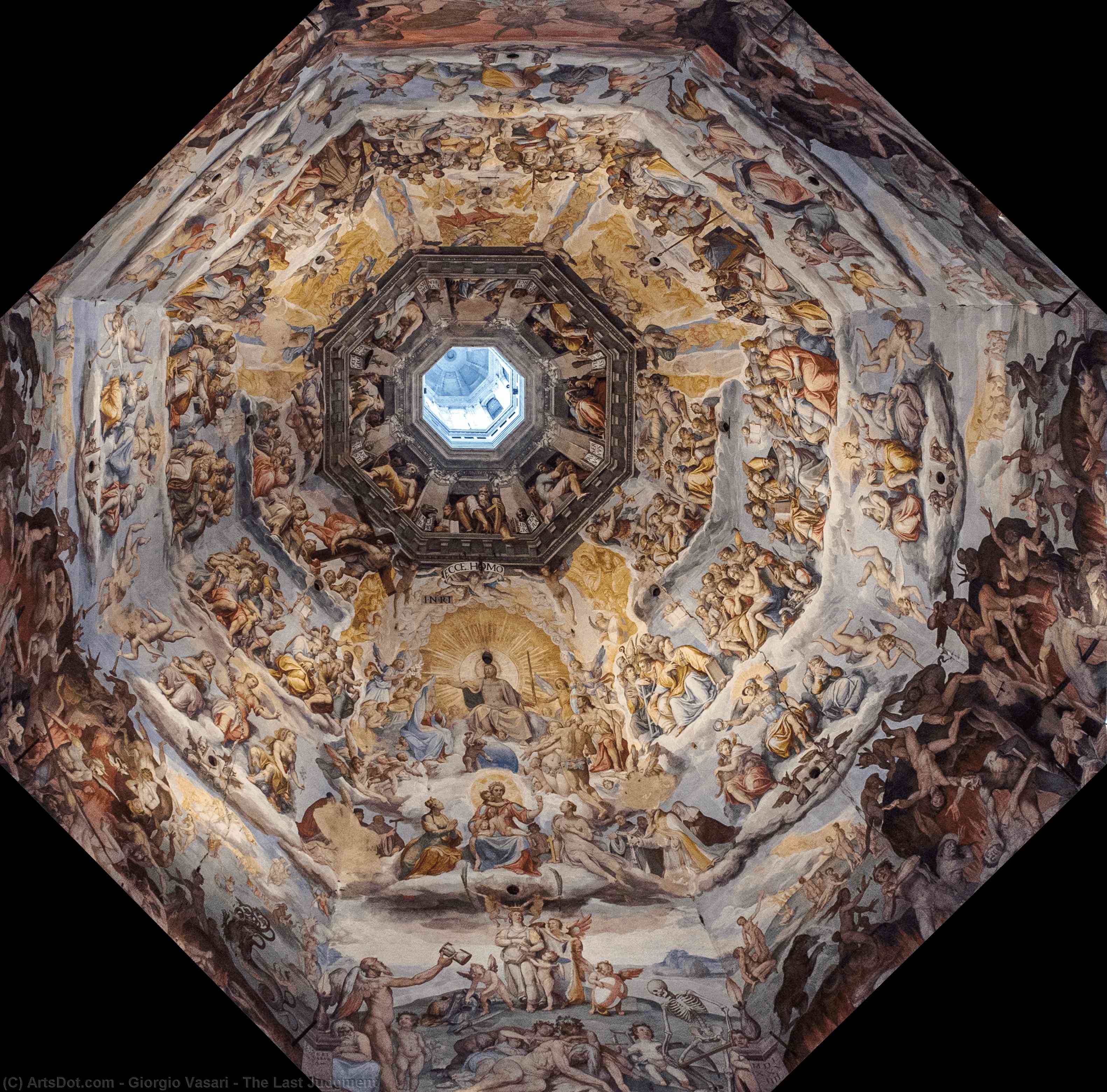
A Celestial Drama Unveiled: The Last Judgment by Giorgio Vasari and Federico Zuccari
Within the soaring dome of Florence Cathedral, a monumental fresco—known as *The Last Judgment*—commands attention, not merely for its sheer scale (spanning over 3,600 square meters), but for the profound drama it embodies. Commissioned by Grand Duke Cosimo I de’ Medici in 1572 and completed a decade later through the collaboration of Giorgio Vasari and Federico Zuccari, this work represents a pivotal moment in Renaissance art, a visual articulation of faith, judgment, and humanity's eternal destiny. It’s more than just a painting; it’s an immersive experience, a testament to the artistic ambition and religious fervor of 16th-century Florence.
Vasari’s initial design established a meticulously structured composition, drawing heavily from biblical narratives—particularly Revelation and Dante's *Divine Comedy*. He envisioned concentric circles radiating outwards from a central depiction of Christ as Judge, each tier representing a progression towards salvation or damnation. The uppermost register showcased the 24 elders of the Apocalypse, bathed in ethereal light, while the lower levels depicted scenes of torment and reward, culminating in a dramatic portrayal of Hell at the base of the dome. Zuccari, inheriting Vasari’s vision but injecting his own stylistic flair, skillfully executed this complex design, utilizing techniques that blended fresco painting with dry painting—a method allowing for greater detail and luminosity than traditional wet fresco.
The Dance of Figures: Style, Technique, and Symbolism
The fresco's style is a fascinating synthesis of Vasari’s refined Tuscan Mannerism and Zuccari’s more theatrical Roman influence. Vasari’s figures retain a sense of grace and composure, while Zuccari introduces dynamism and expressive gestures, particularly in the depiction of the damned souls writhing in agony. The use of *chiaroscuro*—the dramatic interplay of light and shadow—is masterful, creating a palpable sense of depth and volume within the vast dome. The figures themselves are rendered with remarkable anatomical accuracy, reflecting the Renaissance fascination with human form, yet imbued with an emotional intensity that transcends mere realism.
Beyond its aesthetic qualities, *The Last Judgment* is rich in symbolic meaning. The flaming swords of Hell represent divine justice, while the halos surrounding the redeemed signify their salvation. Specific figures—such as St. Sebastian, martyred for his faith, and St. Peter holding the keys to heaven—are strategically placed to reinforce theological concepts. Even the architectural elements of the dome—the arches, columns, and coffers—contribute to the overall narrative, creating a cohesive visual language that speaks directly to the viewer’s soul.
A Legacy in Florence: Historical Context and Artistic Significance
The creation of *The Last Judgment* coincided with the Counter-Reformation, a period of intense religious reform within the Catholic Church. Cosimo I's patronage of this monumental fresco was intended to reaffirm Florence’s commitment to Catholicism and demonstrate its power and influence. Vasari and Zuccari were not simply artists; they were key players in shaping the cultural landscape of Florence, embodying the city’s artistic prestige and intellectual vitality.
The work's impact extends far beyond the confines of the Duomo. Giorgio Vasari’s *Lives of the Most Excellent Painters, Sculptors, and Architects*, published in 1550, cemented his legacy as a pivotal figure in art history. His detailed accounts of artists’ lives and works—including *The Last Judgment*—provided a foundational framework for understanding the Renaissance artistic tradition. Today, reproductions of this extraordinary fresco continue to inspire awe and admiration, offering a glimpse into the spiritual and artistic heart of Florence.
Bringing the Masterpiece Home: Reproductions for Your Space
OriginalUniqueArt offers exquisite, hand-painted reproductions of Giorgio Vasari’s *The Last Judgment*, capturing the fresco's grandeur and emotional depth with meticulous detail. Our artisans employ traditional oil painting techniques to faithfully recreate the artwork’s vibrant colors, dramatic lighting, and intricate figures. Whether you choose a canvas reproduction or a print on canvas, you can bring this iconic masterpiece into your home or office, transforming any space into a sanctuary of art and inspiration. Explore our collection today and experience the timeless beauty of *The Last Judgment* firsthand.
Questions & Answers
Who sells hand-painted copies of "The Last Judgment" by Giorgio Vasari?
You can order a hand-painted reproduction of "The Last Judgment" by Giorgio Vasari directly on its Hand-Painted Reproduction page: a hand-painted oil reproduction on linen canvas, made to order.
Where can I buy a digital image of "The Last Judgment" by Giorgio Vasari?
To get a digital file of "The Last Judgment" by Giorgio Vasari, order a high-resolution digital image download on its Digital Image page.
Who made "The Last Judgment", and when?
The author of "The Last Judgment" is Giorgio Vasari, and the work is dated 1572.
Artist Biography
A Life Woven into the Renaissance Fabric
Giorgio Vasari, born in Arezzo, Tuscany, on July 30, 1511, was more than simply a painter; he was a quintessential embodiment of the Italian Renaissance spirit. His life unfolded as a vibrant tapestry woven with threads of artistic creation, architectural innovation, insightful historical writing, and an unwavering dedication to celebrating the masters who came before him. From his earliest training under Guglielmo da Marsiglia, a skilled artisan in stained glass, young Giorgio’s path was steered towards visual artistry. However, it was his move to Florence at sixteen that truly ignited his potential. Immersing himself within the dynamic circle of Andrea del Sarto and absorbing the influences of Rosso Fiorentino and Jacopo Pontormo, Vasari began a journey that would see him become one of the most influential figures of his era. His formative years were also deeply marked by the patronage and friendship of the powerful Medici family, a relationship that would shape both his career and his perspective on art’s role in society.The Artist's Hand and Eye
Vasari’s artistic style is often categorized as Mannerist, reflecting the prevailing aesthetic trends of the mid-16th century. His paintings are characterized by elongated figures, dynamic compositions, and a sophisticated use of color—qualities highly admired during his lifetime. While perhaps not achieving the same level of enduring fame as some of the artists he chronicled, Vasari’s skill was undeniable. Notable works such as The Studio of the Painter, a fresco housed in Casa Vasari in Arezzo, offer a fascinating glimpse into the artistic practices of the time. The sheer scale and ambition of his frescoes for the Palazzo Vecchio in Florence, undertaken between 1555 and 1572, demonstrate his mastery of large-scale decorative schemes. His final monumental undertaking, The Last Judgement, adorning the cupola of Florence Cathedral—completed after his death by Federico Zuccari—stands as a testament to his unwavering commitment to grand artistic visions. Beyond painting, Vasari’s architectural contributions were equally significant. He designed the elegant loggia of the Palazzo degli Uffizi, transforming it into a public piazza and creating a vital link within Florence's urban landscape. Perhaps most famously, he conceived and oversaw the construction of the Vasari Corridor, a secret passageway connecting the Uffizi Gallery with the Palazzo Pitti—a feat of engineering and architectural ingenuity that continues to captivate visitors today.A Historian Forging a Legacy
However, it is arguably as an art historian that Giorgio Vasari secured his most lasting legacy. His monumental work, Lives of the Most Excellent Painters, Sculptors, and Architects, published in 1550 (with a revised edition in 1568), revolutionized the way art was understood and appreciated. This groundbreaking text wasn’t merely a collection of biographies; it established a narrative framework for the development of Italian Renaissance art, tracing its evolution from the early masters like Cimabue and Giotto to his contemporaries Michelangelo and Raphael. Vasari's work introduced the very concept of the “Renaissance” – a rebirth of classical ideals—and laid the foundation for modern art history as a discipline. While acknowledging that Vasari’s accounts are not without their biases and inaccuracies, particularly concerning artists predating his own time, the impact of Lives remains profound. It provided a crucial historical context for artistic creation, elevating the status of artists from skilled craftsmen to intellectual figures worthy of scholarly attention.Influences and Enduring Significance
Vasari’s artistic development was profoundly shaped by his exposure to the works of Renaissance masters. His visit to Rome in 1529, where he studied the art of Raphael and other High Renaissance artists, proved pivotal. He absorbed their principles of composition, anatomical accuracy, and idealized beauty, incorporating them into his own style. Michelangelo, whom Vasari greatly admired, exerted a particularly strong influence on both his painting and architecture. The grandeur and dynamism characteristic of Michelangelo’s work are evident in many of Vasari’s projects. Beyond specific artists, the broader intellectual currents of the Renaissance—humanism, classical learning, and a renewed interest in empirical observation—also informed Vasari's approach to art and history. Giorgio Vasari died on June 27, 1574, in Florence, leaving behind a multifaceted legacy that continues to resonate today. He was not only a talented artist and architect but also a pioneering historian whose writings shaped our understanding of one of the most transformative periods in Western art history. His work remains essential for anyone seeking to explore the rich cultural heritage of the Italian Renaissance.
Giorgio Vasari
1511 - 1574 , Italy
Quick Facts
- Full Name: Giorgio Vasari
- Nationality: Italian
- Date Of Birth: 1511
- Date Of Death: 1574
- Place Of Birth: Arezzo, Italy
- Notable Artworks:
- The Studio of the Painter
- The Last Judgement
- Adoration of the Magi
- Artistic Movement Or Style: Mannerism
- Artists Who Influenced This Artist:
- Andrea del Sarto
- Raphael
- Michelangelo
- Artists Or Movements Influenced By This Artist: ['Renaissance art history']