 Preview
 Send
Send Share
Share
 Details

 Download
 Similars
 X-Ray
X-Ray Diaporama
Interior decoration


 Read More
Hand Made Oil Reproduction
Hand-painted oil on canvas in your size and frame, made to order by our artists. ( Switch to Print Switch to Image)




































Pick from our preset sizes that match the artwork's original proportions.

You may enter your own dimensions to fit a specific frame or space. If your selected size does not match the original image's proportions, we will either crop the artwork or extend the painting with additional hand-painted elements. A digital mockup will be sent for your approval before production begins.
Please note that the on-screen preview does not reflect the actual cropping or extension. Only the mockup will accurately show the final composition.
While custom sizes are available, we recommend selecting a dimension from the predefined list to preserve the original proportions.
After order, OriginalUniqueArt.com team will email client for instructions and provide a mockup preview
Worldwide Delivery () in 3/4 weeks instead of standard 5 weeks. (11 August). No compromise on quality.

Free Worldwide Express Shipping

High-Quality Linen Canvas

Full Shipping Insurance

Customs Tax Refund Guarantee

True Color Matching Guarantee

60-Day Return Policy (Defects Only)

100% Money-Back Guarantee

Bulk Discount Offer
 Glass option is only available in size under 110 CM

Interior decoration
Reproduction Medium
Reproduction Size
-


Total Price
$ 425
Artist Biography
The Meteor in the Sicilian Sky
In the golden, sun-drenched landscape of seventeenth-century Sicily, a singular brilliance emerged that would forever alter the texture of Baroque ornamentation. Rudolf Wittkower famously christened Giacomo Serpotta as a “meteor in the Sicilian sky,” a metaphor that perfectly captures the sudden, dazzling impact of an artist who rose from provincial roots to achieve a level of mastery rarely seen in the history of sculpture. Born in Palermo in 1656, Serpotta did not seek the grand stages of Rome or Florence; instead, he remained anchored to his native island, transforming its churches and oratories into ethereal realms of white, luminous splendor. While the great masters of his era were preoccupied with the heavy permanence of marble, Serpotta found his voice in a far more humble medium: stucco.
Serpotta’s life was deeply intertwined with the very material he mastered. Born into a family of artisans, he learned the rhythm of the workshop from a young age, absorbing the secrets of gypsum and lime. This intimate connection to his craft allowed him to perform what many described as alchemy—turning wet, malleable plaster into scenes of such lifelike vitality that they seemed to breathe within the stone. His early career was marked by collaborations, most notably with Procopio de Ferrari in the decoration of the Chiesa della Madonna dell'Itria in Monreale. However, it was his ability to move beyond mere architectural ornament to create entire, self-contained dramatic worlds that truly set him apart.
A Mastery of Motion and Light
The genius of Serpotta lay in his profound understanding of spatial illusion and the emotive power of light. Unlike the rigid structures of classical sculpture, Serpotta’s work possessed a florid elegance and a sense of weightless movement. He utilized the unique properties of stucco to create deep undercuts and delicate, fluttering drapery that caught the shifting Sicilian sunlight, creating a dance of shadows across the walls of Palermo's most sacred spaces. His compositions were often teeming with life—a profusion of putti, graceful figures, and intricate floral motifs that seemed to erupt from the very architecture itself.
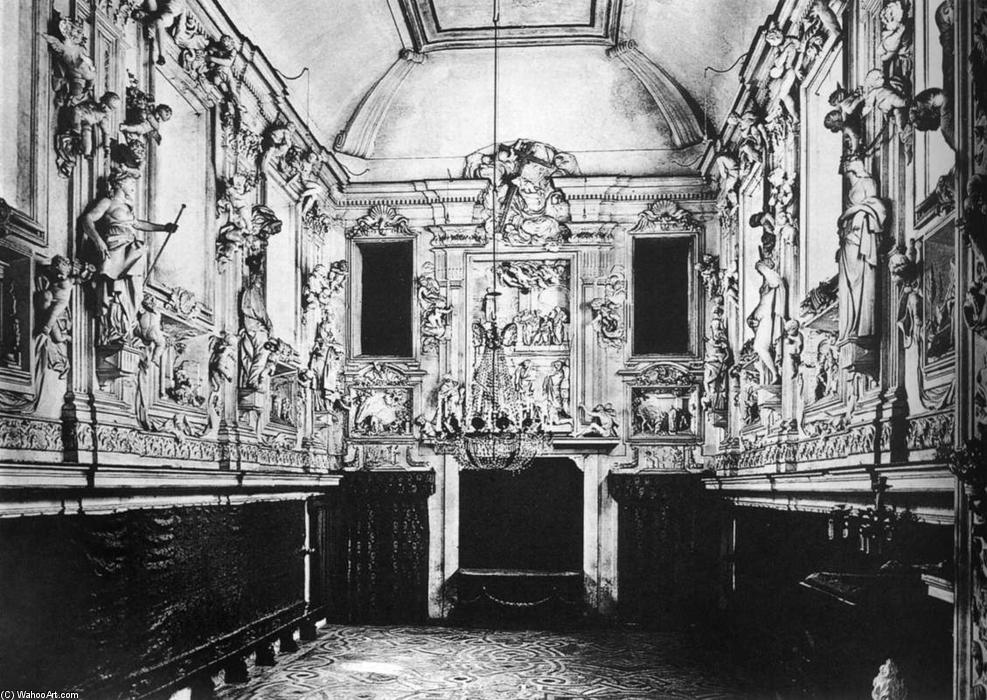
His technical achievements reached breathtaking heights in projects such as the Oratory of San Lorenzo and the Oratory of Santa Cita. In the latter, he achieved a feat of narrative complexity by depicting a massive naval battle, inspired by the Battle of Lepanto, all rendered in the delicate medium of plaster. To witness his work is to experience a sense of organized chaos; the walls appear to quiver with the movement of a crowd, yet every figure is placed with an intuitive sense of balance and grace. This ability to blend the monumental with the minute—to make a heavy wall feel as light as lace—is the hallmark of his unparalleled skill.
Legacy of the Stucco Master
Serpotta’s influence was not merely individual but familial, as he spearheaded a prolific artistic enterprise alongside his brother Giuseppe and his son Procopio. Together, they established a studio that became the heartbeat of Sicilian Baroque decoration, leaving an indelible mark on the religious landscape of Palermo. Though some historians suggest he may have lacked direct exposure to the mainstream currents of the Roman Baroque, his work possesses a distinctive, localized energy that feels entirely original. He did not imitate the grandeur of Bernini; he reimagined it through a Sicilian lens, replacing marble's cold permanence with the radiant, ephemeral glow of white stucco.
The historical significance of Giacomo Serpotta extends far beyond the borders of Sicily. He represents a rare moment in art history where a provincial artist, working in isolation from the major artistic capitals, managed to create a style so potent and recognizable that it redefined the aesthetic of an entire region. His legacy remains etched in the very bones of Palermo’s oratories—a testament to a man who could take the simplest of materials and, through sheer vision, turn them into eternal masterpieces of light and motion.

Giacomo Serpotta
1656 - 1732 , Italy
Quick Facts
- Artistic Movement Or Style: Rococo Stucco Sculpture
- Artists Or Movements Influenced By This Artist: ['Caravaggio']
- Artists Who Influenced This Artist: ['Antonio Raggi']
- Date Of Birth: 1656 Palermo Italy
- Date Of Death: 1732
- Full Name: Giacomo Serpotta
- Nationality: Italian
- Notable Artworks:
- Fortitude
- Humility
- Charity
- Place Of Birth: Palermo Sicily