Menu

() ·

A painting made for you, by hand

Sunset

Hand Made Oil Reproduction

Hand-painted oil on canvas in your size and frame, made to order by our artists. ( Switch to Print Switch to Digital Image)

Collectible Description

Explore Georges Seurat's mesmerizing 'Sunset,' a pivotal Pointillist masterpiece capturing the serene beauty of rural France with cows grazing peacefully under a vibrant sky.

Artist Biography

Discover Georges Seurat (1859-1891), the pioneer of Pointillism & Neo-Impressionism! Explore 'A Sunday on La Grande Jatte' and his revolutionary color theory capturing modern life. Shop hand-painted reproductions!

from ·

Chapter 1

How large should it be?

Slide to change the size; the picture on the left shows the frame at its real width. The proportions of the original are kept.

Standard
custom
CM
INCH

Pick from our preset sizes that match the artwork's original proportions.

width
height

Type the width and the height you need, to fit your frame or your wall. This is hand-painted, so for a size with a different shape the artist can paint a bit more around the picture, or cut a bit — you choose. We send you a digital mockup to approve before the painting starts. The picture shown on this page does not show the real result — only the mockup does.

Chapter 2

How should it arrive?

Choose the edges of the stretched canvas

Choose your frame

Corner sample of the WhiteWrap canvas edge finish, stretched on solid wood bars
White $1
Corner sample of the BlurSideWrap canvas edge finish, stretched on solid wood bars
Blurside $1
Corner sample of the ExtendedWrap canvas edge finish, stretched on solid wood bars
Extended $1
Corner sample of the P118B picture frame: moulded polystyrene, 5 cm wide and 3 cm thick
P118B $10
Corner sample of the P118H picture frame: moulded polystyrene, 5 cm wide and 3 cm thick
P118H $10
Corner sample of the P118W picture frame: moulded polystyrene, 5 cm wide and 3 cm thick
P118W $10
Corner sample of the P438Z picture frame: moulded polystyrene, 5.5 cm wide and 3.5 cm thick
P438Z $10
Corner sample of the P508JH picture frame: moulded polystyrene, 7 cm wide and 3.5 cm thick
P508JH $12
Corner sample of the P508YH picture frame: moulded polystyrene, 7 cm wide and 3.5 cm thick
P508YH $12
Corner sample of the P805H picture frame: moulded polystyrene, 5 cm wide and 3.5 cm thick
P805H $10
Corner sample of the P805Z picture frame: moulded polystyrene, 5 cm wide and 3.5 cm thick
P805Z $10
Corner sample of the P919BZ picture frame: moulded polystyrene, 7 cm wide and 3.5 cm thick
P919BZ $10
Corner sample of the P919G picture frame: moulded polystyrene, 7 cm wide and 3.5 cm thick
P919G $10
Corner sample of the P919XJ picture frame: moulded polystyrene, 7 cm wide and 3.5 cm thick
P919XJ $10
Corner sample of the P959ZH picture frame: moulded polystyrene, 5 cm wide and 3 cm thick
P959ZH $10
Corner sample of the P968JZ picture frame: moulded polystyrene, 6 cm wide and 4 cm thick
P968JZ $12
Corner sample of the W106C picture frame: solid wood, 5 cm wide and 3 cm thick
W106C $8
Corner sample of the W218G picture frame: solid wood, 5 cm wide and 3 cm thick
W218G $10
Corner sample of the W218JH picture frame: solid wood, 5 cm wide and 3 cm thick
W218JH $8
Corner sample of the W218Y picture frame: solid wood, 5 cm wide and 3 cm thick
W218Y $10
Corner sample of the W307PJ picture frame: solid wood, 6 cm wide and 3 cm thick
W307PJ $10
Corner sample of the W316G picture frame: solid wood, 6 cm wide and 3 cm thick
W316G $10
Corner sample of the W316PJ picture frame: solid wood, 6 cm wide and 3 cm thick
W316PJ $8
Corner sample of the W316Y picture frame: solid wood, 6 cm wide and 3 cm thick
W316Y $10
Corner sample of the W398PJ picture frame: solid wood, 5 cm wide and 3 cm thick
W398PJ $8
Corner sample of the W4111J picture frame: solid wood, 6.5 cm wide and 3.5 cm thick
W4111J $10
Corner sample of the W500HY picture frame: solid wood, 7 cm wide and 5 cm thick
W500HY $15
Corner sample of the W500JH picture frame: solid wood, 7 cm wide and 5 cm thick
W500JH $15
Corner sample of the W692G picture frame: solid wood, 8 cm wide and 4 cm thick
W692G $12
Corner sample of the W849H picture frame: solid wood, 5 cm wide and 3 cm thick
W849H $8
Corner sample of the W940BG picture frame: solid wood, 7.5 cm wide and 4.5 cm thick
W940BG $15
Corner sample of the W953PJ picture frame: solid wood, 6 cm wide and 3.5 cm thick
W953PJ $8
Corner sample of the H24-GOLD picture frame: carved wood with gesso, 10 cm wide and 6 cm thick
H24-GOLD $30
Corner sample of the H24-SILVER picture frame: carved wood with gesso, 10 cm wide and 6 cm thick
H24-SILVER $30
Corner sample of the H36-GOLD picture frame: carved wood with gesso, 15 cm wide and 6.5 cm thick
H36-GOLD $45
Corner sample of the H36-SILVER picture frame: carved wood with gesso, 15 cm wide and 6.5 cm thick
H36-SILVER $45
Frame preview
Framed

Moulding: . Overall size with the frame: .

Chapter 3

Who paints it, and should anything change?

Examples of what can be changed: Replace face with customer photo; Add pet (e.g., replace cat with dog); Include hidden message in background; Change background landscape or elements.
After order, OriginalUniqueArt.com team will email client for instructions and provide a mockup preview

Worldwide Delivery () in 3/4 weeks instead of standard 5 weeks. (30 October). No compromise on quality.

Chapter 4

The finishing touches

A nameplate, as in a museum?

Engraved Bronze Plaque Details

This elegant plaque features the artist's name and the title of the artwork, finely engraved for a timeless presentation.

It is made from bronze with a refined, elegant finish. The text is precisely laser-engraved for a sharp and permanent result. Measuring 9x2 cm, the plaque is compact yet easy to read. It's built to be durable and scratch-resistant, offering a professional, museum-quality look. Mounting is simple thanks to the included adhesive backing.

Transparent Acrylic Plaque Details

The plaque includes essential engraved details such as the artist's name, the title of the artwork, the date it was created, the type of media used-like oil on canvas or watercolor-a brief description of the piece, and a QR code that links to the complete artwork information.

It is crafted from clear acrylic, offering a sleek, modern appearance. The text is UV-engraved in black to ensure strong visual contrast. With a size of 10x15 cm, it ensures optimal readability. It comes equipped with two metal hooks for secure wall mounting. The plaque is designed to be weather-resistant, making it suitable for various environments, and it includes interactive features that work seamlessly with smartphone scanning.

Black Acrylic Plaque Details

This elegant plaque includes engraved information such as the artist's name, the title of the artwork, the date it was created, the type of media used (like oil on canvas or watercolor), a short description of the artwork, and a QR code for quick access to more information.

The plaque itself is made from refined black acrylic with a premium finish. The text is laser-engraved in white for high contrast and readability. Its size is 10x15 cm, designed to be easy to read. It comes with two metal hooks for professional mounting. The design is sleek and fits any interior style. It is also weather-resistant and durable, with built-in digital integration for mobile compatibility.

A protective varnish?

When do you need it?

Chapter 5

Your painting, as you ordered it

Sunset

Reproduction Medium

Reproduction Size

-

Elite Senior Artist

More detail, finesse, and extra production time

-

Reproduction Frame

-

-

For artworks or reproductions larger than 105 cm (approximately 41 inches) on any side, the frame will be shipped as a kit, disassembled. This method ensures safe delivery and prevents damage during transport.

Professional assembly required - this is not a DIY product.
The kit must be assembled and the canvas stretched by an experienced professional framer, using wood glue (not supplied), a canvas stretching plier and clamps to hold the bars square while the glue dries. Incorrect assembly or uneven canvas tension can permanently damage the artwork and is not covered by our warranty.

  • All solid wood bars are included, precisely cut to size.

  • Assembled with the screws provided, plus wood glue for the corner joints, which is not supplied and must be sourced by your framer.

  • Professional tools are required and not included: a canvas stretching plier (tensioner) and clamps to hold the bars square while the glue dries.

Important:
The corner joints require wood glue, the bars must be held with clamps until the glue is fully dry, and tightening the canvas on the assembled frame requires a canvas stretching plier. None of these are included in the kit. Please arrange an experienced professional framer before ordering this size.

Nameplate

-

-

Protective Varnish

Glossy Varnish (enhances colors, protects against light/moisture)

-

Customize My Artwork

Examples of what can be changed: Replace face with customer photo; Add pet (e.g., replace cat with dog); Include hidden message in background; Change background landscape or elements.

-

Urgent

Worldwide Delivery () in 3/4 weeks instead of standard 5 weeks. (30 October). No compromise on quality.

-

Express Shipping

Worldwide Delivery () in 5 weeks. (6 November).

Included

Total Price

$ 300

Total Price $ 300

Glass option is only available in size under 110 CM

Included with every order

  • Free Worldwide Express Shipping
  • High-Quality Linen Canvas
  • Full Shipping Insurance
  • Customs Tax Refund Guarantee
  • True Color Matching Guarantee
  • 100-Day Return Policy (Defects Only)
  • 100% Money-Back Guarantee
  • Bulk Discount Offer

Georges Seurat: A Pioneer of Luminosity – Exploring “Sunset”

Georges Pierre Seurat (1859–1891) stands as an undeniable titan amongst Impressionists, yet his legacy transcends the movement’s ephemeral beauty. He wasn't merely capturing a fleeting moment; he was fundamentally reshaping how artists approached color and light—a transformation that cemented his place as one of the progenitors of modern art. His unwavering dedication to scientific principles, specifically optical theory championed by Eugène Chevreuil, fueled his revolutionary technique: Pointillism.

“Sunset,” painted circa 1881 in Fontainebleau Forest, exemplifies this groundbreaking approach. Unlike Impressionists who blended pigments on canvas to achieve tonal harmony, Seurat meticulously applied tiny dots of pure color—often juxtaposed strategically—creating an illusion of luminescence that surpasses mere visual representation. This method wasn’t simply a stylistic preference; it was rooted in the belief that human perception operates through retinal illumination – that our eyes see colors as individual wavelengths of light rather than blended hues.

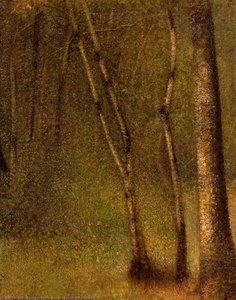
  • Subject Matter: The painting depicts a tranquil forest scene dominated by towering trees silhouetted against a vibrant sunset sky. Scattered cows graze peacefully on the grassy meadow, adding to the idyllic atmosphere.
  • Style & Technique: Pointillism is undeniably Seurat’s signature style. Each dot of pigment—typically mixed with turpentine and linseed oil—is placed independently on the canvas, allowing for maximum color saturation and visual vibrancy when viewed from a distance. The artist employed a hexagonal grid to ensure consistent spacing and tonal accuracy.
  • Historical Context: “Sunset” emerged during a period of intense artistic experimentation following Impressionism’s initial surge. Artists were actively questioning traditional conventions and seeking new ways to express emotion and perception. Seurat's work signaled a decisive break from Impressionistic subjectivity, prioritizing scientific observation as the basis for artistic creation.
  • Symbolism & Emotional Impact: The sunset itself carries profound symbolic weight—representing endings, transitions, and the passage of time. Yet, Seurat’s meticulous rendering imbues it with an almost meditative stillness, inviting contemplation and fostering a sense of serene beauty. It speaks to the artist's fascination with capturing not just what is seen but how it feels to perceive the world.

Reproductions of “Sunset” offer collectors and interior designers alike the opportunity to experience Seurat’s visionary technique firsthand. High-quality prints capture the subtle nuances of color and texture, faithfully recreating the luminous quality that distinguishes this masterpiece from its Impressionist predecessors. Consider framing it in a neutral tone to allow the painting's ethereal glow to shine through—a testament to Seurat’s enduring influence on art history.

Further Exploration: Understanding Pointillism

To truly appreciate “Sunset,” delve deeper into the principles of Pointillism. Researchers like Eugène Chevreuil had begun exploring optical illusions and how color perception works, influencing artists like Seurat. Examining reproductions alongside scientific diagrams illustrating retinal illumination can illuminate the intellectual underpinning of this revolutionary technique.

Questions & Answers

What is the creation date of "Sunset" by Georges Seurat?

"Sunset" by Georges Seurat was created in 1881.

Can I see an X-ray view of "Sunset" by Georges Seurat?

The X-Ray page of "Sunset" by Georges Seurat is an interactive viewer that lets you slide through eleven optical layers of the artwork's image, including an X-ray style view.

What is the format of "Sunset"?

The format of "Sunset" is panoramic. This is useful when planning where a reproduction will be placed.

More about this painting

Preview AR preview Switch to Print Switch to Digital Image Send
Details Guide Add to favorites Download Similars X-Ray Diaporama Q&A Stats

In numbers

  • 1881the year it was painted
  • 29frames to choose from
  • standard sizes, in its own proportions
  • 5weeks to paint and deliver it
Georges Seurat

Georges Seurat

1859 - 1891, France

Quick facts about Georges Seurat

  • Artistic Movement Or Style:
    • Neo-Impressionism
    • Pointillism
    • Post-Impressionism
    • Divisionism
  • Artists Or Movements Influenced By This Artist:
    • Fauvists
    • Cubists
    • Abstract Expressionists
  • Artists Who Influenced This Artist:
    • Michel Eugène Chevreul
    • Ogden Rood
    • Eugène Delacroix
  • Full Name: Georges Pierre Seurat
  • Nationality: French
  • Notable Artworks:
    • A Sunday Afternoon on La Grande Jatte
    • Bathers at Asnières
    • The Circus
    • Young Woman Powdering Herself
  • Place Of Birth: Paris, France
  • Date Of Birth: 1859
  • Date Of Death: 1891

Artist Biography

A Pioneer of Luminous Precision: The Life and Art of Georges Seurat

Georges Pierre Seurat, born in Paris on December 2, 1859, emerged as a pivotal figure in the transition from Impressionism to modern art. His brief but intensely focused career revolutionized painting through the development of Pointillism, a technique predicated on scientific principles and an unwavering pursuit of optical truth. Seurat’s story is one of meticulous observation, intellectual rigor, and a profound sensitivity to the nuances of light and color—qualities that set him apart from his contemporaries and continue to captivate audiences today. His early life, though seemingly conventional, laid the groundwork for his future artistic explorations. The family moved to Boulevard de Magenta shortly after his birth, and his father, Antoine Chrysostome Seurat, a former legal official turned property speculator, provided a comfortable upbringing that allowed young Georges access to art education. He began formal training at the École Municipale de Sculpture et Dessin under sculptor Justin Lequien, followed by enrollment at the prestigious École des Beaux-Arts in 1878, studying under Henri Lehmann. These formative years instilled in him a solid foundation in traditional techniques, yet even then, a unique artistic personality was beginning to take shape—a blend of delicate sensibility and an emerging fascination with systematic analysis.

From Academic Roots to Chromoluminarism

Seurat’s artistic development wasn't a sudden leap into innovation but rather a gradual evolution fueled by intellectual curiosity and rigorous experimentation. Initially, his work reflected the academic standards of the time, demonstrating proficiency in drawing and a respect for established compositional principles. However, he soon began to question these conventions, seeking a more scientific approach to painting. He immersed himself in the burgeoning field of color theory, studying the writings of scientists like Michel Eugène Chevreul and Ogden Rood, who explored the optical effects of juxtaposed colors. This research became the cornerstone of his revolutionary technique, chromoluminarism—the science of color—and its practical application, Pointillism. The core idea was deceptively simple: applying small, distinct dots of pure color to a canvas, relying on the viewer’s eye to optically blend them and create a vibrant, luminous effect. This wasn't merely about achieving brighter colors; it was about understanding how the human visual system perceived light and color, and harnessing that knowledge to create a more dynamic and engaging painting experience. He meticulously prepared for his large-scale compositions with Conté crayon drawings on rough paper, carefully mapping out the placement of each dot, demonstrating an almost mathematical precision in his artistic process.

Landmarks of Innovation: Major Works and Artistic Vision

The culmination of Seurat’s research and experimentation is perhaps best exemplified in A Sunday Afternoon on the Island of La Grande Jatte (1884-1886), a monumental work that marked the beginning of Neo-Impressionism. This iconic painting, depicting Parisians enjoying a leisurely afternoon by the Seine, showcases his pointillist technique to its fullest extent. The figures, rendered as carefully placed dots of color, seem to shimmer and vibrate with light, creating an atmosphere of serene stillness. Alfalfa, Saint-Denis (1886-1887), demonstrates his application of color theory to a rural landscape, while earlier works like Landscape at Saint-Ouen (1882-1883) reveal his evolving style and growing interest in capturing the effects of light and atmosphere. Even depictions of modern Parisian life, such as The Eiffel Tower (1889), were transformed through his unique technique, showcasing a harmonious blend of industrial modernity and artistic innovation. Bathers at Asnières (1884), another significant work, explored themes of leisure and modern life with his distinctive style, foreshadowing the more refined approach seen in *La Grande Jatte*. These paintings weren’t simply representations of scenes; they were carefully constructed visual experiments designed to explore the possibilities of color and perception.

A Lasting Legacy: Influence and Historical Significance

Despite a tragically short life—Seurat died at the age of 31 in 1891—his impact on the art world was profound and far-reaching. His work challenged traditional artistic conventions, paving the way for numerous subsequent movements. The emphasis on subjective expression and exploration of new techniques resonated with artists seeking to break free from academic constraints. Seurat’s influence can be seen in the works of Fauvists, who embraced bold colors and expressive brushwork; Cubists, who deconstructed forms into geometric shapes; and Abstract Expressionists, who prioritized emotional intensity and spontaneous gesture. His scientific approach to painting, while initially controversial, ultimately broadened the definition of artistic possibility. He demonstrated that art could be both intellectually rigorous and emotionally evocative, a synthesis that continues to inspire artists today. Seurat’s legacy extends beyond his technical innovations; he left behind a body of work that captures the essence of modern life with unparalleled precision and beauty, solidifying his place as a true pioneer of modern art. His paintings remain testaments to the power of observation, experimentation, and the enduring human desire to understand the world around us through the lens of artistic expression.

Quick Facts

  • Title: Sunset
  • Notable elements or techniques: Pointillist technique
  • Location: Private Collection
  • Influences: Impressionism
  • Year: 1881
  • Subject or theme: Landscape

Art Quiz

There is only one correct answer for each question.

Question 1:
What artistic movement is Georges Seurat primarily associated with?
Question 2:
The painting depicts a scene of what type of environment?
Question 3:
What technique did Seurat employ to create the vibrant colors in this artwork?
Question 4:
Around what year was 'Sunset' created?
Question 5:
The painting’s composition emphasizes a sense of tranquility and observation, reflecting the influence of which artistic philosophy?