Switch to Print
 Read More







































 For artworks or reproductions larger than 105 cm (approximately 41 inches) on any side, the frame will be shipped as a kit, disassembled. This method ensures safe delivery and prevents damage during transport.


George Edmund Butler: Bridging Disciplines and Capturing the Spirit of New Zealand
George Edmund Butler’s artistic journey represents more than just a painter's pursuit; it embodies a fascinating confluence of intellectual curiosity, familial relocation, and patriotic dedication—a narrative that unfolded across continents and ultimately cemented his legacy as one of New Zealand’s foremost early 20th-century landscape artists.
Born in Southampton, England, in 1872, Butler possessed an innate aptitude for art fostered by rigorous academic training at Marlborough College and subsequently pursued at Slade School of Fine Art in London. This grounding in classical artistic principles would prove invaluable as he embarked on a transatlantic voyage to Wellington, New Zealand, in 1883—a move that irrevocably shaped his creative vision.
The Wellington environment immediately captivated Butler’s sensibilities, introducing him to the burgeoning artistic community and sparking an enduring fascination with the dramatic landscapes of Australasia. He quickly established himself as a respected portrait artist, capturing the likenesses of prominent figures within New Zealand society—a testament to his technical skill and keen observational abilities.
- Style: Butler’s oeuvre leans heavily toward Impressionistic tendencies, characterized by loose brushstrokes and dappled light effects that strive to convey atmospheric conditions and evoke emotional resonance.
- Technique: Primarily employing oil paints on canvas, Butler meticulously blended pigments to achieve nuanced tonal gradations—a hallmark of his approach that lends depth and luminosity to his compositions.
However, Butler’s most enduring contribution to New Zealand art history lies in his role as an official war artist for the New Zealand Expeditionary Force (NZEF) during World War I. Recognizing the importance of documenting the experiences of his countrymen on the front lines, he volunteered his artistic talents and produced a series of evocative paintings depicting scenes from trench warfare—a courageous undertaking that captured both the grim realities of combat and the unwavering spirit of resilience.
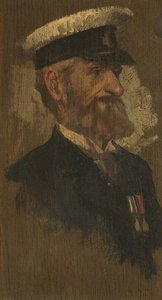
Notable amongst Butler’s wartime works is “B. Baxter, 90th & 41st,” a portrait commissioned by Sir William James Ford, a prominent New Zealand businessman and philanthropist. The painting portrays Baxter in a dignified pose against a muted backdrop—a masterful depiction of human character infused with subtle psychological insight. Butler skillfully utilized chiaroscuro techniques to sculpt Baxter’s form, emphasizing his posture and conveying an aura of quiet contemplation.
Beyond its technical brilliance, “B. Baxter, 90th & 41st” resonates deeply with viewers due to its symbolic representation of Victorian ideals—honor, duty, and steadfastness—values that underpinned the ethos of the NZEF during a period of profound national upheaval. Butler’s artistic endeavor serves as a poignant reminder of the transformative power of art to illuminate human experience and preserve historical memory.
Butler's legacy extends beyond individual artworks; he championed New Zealand art education, establishing Wellington Technical College in 1908—a pivotal institution that nurtured generations of artists and solidified Wellington’s position as a hub for creative expression. His enduring influence continues to inspire contemporary artists and collectors alike.
Further Exploration:- Visit W. J. Ford, 13th, 25th & 39th at Bristol Museums, Galleries & Archives for a comparative study of Butler’s stylistic evolution.
- Explore B. Baxter, 90th & 41st’s detailed portrayal of Sir William James Ford—a captivating glimpse into Victorian society and artistic sensibilities.
- Discover George Anthony Butler's broader oeuvre, encompassing landscapes and portraits that capture the beauty and spirit of New Zealand’s natural environment.
Questions & Answers
What emotion does the Impressionistic Realism work "P. Page, 4th" convey?
Within the Impressionistic Realism movement, "P. Page, 4th" is recorded with a reflective tone.
Is there a guide for "P. Page, 4th" by George Edmund Butler?
A Guide page is available for "P. Page, 4th" by George Edmund Butler: a printable factsheet about the artwork, designed for students and classroom use.
Where and for what purpose is "P. Page, 4th" recommended?
"P. Page, 4th" by George Edmund Butler is recommended for accent, ideally in a living room. Use and space together guide where a reproduction fits.
More about this painting
 Preview
 Send
Send Share
Share
 Details
 Guide
Guide

 Download
 Similars
 X-Ray
X-Ray Diaporama
 Q&A
Q&A Stats
Stats