Preview
 Send
Send Share
Share
 Details

 Download
 Similars
 X-Ray
X-Ray Diaporama
 Stats
StatsUntitled (Green and Orange)
 1956
1956 22.0 x 28.0 cm
 Read More
Giclée / Art Print
Museum-quality giclée or canvas print with fast production and flexible finish options. ( Buy Hand Made Painting Switch to Digital Image)




































Pick from our preset sizes that match the artwork's original proportions.

You may enter your own dimensions to fit a specific frame or space. If your selected size does not match the original image's proportions, we will either crop the artwork or extend the image with a mirrored or solid-fill edge. A digital mockup will be sent for your approval before production begins.
Please note that the on-screen preview does not reflect the actual cropping or extension. Only the mockup will accurately show the final composition.
While custom sizes are available, we recommend selecting a dimension from the predefined list to preserve the original proportions.
Worldwide Delivery () in 2 weeks instead of standard 4/5 weeks. (16 September)

Free Worldwide Express Shipping

High-Quality Linen Canvas

Full Shipping Insurance

Customs Tax Refund Guarantee

True Color Matching Guarantee

100-Day Return Policy (Defects Only)

100% Money-Back Guarantee

Bulk Discount Offer
 Glass option is only available in size under 110 CM

Untitled (Green and Orange)
Giclée / Art Print
Reproduction Size
-


Total Price
$ 81
The Artist's Style and Inspiration
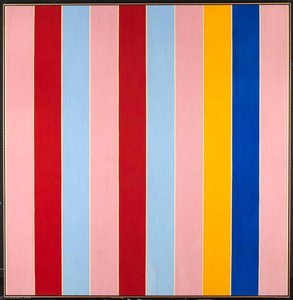
Davis's style was characterized by his use of vibrant colors and improvisational techniques. He often compared himself to a jazz musician, describing his approach to painting as "playing by eye." This spontaneity is evident in Untitled (Green and Orange), where the green and orange hues create an interesting contrast against each other. The piece is a testament to Davis's ability to experiment with color and form. Key Features of the Painting:- The use of pencil as the primary medium, giving the piece a more artistic and handmade appearance
- The vibrant colors, which create a visually appealing contrast
- The simple yet effective composition, showcasing Davis's ability to balance form and color
Gene Davis and the Washington Color School
Davis was a leading figure in the Washington Color School, a group of artists known for their abstract compositions in acrylic colors on unprimed canvas. His work, including Untitled (Green and Orange), exemplifies the "primacy of color" in abstract painting. To learn more about Davis and his contemporaries, visit Joshua Reynolds: Lord Lifford or explore the works of other artists like Richard Wilson and Albert Edward Sterner on https://OriginalUniqueArt.com. BR The Smithsonian American Art Museum is home to an extensive collection of American art, including works by Davis and other notable artists. For more information on the museum and its collections, visit https://OriginalUniqueArt.com or check out the Richard Wilson: White Monk page.Artist Biography
The Architect of Color: The Life and Legacy of Gene Davis
In the vibrant tapestry of mid-century American abstraction, few threads shine as brightly or as rhythmically as those woven by Gene Davis. A pioneer of the Color Field movement, Davis possessed a singular ability to transform the canvas into a rhythmic experience of light and motion. Born in Washington, D.C., in 1920, his journey toward becoming a central figure of the Washington Color School was not one of immediate abstraction, but rather a gradual evolution shaped by a keen observational eye. Before he ever commanded the brush to create his iconic stripes, Davis worked as a sportswriter, a profession that demanded a sharp focus on movement, energy, and the unfolding drama of live events—elements that would later find their way into the pulsating verticality of his paintings.
The seeds of his abstract language were sown through deep engagement with European modernism. During his formative years, Davis found profound inspiration in the works of Paul Klee and Arshile Gorky, artists who demonstrated how form could be distilled into pure emotion and symbolic weight. By immersing himself in the masterpieces held within the Phillips Collection, he began to understand that color did not merely serve a subject; color was the subject. This realization set him on a path away from traditional representation and toward a revolutionary way of seeing, where the boundaries between shape and hue began to dissolve into pure, chromatic energy.
The Rhythm of the Stripe: Innovation and Technique
The year 1958 marked a seismic shift in Davis’s career and the broader trajectory of American art. It was during this period that he began producing his celebrated acrylic stripe paintings, a technique that would become his unmistakable signature. Moving away from the heavy, gestural textures of Abstract Expressionism, Davis embraced the flat, luminous qualities of acrylic paint. His compositions often featured monumental vertical bands of color that seemed to vibrate against one another, creating a sense of optical movement that drew the viewer into a hypnotic, rhythmic trance.
These works were far more than simple geometric exercises; they were explorations of space and perception. By utilizing the Washington Color School approach, Davis emphasized the primacy of color, allowing each stripe to interact with its neighbor through subtle shifts in value and saturation. His technique allowed for a unique kind of "breathing" within the painting, where the eye is encouraged to dance vertically across the canvas. This mastery of repetition and rhythm allowed him to capture the essence of urban energy and natural light, translating the chaos of the modern world into a structured, yet profoundly fluid, visual language.
A Lasting Impression on American Abstraction
As a cornerstone of the Washington Color School alongside contemporaries like Morris Louis and Kenneth Nurtland, Gene Davis helped redefine the boundaries of post-painterly abstraction. His work stood as a testament to the power of restraint and the infinite possibilities found within a limited palette. Even in his later works, such as the evocative Night Rider from 1983, one can see his ability to blend bold hues with complex imagery, proving that his mastery of color could support deep, symbolic narratives.
The historical significance of Gene Davis lies in his role as a bridge between the intense emotionality of early abstraction and the cool, calculated precision of later Color Field painting. His legacy is found in every canvas that prioritizes the sensory experience of color over the depiction of form. Through his rhythmic stripes, he left behind a visual symphony that continues to resonate with collectors and art enthusiasts worldwide, reminding us that art can be both profoundly simple and infinitely complex.

Gene Davis
1920 - 1985 , United States of America
Quick Facts
- Artistic Movement Or Style: Color Field Painting
- Artists Or Movements Influenced By This Artist: ['Abstract Expressionism']
- Artists Who Influenced This Artist:
- Paul Klee
- Arshile Gorky
- Date Of Birth: August 22, 1920
- Date Of Death: April 6, 1985
- Full Name: Gene Bernard Davis
- Nationality: American
- Notable Artworks:
- Black Grey Beat
- Blue Freak-Out
- Place Of Birth: Washington, D.C.