1966
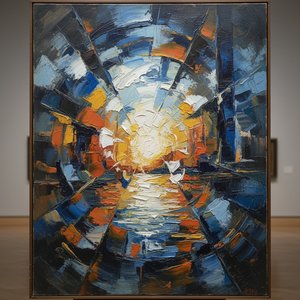
Eclipse IV (Gabor Peterdi, 1966)
Gabor Peterdi (1915–2001) made Eclipse IV. It dates from 1966. It measures 91 × 61 cm (35.8 × 24 in).
- 1966
- 91 × 61 cm (35.8 × 24 in)

 Preview

 Hand Made Oil Painting
 Send
 Share
 Fact sheet


 Download
 Similars
 X-Ray
 Diaporama
 Q&A

 Stats
Eclipse IV, in brief
- Title
- Eclipse IV
- Artist
- Gabor Peterdi (1915–2001)
- Artist born in
- Pestújhely, Hungary
- Date
- 1966
- Dimensions
- 91 × 61 cm (35.8 × 24 in)
What does Eclipse IV depict?
The Artist's Vision
Gabor Peterdi was a Hungarian-American artist known for his innovative contributions to printmaking and painting. His work is characterized by a dynamic use of color and form, reflecting both his European roots and his adaptation to the American art scene. Eclipse IV is a prime example of his unique style, featuring two large circles in the center, with one being larger than the other, surrounded by smaller circles that evoke a sense of celestial bodies or planets.Artistic Significance
The Lyrical Abstraction Art Movement, which Gabor Peterdi was a part of, is a type of abstract art that emerged in the post-war period. This movement is characterized by a focus on the emotional and expressive qualities of art, rather than the representational or figurative aspects. As seen in Eclipse IV, Gabor Peterdi's use of line, shape, and tone is forceful and expressive, evoking the essence of his subjects. For more information on this movement, visit The Lyrical Abstraction Art Movement page on OriginalUniqueArt.Other Notable Works
Some other notable works by Gabor Peterdi include Arctic Night IV, which can be found on OriginalUniqueArt. This piece showcases the artist's ability to convey the power of nature through his use of color and form.- Gabor Peterdi's work is a testament to the enduring beauty of Lyrical Abstraction.
- His innovative use of color and form has inspired generations of artists.
- The Smithsonian American Art Museum is home to many of his notable works, including Eclipse IV.
The captivating Eclipse IV by Gabor Peterdi is a must-see for anyone interested in Lyrical Abstraction and the art of the 20th century. With its unique blend of color and form, this piece is sure to leave a lasting impression on all who view it. Visit OriginalUniqueArt to learn more about this incredible artwork and the artist behind it.
High-resolution images of Eclipse IV
Protected by copyright: these files are for personal reference, not a licence to republish.
Gabor Peterdi, Eclipse IV (1966).
Gabor Peterdi (1915–2001), Eclipse IV, 1966. Image: OriginalUniqueArt.com.
Questions on Eclipse IV, answered
What is the creation date of "Eclipse IV" by Gabor Peterdi?
"Eclipse IV" by Gabor Peterdi was created in 1966.
How big is the original "Eclipse IV"?
"Eclipse IV" measures 91 x 61 cm (35.8 × 24 in) in its original form. Original dimensions are a useful reference when choosing a reproduction size.
Can the image of "Eclipse IV" by Gabor Peterdi be freely reproduced?
"Eclipse IV" by Gabor Peterdi is still protected by copyright. This status governs how the image of the work may be reproduced.
Who created "Eclipse IV"?
"Eclipse IV" was created by Gabor Peterdi. The information on this page describes Gabor Peterdi's original work.
How old was Gabor Peterdi when creating "Eclipse IV" in 1966?
When "Eclipse IV" was created in 1966, Gabor Peterdi - born in 1915 - was 51 years old.
What explains the copyright situation of "Eclipse IV" by Gabor Peterdi?
"Eclipse IV" by Gabor Peterdi is still protected by copyright. Copyright terms are measured from the artist's death, and Gabor Peterdi died in 2001.
About the artist, Gabor Peterdi

1915–2001, Hungary
Gabor Peterdi
Gabor Peterdi: A Master of Intaglio and Arctic Light Gabor Peterdi (1915-2001) was a Hungarian-American painter and printmaker whose career spanned nearly seven decades, marked by an evolving exploration of biblical themes, evocative landscapes, and a deeply expressive mastery of intaglio techniques. Born in Pestújhely, Hungary, during a period of significant political and social change, Peterdi’s artistic journey reflects both the turmoil of his early life and a profound connection to the natural world – particularly the stark beauty of the Arctic. Early influences shaped Peterdi's distinctive style. He began his artistic training at fifteen, winning a prestigious Prix de Rome to study painting in Italy.
Also by Gabor Peterdi
 Pacific1971
 The Sea Shines, State 1 (center plate only), from the portfolio A Genesis1967
 Morning After
 The Time of the Beast1964
Essays around Eclipse IV
 Georgia O'Keeffe: The Top 25 Masterpieces of an American Icon1926's Black Iris marked a quiet rebellion against the ordinary. Compare the botanical abstraction of this work with her 1928 Oriental Popp…
 20th century Hungarian paintersVictor Vasarely began with medical studies at Eötvös Loránd University. Compare his scientific logic to the styles of Sher-Gil and Moholy-N…
 Gabor Peterdi: A Legacy of Abstract Expressionism & the Exploration of Light and FormExplore the powerful work of Gabor Peterdi (1915-2001), a Hungarian-American master of abstract expressionism and intaglio printmaking. Dis…