- Home

- Oil Painting Reproduction
- Frederick Etchells
- The Dead Mole

 Preview
 Buy print
 Send
Send Share
Share
 Details

 Download
 Similars
 X-Ray
X-Ray Diaporama
The Dead Mole
 1912
1912 167.0 x 106.0 cm
 Fitzwilliam College
 Read More
Hand Made Oil Reproduction
Hand-painted oil on canvas in your size and frame, made to order by our artists.




































Pick from our preset sizes that match the artwork's original proportions.

You may enter your own dimensions to fit a specific frame or space. If your selected size does not match the original image's proportions, we will either crop the artwork or extend the painting with additional hand-painted elements. A digital mockup will be sent for your approval before production begins.
Please note that the on-screen preview does not reflect the actual cropping or extension. Only the mockup will accurately show the final composition.
While custom sizes are available, we recommend selecting a dimension from the predefined list to preserve the original proportions.
After order, OriginalUniqueArt.com team will email client for instructions and provide a mockup preview
Worldwide Delivery () in 3/4 weeks instead of standard 5 weeks. (26 July). No compromise on quality.

Free Worldwide Express Shipping

High-Quality Linen Canvas

Full Shipping Insurance

Customs Tax Refund Guarantee

True Color Matching Guarantee

60-Day Return Policy (Defects Only)

100% Money-Back Guarantee

Bulk Discount Offer
 Glass option is only available in size under 110 CM

The Dead Mole
Reproduction Medium
Reproduction Size
-


Total Price
-
Artwork Description
Artistic Style and Technique
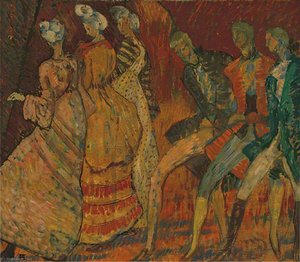
Frederick Etchells was known for his bold and expressive brushstrokes, which are evident in The Dead Mole. The painting features a serene outdoor scene with two figures standing amidst trees, engaging in conversation. The woman wears a striking blue dress, while the man stands tall beside her. The use of color and composition creates a sense of harmony and balance, drawing the viewer's eye into the heart of the scene. Key Features of the painting include:- The captivating depiction of the natural world
- The expressive use of color and light
- The intriguing interaction between the two figures
The Fitzwilliam Museum is renowned for its extensive collection of art and artifacts, including works by other notable artists such as Jan Van Goyen and Paul Cezanne. To explore more of their collection, visit /art/list/?Filter=AQRUC4-Jan-Van-Goyen-An-Estuary and /art/list/?Filter=D367Z7-Paul-Cezanne-A-male-nude. For a deeper understanding of the artist and his work, see Frederick Etchells on Wikipedia.
Artist Biography
The Architect of the Avant-Garde: The Life and Legacy of Frederick Etchells
Born in the industrial heart of Newcastle upon Tyne in 1886, Frederick Etchells emerged as a singular force in the British twentieth-century landscape, a man whose creative spirit refused to be confined by the boundaries of a single discipline. His journey began within the hallowed halls of the London School of Kensington, now the Royal College of Art, where he studied under the tutelage of masters like Arthur Beresford Pite and William Lethaby. This rigorous architectural training provided him with a structural foundation that would later inform his visual art, yet it was his immersion in the intellectual ferment of the Bloomsbury Group that truly ignited his creative consciousness. Through connections with luminaries such as Clive Bell and Roger Fry, Etchells found himself at the epicenter of a cultural revolution, navigating the delicate tension between classical tradition and the radical abstractions of a new age.
The trajectory of Etchells’s career is defined by a restless pursuit of the "new," a quality that led him from the decorative experiments of the Omega Workshops to the jagged, energetic frontiers of Vorticism. While his early involvement with the Omega workshops connected him to the aesthetic sensibilities of the Blooms and the craft-oriented ideals of the era, it was his subsequent break with Wyndham Lewis that signaled his true arrival as a provocateur. Alongside Lewis, Etchells helped establish the Rebel Art Centre, a sanctuary for those seeking to dismantle the stagnant conventions of Impressionism in favor of something more visceral and dynamic. This period of intense experimentation saw his illustrations grace the pages of BLAST magazine, where the sharp, geometric rhythms of Vorticism found their visual voice. His paintings from this era, such as the evocative Hip Bath, reflect a fascination with form and the psychological weight of modern life, capturing a sense of movement and tension that mirrored the turbulent spirit of the pre-war years.
A Synthesis of Form: From Canvas to Concrete
As the decades progressed, Etchells underwent a profound metamorphosis, transitioning from the experimental canvases of a painter to the enduring structures of an architect. This was not a departure so much as an evolution; he sought to translate the rhythmic complexities and structural boldness of his early modernism into the very fabric of London’s skyline. His architectural achievements stand as monuments to this synthesis of art and utility. In works such as 232 High Holborn and the Crawford's Advertising Building, one can observe the lingering echoes of his Vorticist roots—a preference for clean lines, functional clarity, and a modern aesthetic that embraced the industrial pulse of the city. He became a pioneer of modernist architecture in Britain, proving that the radical energy of the avant-garde could be anchored in permanent, habitable stone and steel.
Beyond his physical constructions, Etchells played a vital role as a cultural conduit, bridging the gap between Continental theory and British practice. His scholarly dedication led him to translate the seminal works of Le Corbusier, including Vers Une Architecture and Urbansime, into English. By bringing these revolutionary ideas to an English-speaking audience, he helped lay the intellectual groundwork for the widespread adoption of Modernism in the United Kingdom. This dual legacy—as both a creator of visual meaning and a translator of architectural thought—ensures his historical significance remains profound. Whether through the serene, textured landscapes of On the Grass or the commanding presence of his urban structures, Frederick Etchells remains an essential figure whose work continues to resonate with the enduring power of structural innovation and artistic courage.

Frederick Etchells
1886 - 1973 , United Kingdom
Quick Facts
- Artistic Movement Or Style: Vorticism, Modernism
- Artists Or Movements Influenced By This Artist: ['Le Corbusier']
- Artists Who Influenced This Artist: ['Arthur Beresford Pite']
- Date Of Birth: September 14, 1886
- Date Of Death: August 16, 1973
- Full Name: Frederick Etchells
- Nationality: British
- Notable Artworks:
- The Dead Mole
- Hip Bath
- Place Of Birth: Newcastle upon Tyne, United Kingdom