Preview
 Send
Send Share
Share
 Details
 Guide
Guide

 Download
 Similars
 X-Ray
X-Ray Diaporama
 Stats
StatsDissonance


 Read More
Giclée / Art Print
Museum-quality giclée or canvas print with fast production and flexible finish options. ( Buy Hand Made Painting Switch to Digital Image)




P118B $10

P118H $10

P118W $10

P438Z $10

P508JH $12

P508YH $12

P805H $10

P805Z $10

P919BZ $10

P919G $10

P919XJ $10

P959ZH $10

P968JZ $12

W106C $8

W218G $10

W218JH $8

W218Y $10

W307PJ $10

W316G $10

W316PJ $8

W316Y $10

W398PJ $8

W4111J $10

W500HY $15

W500JH $15

W692G $12

W849H $8

W940BG $15

W953PJ $8




Pick from our preset sizes that match the artwork's original proportions.

Type the width and the height you need, to fit your frame or your wall. A print can only be cut, never made bigger than the picture, so a size with a different shape loses a part of the image. We send you a digital mockup to approve before we print anything. The picture shown on this page does not show the real cut — only the mockup does.
Worldwide Delivery () in 2 weeks instead of standard 4/5 weeks. (25 October)

Free Worldwide Express Shipping

High-Quality Linen Canvas

Full Shipping Insurance

Customs Tax Refund Guarantee

True Color Matching Guarantee

100-Day Return Policy (Defects Only)

100% Money-Back Guarantee

Bulk Discount Offer
 Glass option is only available in size under 110 CM

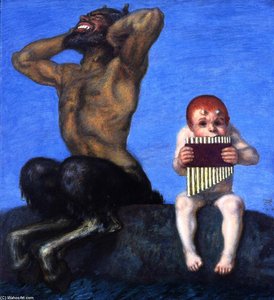
Dissonance
Giclée / Art Print
Reproduction Size
-


Total Price
$ 81
Dissonance by Franz Von Stuck: A Symphony of Contrasts
Franz Von Stuck’s “Dissonance,” painted in 1910, is more than just a depiction of a man and child; it's a profound exploration of the inherent tensions within human experience. Created during a pivotal moment in art history – the rise of Symbolism – this oil on panel work captures the movement’s core tenet: to evoke emotion and provoke thought through symbolic imagery rather than literal representation. Stuck, a key figure in German Symbolism, masterfully utilizes composition and color to create a scene brimming with unsettling beauty and intellectual depth.
Subject and Composition – A Devilish Encounter
The painting immediately confronts the viewer with a striking juxtaposition. A formally dressed man, clearly embodying demonic qualities through his horns and posture, holds a musical instrument—a pipe—while a child clutches a drum. This deliberate pairing creates an immediate sense of discord, reflecting the title’s core theme: dissonance. The setting, a backdrop of a serene blue sky, amplifies this tension, drawing attention to the unsettling interaction between innocence and corruption. Stuck's skill lies in his ability to render both figures with remarkable detail; the man’s suit and tie contrast sharply with his monstrous features, while the child’s simple clothing and gentle expression highlight their vulnerability.
Symbolism and Technique – The Language of Emotion
Stuck's technique is characterized by rich, layered brushstrokes and a masterful use of color. The blues of the sky provide a cool counterpoint to the warmer tones used for the figures, further emphasizing their opposing natures. The musical instruments themselves are laden with symbolism – the pipe representing temptation and the drum signifying primal rhythm and perhaps even chaos. The painting’s formal composition, reminiscent of classical mythology, subtly elevates the scene beyond a simple narrative, inviting viewers to contemplate deeper philosophical questions about morality, good versus evil, and the nature of human desire. The panel medium itself adds to the work's tactile quality and reinforces its connection to traditional artistic practices.
Historical Context – Symbolism at the Crossroads
"Dissonance" was created during a period of significant social and intellectual upheaval in Europe. The rise of industrialization, coupled with anxieties about modernity, fueled a desire for artists to explore subjective experience and spiritual themes. Stuck’s work aligns perfectly with this movement, rejecting the naturalistic conventions of earlier art styles in favor of a more emotionally resonant approach. His connection to the Museum Villa Stuck in Munich, where the painting resides, places it within a vibrant artistic community dedicated to preserving and promoting Symbolist ideals.
Emotional Impact – A Timeless Exploration
“Dissonance” continues to resonate with viewers today due to its powerful exploration of fundamental human conflicts. The painting’s unsettling beauty, combined with its complex symbolism, invites contemplation and evokes a range of emotions—from fascination to unease. It's a testament to Stuck’s artistic vision and his ability to capture the complexities of the human condition through a uniquely symbolic lens. A hand-painted reproduction offers an unparalleled opportunity to experience this masterpiece in exquisite detail.
Questions & Answers
Why is the copyright status of "Dissonance" what it is?
"Dissonance" by Franz Ritter von Stuck is in the public domain - its copyright has expired. Copyright duration runs from the artist's death, which occurred in 1928.
In what year was "Dissonance" by Franz Ritter von Stuck created?
"Dissonance" dates from 1910. The date places the work within Franz Ritter von Stuck's career and its era.
What does "Dissonance" share with the rest of Franz Ritter von Stuck's output?
Within Franz Ritter von Stuck's output, "Dissonance" sits in the Symbolist Movement style, alongside the themes of mythological symbolism, german art, devil vs innocence, early 20th century, stuck’s key symbolism, exploring dark themes.
Artist Biography
A Life Steeped in Myth and Symbol
Franz Ritter von Stuck, a name synonymous with the evocative power of German Symbolism, emerged from the rural landscapes of Bavaria in 1863 to become one of the most influential artists of his generation. Born in Tettenweis, initially destined for a life following his father as a forester, young Franz demonstrated an undeniable artistic inclination that would irrevocably alter his path. This early aptitude led him to Munich, first to the School of Applied Arts in 1878 and then to the Academy of Fine Arts from 1882-1884, where he fell under the spell of Arnold Böcklin’s hauntingly beautiful mythological scenes – a formative influence that would deeply shape his artistic vision. Stuck wasn't merely an artist; he was a cultural phenomenon, a “Prince of Art” as he became known during his lifetime, bridging the gap between 19th-century academic tradition and the burgeoning currents of modernism.The Rise of a Symbolist Master
Stuck’s ascent to prominence was remarkably swift. His breakthrough arrived in 1889 with The Guardian of Paradise, exhibited at the Munich Glass Palace, instantly garnering critical acclaim and a gold medal. This painting wasn't simply a display of technical skill; it announced a new artistic voice – one that blended classical precision with mythological subject matter and an undercurrent of Symbolist mystery. He quickly became a central figure in challenging established norms, co-founding the Munich Secession in 1892 alongside like-minded artists determined to break free from conservative constraints and champion modern art. This act of artistic rebellion coincided with his exploration into sculpture, debuting with Athlete, demonstrating an impressive versatility. However, it was The Sin (1893) that truly cemented his reputation as a master of Symbolist painting, captivating audiences with its dramatic intensity and psychological depth. This period marked the full flowering of Stuck’s unique style – a potent combination of sensuality, classical form, and symbolic resonance.Themes and Influences: A World of Desire and Myth
The artistic universe of Franz von Stuck is populated by recurring motifs that reveal his profound engagement with timeless themes. Mythology served as a constant source of inspiration, drawing from Greek, Roman, and biblical narratives which he reimagined with a distinctly personal flair. These weren’t mere retellings; they were explorations of the human condition filtered through the lens of ancient stories. Equally prominent was his fascination with sensuality and the femme fatale, powerfully embodied in his numerous depictions of Salome – a figure representing desire, danger, and moral ambiguity. These paintings weren’t simply about physical beauty; they delved into the psychological complexities of female power and its potential for both allure and destruction. Underlying all this was a deep reverence for classical art, evident in his meticulous technique, anatomical accuracy, and compositional rigor. Beyond Böcklin, Stuck acknowledged influences from the Pre-Raphaelites and Gustave Moreau, but he wasn’t merely an imitator; he synthesized these influences into something uniquely his own, profoundly impacting subsequent generations of artists.Legacy and Influence: A Teacher and a Knight
In 1895, Franz von Stuck took on another crucial role – that of teacher at the Munich Academy. He became a highly respected instructor, not only imparting technical skills but also encouraging his students to explore their individual artistic visions. Among those who benefited from his guidance were luminaries such as Paul Klee, Hans Purrmann, and Josef Albers, demonstrating the breadth of his influence. His dedication to art was further recognized in 1905 when he was ennobled, becoming “Ritter von Stuck” – a testament to his growing prestige and contribution to German culture. He continued to receive accolades throughout Europe, solidifying his position as one of the leading artists of his time. His Villa Stuck in Munich, now a museum, stands as a lasting monument to his life and work, offering invaluable insights into his artistic vision and the cultural milieu of late 19th and early 20th-century Germany. His legacy endures not only through his paintings and sculptures but also through the countless artists he inspired, ensuring that the spirit of Franz von Stuck continues to resonate within the art world today.Major Works and Enduring Significance
- The Spring (1886): A vibrant depiction showcasing his early mastery of color and composition.
- Dissonance (1893): An unsettling portrayal embodying emotional turmoil through a woman playing the violin.
- Salome (various versions): Perhaps his most iconic work, depicting the biblical story with striking sensuality and psychological depth.
- Athlete (1892): A powerful sculpture demonstrating his skill in three-dimensional form.

Franz Ritter von Stuck
1863 - 1928 , Germany
Quick Facts
- Full Name: Franz Ritter von Stuck
- Nationality: German
- Date Of Birth: 1863
- Date Of Death: 1928
- Place Of Birth: Tettenweis, Germany
- Notable Artworks:
- The Guardian of Paradise
- Salome
- The Sin
- Athlete
- Dissonance
- Artistic Movement Or Style: Symbolism, Art Nouveau
- Artists Who Influenced This Artist:
- Arnold Böcklin
- Pre-Raphaelites
- Gustave Moreau
- Artists Or Movements Influenced By This Artist:
- Paul Klee
- Wassily Kandinsky
Related Articles
Symbolism's Soul: 10 Masterpieces That Transformed Art & Decor
Delve into the dreamlike world of Symbolism with 10 iconic masterpieces by Moreau, Munch & Redon. Explore the movement’s emotional depth and artistic techniques. Find museum-quality reproductions & curated decor ideas at OriginalUniqueArt.com.
Eugen von Blaas: Capturing Alpine Life & Sentiment in 19th-Century Austrian Painting
Discover the captivating world of Eugen von Blaas! Explore his exquisite 19th-century paintings capturing Venetian life & Alpine beauty. Learn about his Academic Classicism style and find museum-quality reproductions at OriginalUniqueArt.
Franz von Stuck: Symbolism, Decadence & the Pursuit of Ideal Beauty
Explore the captivating world of Franz von Stuck, a leading Symbolist painter. Discover his mythological masterpieces, decadent themes, & investment potential. Expert analysis for discerning collectors.

Beyond Reality: A Definitive Guide to the Dreamlike World of Symbolist Painting
Explore the evocative world of Symbolist painting. Discover how masters like Gustave Moreau rejected realism to capture dreams, myths, and the subconscious through fine art history and expert analysis.
Beyond Reality: A Sophisticated Guide to the Enigmatic World of Symbolist Painting
Embark on a journey through the dreamlike realm of Symbolist painting. Discover the visionary works of Redon and Moreau, exploring themes of myth, psyche, and mystery in this expert guide for fine art enthusiasts and collectors.