Text size

() ·

A painting made for you, by hand

Nijinsky

Hand Made Oil Reproduction

Hand-painted oil on canvas in your size and frame, made to order by our artists. ( Switch to Print Switch to Digital Image)

Collectible Description

Artist Biography

Franz Kline (1910-1962): Pioneer of Abstract Expressionism renowned for dynamic black brushstrokes & powerful action paintings. Explore his legacy!

from ·

Chapter 1

How large should it be?

Slide to change the size; the picture on the left shows the frame at its real width. The proportions of the original are kept.

Standard
custom
CM
INCH

Pick from our preset sizes that match the artwork's original proportions.

width
height

Type the width and the height you need, to fit your frame or your wall. This is hand-painted, so for a size with a different shape the artist can paint a bit more around the picture, or cut a bit — you choose. We send you a digital mockup to approve before the painting starts. The picture shown on this page does not show the real result — only the mockup does.

Chapter 2

How should it arrive?

Choose the edges of the stretched canvas

Choose your frame

Corner sample of the WhiteWrap canvas edge finish, stretched on solid wood bars
White $1
Corner sample of the BlurSideWrap canvas edge finish, stretched on solid wood bars
Blurside $1
Corner sample of the ExtendedWrap canvas edge finish, stretched on solid wood bars
Extended $1
Corner sample of the P118B picture frame: moulded polystyrene, 5 cm wide and 3 cm thick
P118B $10
Corner sample of the P118H picture frame: moulded polystyrene, 5 cm wide and 3 cm thick
P118H $10
Corner sample of the P118W picture frame: moulded polystyrene, 5 cm wide and 3 cm thick
P118W $10
Corner sample of the P438Z picture frame: moulded polystyrene, 5.5 cm wide and 3.5 cm thick
P438Z $10
Corner sample of the P508JH picture frame: moulded polystyrene, 7 cm wide and 3.5 cm thick
P508JH $12
Corner sample of the P508YH picture frame: moulded polystyrene, 7 cm wide and 3.5 cm thick
P508YH $12
Corner sample of the P805H picture frame: moulded polystyrene, 5 cm wide and 3.5 cm thick
P805H $10
Corner sample of the P805Z picture frame: moulded polystyrene, 5 cm wide and 3.5 cm thick
P805Z $10
Corner sample of the P919BZ picture frame: moulded polystyrene, 7 cm wide and 3.5 cm thick
P919BZ $10
Corner sample of the P919G picture frame: moulded polystyrene, 7 cm wide and 3.5 cm thick
P919G $10
Corner sample of the P919XJ picture frame: moulded polystyrene, 7 cm wide and 3.5 cm thick
P919XJ $10
Corner sample of the P959ZH picture frame: moulded polystyrene, 5 cm wide and 3 cm thick
P959ZH $10
Corner sample of the P968JZ picture frame: moulded polystyrene, 6 cm wide and 4 cm thick
P968JZ $12
Corner sample of the W106C picture frame: solid wood, 5 cm wide and 3 cm thick
W106C $8
Corner sample of the W218G picture frame: solid wood, 5 cm wide and 3 cm thick
W218G $10
Corner sample of the W218JH picture frame: solid wood, 5 cm wide and 3 cm thick
W218JH $8
Corner sample of the W218Y picture frame: solid wood, 5 cm wide and 3 cm thick
W218Y $10
Corner sample of the W307PJ picture frame: solid wood, 6 cm wide and 3 cm thick
W307PJ $10
Corner sample of the W316G picture frame: solid wood, 6 cm wide and 3 cm thick
W316G $10
Corner sample of the W316PJ picture frame: solid wood, 6 cm wide and 3 cm thick
W316PJ $8
Corner sample of the W316Y picture frame: solid wood, 6 cm wide and 3 cm thick
W316Y $10
Corner sample of the W398PJ picture frame: solid wood, 5 cm wide and 3 cm thick
W398PJ $8
Corner sample of the W4111J picture frame: solid wood, 6.5 cm wide and 3.5 cm thick
W4111J $10
Corner sample of the W500HY picture frame: solid wood, 7 cm wide and 5 cm thick
W500HY $15
Corner sample of the W500JH picture frame: solid wood, 7 cm wide and 5 cm thick
W500JH $15
Corner sample of the W692G picture frame: solid wood, 8 cm wide and 4 cm thick
W692G $12
Corner sample of the W849H picture frame: solid wood, 5 cm wide and 3 cm thick
W849H $8
Corner sample of the W940BG picture frame: solid wood, 7.5 cm wide and 4.5 cm thick
W940BG $15
Corner sample of the W953PJ picture frame: solid wood, 6 cm wide and 3.5 cm thick
W953PJ $8
Corner sample of the H24-GOLD picture frame: carved wood with gesso, 10 cm wide and 6 cm thick
H24-GOLD $30
Corner sample of the H24-SILVER picture frame: carved wood with gesso, 10 cm wide and 6 cm thick
H24-SILVER $30
Corner sample of the H36-GOLD picture frame: carved wood with gesso, 15 cm wide and 6.5 cm thick
H36-GOLD $45
Corner sample of the H36-SILVER picture frame: carved wood with gesso, 15 cm wide and 6.5 cm thick
H36-SILVER $45
Frame preview
Framed

Moulding: . Overall size with the frame: .

Chapter 3

Who paints it, and should anything change?

Examples of what can be changed: Replace face with customer photo; Add pet (e.g., replace cat with dog); Include hidden message in background; Change background landscape or elements.
After order, OriginalUniqueArt.com team will email client for instructions and provide a mockup preview

Worldwide Delivery () in 3/4 weeks instead of standard 5 weeks. (8 November). No compromise on quality.

Chapter 4

The finishing touches

A nameplate, as in a museum?

Engraved Bronze Plaque Details

This elegant plaque features the artist's name and the title of the artwork, finely engraved for a timeless presentation.

It is made from bronze with a refined, elegant finish. The text is precisely laser-engraved for a sharp and permanent result. Measuring 9x2 cm, the plaque is compact yet easy to read. It's built to be durable and scratch-resistant, offering a professional, museum-quality look. Mounting is simple thanks to the included adhesive backing.

Transparent Acrylic Plaque Details

The plaque includes essential engraved details such as the artist's name, the title of the artwork, the date it was created, the type of media used-like oil on canvas or watercolor-a brief description of the piece, and a QR code that links to the complete artwork information.

It is crafted from clear acrylic, offering a sleek, modern appearance. The text is UV-engraved in black to ensure strong visual contrast. With a size of 10x15 cm, it ensures optimal readability. It comes equipped with two metal hooks for secure wall mounting. The plaque is designed to be weather-resistant, making it suitable for various environments, and it includes interactive features that work seamlessly with smartphone scanning.

Black Acrylic Plaque Details

This elegant plaque includes engraved information such as the artist's name, the title of the artwork, the date it was created, the type of media used (like oil on canvas or watercolor), a short description of the artwork, and a QR code for quick access to more information.

The plaque itself is made from refined black acrylic with a premium finish. The text is laser-engraved in white for high contrast and readability. Its size is 10x15 cm, designed to be easy to read. It comes with two metal hooks for professional mounting. The design is sleek and fits any interior style. It is also weather-resistant and durable, with built-in digital integration for mobile compatibility.

A protective varnish?

When do you need it?

Chapter 5

Your painting, as you ordered it

Nijinsky

Reproduction Medium

Reproduction Size

-

Elite Senior Artist

More detail, finesse, and extra production time

-

Reproduction Frame

-

-

For artworks or reproductions larger than 105 cm (approximately 41 inches) on any side, the frame will be shipped as a kit, disassembled. This method ensures safe delivery and prevents damage during transport.

Professional assembly required - this is not a DIY product.
The kit must be assembled and the canvas stretched by an experienced professional framer, using wood glue (not supplied), a canvas stretching plier and clamps to hold the bars square while the glue dries. Incorrect assembly or uneven canvas tension can permanently damage the artwork and is not covered by our warranty.

  • All solid wood bars are included, precisely cut to size.

  • Assembled with the screws provided, plus wood glue for the corner joints, which is not supplied and must be sourced by your framer.

  • Professional tools are required and not included: a canvas stretching plier (tensioner) and clamps to hold the bars square while the glue dries.

Important:
The corner joints require wood glue, the bars must be held with clamps until the glue is fully dry, and tightening the canvas on the assembled frame requires a canvas stretching plier. None of these are included in the kit. Please arrange an experienced professional framer before ordering this size.

Nameplate

-

-

Protective Varnish

Glossy Varnish (enhances colors, protects against light/moisture)

-

Customize My Artwork

Examples of what can be changed: Replace face with customer photo; Add pet (e.g., replace cat with dog); Include hidden message in background; Change background landscape or elements.

-

Urgent

Worldwide Delivery () in 3/4 weeks instead of standard 5 weeks. (8 November). No compromise on quality.

-

Express Shipping

Worldwide Delivery () in 5 weeks. (15 November).

Included

Total Price

$ 300

Total Price $ 300

Glass option is only available in size under 110 CM

Included with every order

  • Free Worldwide Express Shipping
  • High-Quality Linen Canvas
  • Full Shipping Insurance
  • Customs Tax Refund Guarantee
  • True Color Matching Guarantee
  • 100-Day Return Policy (Defects Only)
  • 100% Money-Back Guarantee
  • Bulk Discount Offer
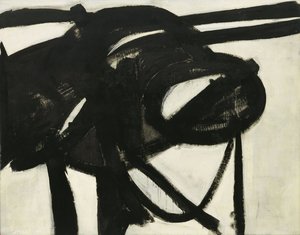
Kline was married to a ballet dancer, Elizabeth Parsons, who, like the famous Russian dancer Nijinsky, suffered from schizophrenia. Kline made several portraits of Nijinsky during his early years, when he worked as a commercial illustrator. This work, however, does not depict the dancer. It is one of the first in Kline’s mature style, developed over the winter of 1949–50. During a visit to de Kooning’s studio, Kline saw one of his own sketches enlarged with an overhead projector. For the first time he saw that his calligraphic studies, which were made on the pages of a telephone book, worked well as large pictures. This canvas was included in Kline’s first one-man show at Charles Egan’s gallery. The titles were created, more or less arbitrarily, by a committee composed of Egan, Elaine and Willem de Kooning, and Kline. The zig-zag line at bottom left may have reminded Kline of the ruff that Nijinsky wore in an earlier portrait of him as Petrouchka.

Questions & Answers

Is "Nijinsky" by Franz Kline in the public domain, and why?

"Nijinsky" by Franz Kline is still protected by copyright. Copyright terms are measured from the artist's death, and Franz Kline died in 1962.

What shape and dimensions is "Nijinsky" by Franz Kline?

"Nijinsky" by Franz Kline is a portrait composition measuring 117 x 90 cm in the original.

What orientation does "Nijinsky" by Franz Kline have?

"Nijinsky" by Franz Kline has a portrait format. The format describes the proportions of the composition.

More about this painting

Preview AR preview Switch to Print Switch to Digital Image Send
Details Guide Add to favorites Download Similars X-Ray Diaporama Q&A Stats

In numbers

  • 1950the year it was painted
  • 29frames to choose from
  • standard sizes, in its own proportions
  • 5weeks to paint and deliver it

About the original

Dimensions
117.0 x 90.0 cm
Franz Kline

Franz Kline

1910 - 1962, United States of America

Quick facts about Franz Kline

  • Full Name: Franz Kline
  • Nationality: American
  • Date Of Birth: 1910
  • Date Of Death: 1962
  • Place Of Birth: Wilkes-Barre, United States of America
  • Notable Artworks:
    • Lehighton
    • Palladio
    • Kitzker
    • Untitled
  • Artistic Movement Or Style: Abstract Expressionism
  • Artists Who Influenced This Artist:
    • Rembrandt
    • Velasquez
    • El Greco
    • Goya
    • De Kooning
  • Artists Or Movements Influenced By This Artist:
    • Minimalism
    • Donald Judd
    • Richard Serra

Artist Biography

A Life Forged in Contrast: The World of Franz Kline

Franz Kline, a pivotal figure in the Abstract Expressionist movement, remains an artist whose work resonates with raw power and emotional depth. Born in Wilkes-Barre, Pennsylvania, in 1910, his life was marked by early hardship – the suicide of his father when he was just seven years old cast a long shadow, influencing a sensibility that would later find expression in the stark contrasts defining his art. This formative experience led to a nomadic youth and eventual enrollment at Girard College, a Philadelphia boarding school for boys who had lost their fathers. It was here, amidst structured discipline, that Kline’s artistic inclinations began to surface, nurtured by traditional training in illustration and drafting. He continued his studies at Boston University and later honed his skills at the Heatherley School of Fine Art in London, immersing himself in the works of the Old Masters – Rembrandt, Velázquez, El Greco, Goya, Dürer – and absorbing the nuances of Japanese prints. These early influences, though seemingly distant from his eventual abstract style, laid a foundation for his understanding of composition, light, and the expressive potential of line.

From Representation to Revelation: The Evolution of an Abstract Vision

Kline’s artistic journey wasn't immediate or linear. Throughout the 1930s and early 40s, he worked as a figurative painter, creating landscapes, cityscapes, portraits, and even murals. His “Hot Jazz” mural series from 1940, commissioned for a Greenwich Village tavern, signaled a shift towards simplification, hinting at the bold forms to come. However, it was a pivotal encounter with Willem de Kooning in 1948 that truly unlocked his abstract potential. De Kooning suggested projecting one of Kline’s sketches onto a wall using a Bell-Opticon projector – an act that dramatically enlarged and transformed the image, reducing it to its essential strokes. This experience proved revelatory for Kline; he began exploring large-scale abstractions characterized by dynamic black brushstrokes on white canvases. He abandoned representationalism not as a rejection of form, but as a pursuit of pure expression, stripping away narrative content to focus on the visceral impact of gesture and line. The resulting works weren’t merely paintings, they were *events* – energetic confrontations between darkness and light, control and chaos.

The Language of Black and White: Defining Kline's Aesthetic

Kline’s mature style is instantly recognizable for its monochromatic palette—primarily black on white. This wasn’t a limitation but a deliberate choice, emphasizing the interplay of positive and negative space, creating a visual tension that draws the viewer into the heart of the composition. He believed the white was as crucial as the black, not merely an absence of color but an active participant in the dialogue between form and void. His brushstrokes were fluid, dynamic, and often applied with house-painting brushes on large canvases, immersing the spectator within his abstract world. While some observers have noted similarities to Japanese calligraphy, Kline consistently denied any conscious influence, asserting that his work stemmed from a more primal, intuitive source. He frequently titled his paintings after places from his childhood or industrial landscapes – “Lehighton,” “Mahoning” – offering subtle anchors to his personal history without dictating the interpretation of the abstract forms. These titles served as echoes rather than explanations, inviting viewers to engage with the work on their own terms.

Legacy and Influence: A Lasting Impact on Modern Art

By the 1950s, Franz Kline had achieved significant recognition within the New York School—an informal group of artists including Jackson Pollock, Willem de Kooning, Robert Motherwell, and Lee Krasner who were redefining American art. He exhibited at prestigious galleries like Egan Gallery and Sidney Janis Gallery, participated in the Venice Biennale in 1960 (receiving the Italian Ministry of Public Instruction Prize), and taught at Black Mountain College and Pratt Institute. Kline’s influence extended beyond Abstract Expressionism, subtly shaping the development of Minimalism. His reluctance to imbue his work with hidden meanings resonated with artists like Donald Judd and Richard Serra, who sought to reduce art to its essential forms. Tragically, Kline's career was cut short by declining health; diagnosed with rheumatic heart disease in 1961, he died in New York City in 1962 at the age of 51. Despite his relatively brief artistic output, Franz Kline left an indelible mark on modern art, establishing gestural abstraction as a powerful and enduring force. His paintings continue to captivate audiences with their raw energy, emotional intensity, and profound exploration of form and space—a testament to a life forged in contrast and expressed through the bold language of black and white.