Preview
 Send
Send Share
Share
 Details
 Guide
Guide

 Download
 Similars
 X-Ray
X-Ray Diaporama
 Stats
StatsSt Luke
 Oil On Canvas
- WallArt
- Dutch Golden Age
 1625
1625- Early Modern
 70.0 x 55.0 cm
 Museum of Western European and Oriental Art
 Read More
Giclée / Art Print
Museum-quality giclée or canvas print with fast production and flexible finish options. ( Buy Hand Made Painting Switch to Digital Image)




P118B $10

P118H $10

P118W $10

P438Z $10

P508JH $12

P508YH $12

P805H $10

P805Z $10

P919BZ $10

P919G $10

P919XJ $10

P959ZH $10

P968JZ $12

W106C $8

W218G $10

W218JH $8

W218Y $10

W307PJ $10

W316G $10

W316PJ $8

W316Y $10

W398PJ $8

W4111J $10

W500HY $15

W500JH $15

W692G $12

W849H $8

W940BG $15

W953PJ $8




Pick from our preset sizes that match the artwork's original proportions.

Type the width and the height you need, to fit your frame or your wall. A print can only be cut, never made bigger than the picture, so a size with a different shape loses a part of the image. We send you a digital mockup to approve before we print anything. The picture shown on this page does not show the real cut — only the mockup does.
Worldwide Delivery () in 2 weeks instead of standard 4/5 weeks. (25 October)

Free Worldwide Express Shipping

High-Quality Linen Canvas

Full Shipping Insurance

Customs Tax Refund Guarantee

True Color Matching Guarantee

100-Day Return Policy (Defects Only)

100% Money-Back Guarantee

Bulk Discount Offer
 Glass option is only available in size under 110 CM

St Luke
Giclée / Art Print
Reproduction Size
-


Total Price
$ 81
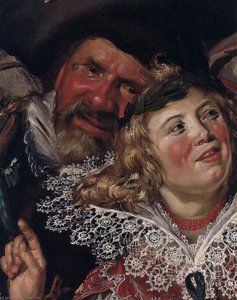
A Scholar in the Glow of Devotion
In the quiet, amber-hued atmosphere of a seventeenth-century study, Frans Hals captures a moment of profound intellectual and spiritual communion. St Luke is not merely a portrait of an evangelist; it is a window into the very soul of the Dutch Golden Age, where faith and humanism began to intertwine through the lens of careful observation. The painting presents the saint as a scholar deeply immersed in his work, his gaze cast downward toward an open book that serves as both his subject and his sanctuary. There is an intimate stillness to the scene, a sense that the viewer has stumbled upon a private moment of intense concentration. As the candlelight flickers across the textured pages and the man's contemplative face, one feels the weight of the words being read and the gravity of the divine truths being recorded.
Hals masterfully employs a rich, warm palette to evoke the tactile reality of the studio. The deep shadows and luminous highlights create a dramatic chiaroscuro effect that draws the eye directly to the subject's weathered features and the delicate details of his scholarly tools. This interplay of light does more than just define form; it breathes life into the atmosphere, suggesting the warmth of a single flame struggling against the encroaching darkness of the room. For the discerning collector or interior designer, this piece offers a sense of timelessness and intellectual depth, making it an ideal centerpiece for spaces that value quiet elegance, historical resonance, and a sophisticated, moody aesthetic.
The Mastery of the Expressive Brush
What truly distinguishes this work is Hals’s revolutionary approach to technique. Moving away from the stiff, overly polished finishes common in many contemporary portraits, Hals embraced a loose, impasto brushstroke that lends the canvas an extraordinary sense of immediacy. Each stroke feels deliberate yet spontaneous, as if the artist were capturing the very movement of light across skin and parchment. This textured application of paint creates a shimmering surface that reacts dynamically to the ambient light in any room where it is displayed. The way the paint builds up on the highlights—on the bridge of the nose, the edge of a page, or the glint of spectacles—adds a three-dimensional quality that invites close inspection.
This technique serves a higher purpose than mere decoration; it is essential to the painting's emotional impact. The visible energy of the brushwork mirrors the internal vitality of the subject’s thoughts. In St Luke, the blurred edges and soft transitions between light and shadow create an atmospheric haze, suggesting that the saint is lost in a world of ideas that transcends his physical surroundings. This sense of psychological realism—the ability to portray not just a face, but a mind at work—is what makes this reproduction such a compelling acquisition for those who appreciate art that speaks to the human condition.
A Legacy of Light and Learning
To possess a piece like St Luke is to hold a fragment of history. Painted in 1625, during the height of the Dutch Republic's cultural flourishing, the work reflects the era's burgeoning respect for literacy, documentation, and the pursuit of knowledge. The presence of books and the focused, scholarly demeanor of the subject speak to a society that was increasingly defining itself through its intellectual achievements. The subtle inclusion of symbolic elements, such as the birds that inhabit the periphery of the composition, adds layers of meaning that invite continuous rediscovery.
For those looking to curate an environment of inspiration, this artwork provides a foundation of classical beauty and narrative complexity. Whether placed in a private library, a formal study, or a contemporary living space, the painting acts as a silent interlocutor, prompting reflection and conversation. It is a masterpiece that transcends its era, offering a profound sense of peace and a reminder of the enduring power of focused devotion and the pursuit of truth.
Questions & Answers
At what age did Frans Hals I make "St Luke"?
Frans Hals I was 45 years old when creating "St Luke" in 1625. The age is computed from the artist's birth year, 1580.
What is the dominant hue of "St Luke" by Frans Hals I?
The dominant hue of "St Luke" by Frans Hals I is amber to saffron. The hue is the underlying tone of the palette.
Are the colors of "St Luke" by Frans Hals I saturated or muted?
The colors of "St Luke" by Frans Hals I have a subtle color saturation. Saturation describes how vivid or muted the colors are.
Artist Biography
Frans Hals I: A Life in Paint
Frans Hals I was a Dutch painter born in Antwerp, Belgium, around 1580. Though his early life remains somewhat shrouded in mystery, he rose to become one of the most important figures of the Dutch Golden Age, celebrated for his innovative portraiture and genre scenes.
Early Life and Training
Details surrounding Hals’s formative years are scarce. It is believed he received initial artistic training in Antwerp, a prominent center for painting at the time. However, due to religious and political turmoil, his family relocated to Haarlem in the Netherlands. He became a member of the Haarlem Guild of St. Luke in 1610, marking the formal beginning of his professional career.
Artistic Style and Development
Hals distinguished himself through a remarkably fresh and spontaneous style. Unlike many of his contemporaries who favored meticulous detail, Hals employed a loose and expressive brushstroke. This technique imbued his paintings with a sense of immediacy and vitality, capturing the personality and character of his subjects in a way that was revolutionary for its time.
- His portraits weren’t simply likenesses; they were psychological studies.
- He excelled at depicting fleeting moments – laughter, conversation, or contemplation.
- Hals's use of light and shadow added depth and drama to his compositions.
Notable Works
While Hals produced a wide range of works, he is best known for his portraits. Some of his most celebrated paintings include:
- The Laughing Cavalier (1624) – A quintessential example of his ability to capture character and movement.
- Malle Babbe (c. 1633-1635) – A striking portrayal of an elderly woman, showcasing Hals’s skill in depicting age and personality.
- Portraits of the Regents of the Old Men's Home in Haarlem (1664) - Demonstrating his mastery of group portraiture.
He also created compelling genre scenes – depictions of everyday life – that offered glimpses into Dutch society.
Influences and Legacy
Determining Hals’s direct influences is challenging, as he developed a highly individual style. However, it's likely he was aware of the work of earlier Flemish painters like Pieter Bruegel the Elder. His innovative approach to portraiture profoundly impacted subsequent generations of artists.
- He influenced artists such as Adriaen Brouwer and Johannes Vermeer.
- His emphasis on capturing personality paved the way for more intimate and psychological portraits.
- Later artists, including the Impressionists, admired his loose brushwork and focus on light.
Historical Significance
Frans Hals I played a crucial role in shaping Dutch painting during the Golden Age. His work reflects the burgeoning prosperity and individualism of the Netherlands at that time. He moved away from rigid formality towards a more naturalistic and expressive style, leaving an enduring legacy on the art world.
Today, his paintings are highly sought after and can be found in major museums worldwide, including the Frans Hals Museum in Haarlem, which houses the largest collection of his work. His contributions continue to inspire artists and captivate audiences centuries later.

Frans Hals I
1580 - 1585 , Belgium
Quick Facts
- Name: Frans Hals I
- Movement: Dutch Golden Age
- Birth Date: 1580
- Death Date: 1585
- Birth Place: Antwerp, Belgium
- Nationality: Dutch
- Date Of Birth: 1580
- Date Of Death: 1585
- Notable Works: Portraits and genre scenes
- Place Of Birth: Antwerp, Belgium
Related Articles

Dutch Masters: 10 Golden Age Paintings That Still Inspire |
Journey into the Dutch Golden Age! Explore 10 iconic paintings by Rembrandt, Vermeer & Hals. Discover the stories behind these Baroque masterpieces and find museum-quality art reproductions to elevate your home decor on .
Illuminating Realism: Exploring the Dutch Golden Age of Painting (1600-1700)
Explore the Dutch Golden Age of painting (1600-1700) with OriginalUniqueArt. Discover Rembrandt, Vermeer & other masters. Learn about techniques, history & find museum-quality reproductions.

Golden Light & Dutch Skies: The Timeless Magic of Dutch Golden Age Landscapes
Discover the breathtaking beauty of Dutch Golden Age landscapes. Explore the mastery of light, chiaroscuro, and 17th-century realism through an expert art history lens, celebrating the enduring legacy of the Dutch Masters for discerning collectors and art lovers.

Frans Hals I: Innovation, Intimacy & the Dutch Golden Age Portrait
Explore the revolutionary portraiture of Frans Hals I, a master of the Dutch Golden Age. Discover his innovative techniques, captivating character studies & lasting impact on art history. Learn more at OriginalUniqueArt.

Illuminating Innovation: Exploring the Dutch Golden Age of Painting
Explore the Dutch Golden Age of painting with OriginalUniqueArt. Discover Rembrandt, Vermeer & other Masters. Learn about key characteristics, iconic artworks, and lasting influence. Expert insights for collectors & enthusiasts.