Switch to Print
 Read More







































 For artworks or reproductions larger than 105 cm (approximately 41 inches) on any side, the frame will be shipped as a kit, disassembled. This method ensures safe delivery and prevents damage during transport.


A Vision of Industry and Light: Frank Brangwyn’s “The Spinners”
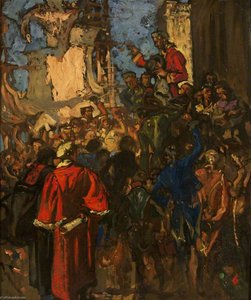
Frank Brangwyn’s “The Spinners,” completed in 1906, stands as a testament to the Arts & Crafts movement's fascination with depicting the realities of modern industrial life while simultaneously striving for aesthetic beauty. Executed on a monumental canvas measuring 165 x 541 cm and housed at Leeds Museums and Galleries, this painting captures a bustling factory scene bathed in an ethereal glow—a deliberate juxtaposition designed to elevate the mundane into something sublime.
Brangwyn’s distinctive style is immediately recognizable through his bold use of color and dramatic chiaroscuro. He eschewed traditional academic realism, favoring instead expressive brushstrokes that convey movement and energy. The palette leans heavily towards warm hues—ochres, reds, and yellows—dominating the factory walls and illuminating the faces of the workers depicted within. These colors aren’t merely decorative; they symbolize vitality and industriousness, mirroring Brangwyn's own belief in the transformative power of labor.
- Subject Matter: The painting portrays a group of men diligently operating machinery—a common motif in industrial art of the period. However, Brangwyn elevates this subject beyond mere documentation by imbuing it with spiritual significance.
- Technique: Brangwyn employed oil paint on canvas using a technique characterized by thick impasto – applying pigment thickly onto the surface to create textural relief. This method lends physicality and immediacy to the scene, conveying the palpable energy of the factory environment.
The historical context surrounding “The Spinners” is crucial to understanding its artistic intent. Brangwyn was deeply influenced by Jules Verne’s novels and fascinated by depictions of exotic locales—particularly Persia and Egypt—which informed his broader artistic vision. He sought to capture not just the physical appearance of industrial spaces but also their psychological impact on human beings, portraying them as figures striving for transcendence amidst the drudgery of daily toil.
Symbolically, the scattered bottles throughout the workspace aren’t simply props; they represent tools—instruments of labor and creativity. Their positioning against the backdrop of the building emphasizes the importance of architectural form in shaping human experience. Brangwyn's masterful use of light – particularly the diffused glow emanating from unseen sources – contributes to the painting’s emotional resonance, suggesting a sense of hopefulness and aspiration despite the challenges inherent in industrial life.
Ultimately, “The Spinners” transcends its subject matter to become an emblem of artistic idealism. Brangwyn's ambition was to transform ordinary scenes into meditations on beauty and spirituality—a goal he achieved with remarkable success, cementing his place as a pivotal figure in the Arts & Crafts movement and leaving behind a legacy of paintings that continue to inspire awe and contemplation.
Questions & Answers
How do I discover artworks close to "The Spinners" by Frank Brangwyn?
Artworks similar to "The Spinners" by Frank Brangwyn are gathered on the artwork's Similars page.
Which reproduction size is suggested for "The Spinners" by Frank Brangwyn?
A large reproduction is suggested for "The Spinners" by Frank Brangwyn. Size can be adjusted while keeping the proportions.
At what size is "The Spinners" suggested for a living room?
In a living room, "The Spinners" is suggested at a large print size.
More about this painting
 Preview
 Send
Send Share
Share
 Details
 Guide
Guide

 Download
 Similars
 X-Ray
X-Ray Diaporama
 Q&A
Q&A Stats
Stats