
 Preview
 Send
Send Share
Share
 Details
 Guide
Guide

 Download
 Similars
 X-Ray
X-Ray Diaporama
 Q&A
Q&A Stats
StatsTriptych, left


 Read More
Get a print-ready file that goes far beyond the web preview. Every digital image we sell comes from a high-resolution master in our stock database — usually 5,000 to 15,000 pixels wide — so you can print large, crop tightly, or reproduce fine detail with confidence.
No file leaves our studio untouched. A digital expert checks the colors against the original painting and corrects them if needed, then improves clarity and detail with professional retouching tools — always staying faithful to the artist's brushwork and style. The result is an image that looks like the painting, not like a filtered scan.
You approve before you're done: our expert sends the image by e-mail within 72 hours for your review. Not satisfied? Ask for improvements or corrections, or request a refund if the quality falls short.
This is the quality relied on by publishers, design studios, galleries and print shops.
Digital Image
Download a high-resolution file for personal display, printing, and creative projects. ( Switch to Print Buy Hand Made Painting)
Included in Every Digital Image Order
Expert Digital Delivery, Guaranteed
When you choose OriginalUniqueArt.com, you're not just getting an image - you're receiving a professionally enhanced digital artwork, crafted with precision and backed by a satisfaction guarantee. Here's everything that comes with your order, automatically:

Fast Email Delivery
Your high-resolution digital image file will be emailed to you within 72 hours of ordering - ready for immediate use.

AI-Enhanced Digital File
Your artwork is professionally optimized using advanced AI tools and manual editing, ensuring maximum detail, clarity, and color accuracy.

Free Lifetime Re-Delivery
Accidentally deleted or lost your file? No worries - we'll resend it to you anytime, free of charge.

No Import Fees - Ever
Enjoy your artwork instantly with zero customs, duties, or delivery fees - digital downloads are always tax-free.

Color Accuracy Guarantee
We ensure your digital image reflects the original colors as closely as possible using professional tools and color management.

100-Day Satisfaction Guarantee
If you're not satisfied with your digital image, we'll revise it or refund 100% within 100 days - no questions asked.

100% Money-Back Guarantee
Not satisfied? Get a full refund within 100 days of receiving your digital file - no questions asked.

Bulk Order Discounts
Buy 3 images, save 10% - Buy 5, save 15% - Buy 10+, save 20%. Great for creative projects, galleries, and agencies.
A Portrait of Isolation: Examining Francis Bacon’s “Triptych, Left”
Francis Bacon's "Triptych, Left" stands as a monumental testament to the artist’s unflinching exploration of human vulnerability and psychological torment. Completed in 1977, this unsettling masterpiece transcends mere representation; it plunges viewers into a realm of visceral emotion where form relentlessly pursues feeling. The painting depicts a solitary figure seated on a chair, positioned at an oblique angle—a deliberate compositional choice designed to heighten the sense of unease and detachment. Bacon’s signature style – characterized by jagged lines, distorted forms, and unsettling textures – is powerfully evident here, mirroring the fractured psyche he sought to convey.- Style: Expressionism – Bacon eschewed traditional academic conventions, prioritizing subjective experience over objective observation.
- Technique: Thickly applied oil paint—Bacon employed a technique known as “dragging,” where pigment is pulled across the canvas surface to create palpable ridges and grooves. This physicality underscores the painting’s emotional intensity.
- Color Palette: Dominated by muted reds, browns, and blacks – These colors contribute to the overall atmosphere of gloom and decay, reflecting themes of mortality and suffering.
Historical Context & Influences
Bacon's work emerged during the postwar period, a time marked by disillusionment and anxiety following the devastation of World War II. He drew inspiration from Surrealism and Freud’s psychoanalytic theories, particularly his concept of the unconscious mind—a preoccupation with repressed desires and anxieties that fueled Bacon’s artistic vision. The painting reflects the broader cultural mood of its era, grappling with questions of identity, trauma, and the human condition in the face of existential dread.Symbolism & Emotional Resonance
“Triptych, Left” operates on multiple symbolic levels. The seated figure embodies stillness amidst chaos—a paradoxical representation of inner turmoil. Bacon deliberately avoids depicting a recognizable face, furthering this ambiguity and inviting viewers to project their own emotions onto the canvas. The jagged lines and distorted forms serve as visual metaphors for psychological fragmentation, mirroring the fractured state of consciousness. Ultimately, the painting compels us to confront uncomfortable truths about human suffering and mortality—a visceral reminder of our shared vulnerability.Why Choose a Reproduction?
A high-quality reproduction of “Triptych, Left” allows you to experience Bacon’s masterful technique and profound emotional depth within your own home environment. OriginalUniqueArt offers meticulously crafted reproductions that faithfully capture the painting's textures and colors, bringing its unsettling beauty into focus. Invest in an artwork that speaks to the soul—a timeless piece of art history destined to inspire contemplation and provoke emotion for generations to come.Questions & Answers
Where can I find a guide to "Triptych, left"?
The Guide page of "Triptych, left" by Francis Bacon offers a printable two-sheet factsheet: the artwork with its identity table, a decade band placing it in the artist's lifetime, other works by the artist, the measured color palette, and ready-to-copy citations in four styles.
What style does "Triptych, left" belong to?
The movement associated with "Triptych, left" by Francis Bacon is Contemporary Realism. This classification situates the work among related artists and artworks.
Is "Triptych, left" one of Francis Bacon's most popular works?
The popularity level recorded for "Triptych, left" by Francis Bacon is iconic.
Artist Biography
Early Life, Family and Training
Francis Bacon was born on October 28, 1909, in Dublin, Ireland. He grew up in a house in the Irish countryside, the son of a racehorse trainer. His childhood was marked by physical struggle; he was severely asthmatic, a condition that often made breathing a difficult task. He also experienced a sense of confinement during his younger years, remembering being shut in dark cupboards by a housemaid for long periods. This feeling of suffocation and the dread of family members hiding in locked rooms during the Irish revolutionary period left a lasting impression on his early years.
His education was largely private, conducted by tutors within the home rather than in a traditional classroom. This unconventional upbringing meant he never followed the standard path of an art school apprenticeship. By the age of sixteen, the restlessness of his youth led him to leave his home in rural Ireland to seek his fortune in London. He arrived in the city at seventeen, surviving on an allowance provided by his mother as he navigated the complexities of urban life.
Life in London, Berlin and Paris
By the late 1920s, Bacon was a man in motion. He drifted through the streets of London, Berlin, and Paris, living a life that was often as unsettled as the cities he inhabited. He settled in London in 1928, finding himself in the middle of the city's bohemian scene. It was a period of wandering and survival, marked by a restless energy as he moved between these European hubs. He lived off an allowance from his mother and took on various odd jobs to make ends meet.
During these years, his professional life was tied to the world of interior design and decoration. He spent much of his time working with textures and shapes, creating structured objects for the homes of others. However, a pivotal moment arrived during a trip to Paris in the late 1920s. He visited an exhibition of Picasso’s work, and the sight of it changed his direction entirely. The way Picasso handled the human form—treating it as something organic and bone-like—offered him a new way to see the world. He decided to leave design behind to pursue painting, a choice that would define the rest of his life.
Interior Design and Early Career
Before the world knew him as a painter, Bacon spent his early professional years working as an interior designer and decorator. This was a practical, structured period of his life that stood in contrast to the turbulent years he spent drifting through London, Berlin, and Paris. He did not follow the traditional path of an artist, bypassing art school and formal apprenticeships entirely. Instead, he was a self-taught man who learned through direct observation and the hands-on work of shaping physical spaces.
His work in design was far from minor. He contributed to the aesthetic of the era by creating Royal Wilton rugs that featured abstract motifs. His eye for form extended to various household objects and furniture, including calfskin pouffes, cocktail shelves, and room screens. He also designed chairs, often utilizing tubular steel and glass to create silhouettes that felt modern and geometric. These early years provided him with a deep understanding of structure and the way objects occupy a room.
This background in decoration left a lasting mark on his later approach to the canvas. The geometric shapes and architectural frames he once built for living spaces eventually transformed into the transparent cages and spatial structures that would define his paintings. He moved from designing the physical environments people inhabited to creating the psychological spaces that trapped his subjects. Even as he abandoned design for the brush, the sense of construction remained.
Technique and Artistic Style
Bacon’s approach to the canvas was physical and direct. He worked with oils and large brushes, applying paint in a way that felt heavy and immediate. His colors were often smeared and violent, used to strip away any sense of decorative comfort. Through this method, he created figural images that expressed a profound sense of isolation, brutality, and terror. He did not aim for the polished finish of traditional portraiture, preferring instead to capture the raw sensation of being alive and vulnerable.
To organize these intense emotions, he often used a specific structural device. He employed a cubic, architectural framing system known as a space-frame. These geometric constructions acted like transparent cages, trapping his subjects within a defined, often claustrophobic, space. By placing figures inside these rigid structures, he was able to concentrate the image and force the viewer to confront the subject's isolation. This technique helped him move away from simple storytelling, focusing instead on the visceral impact of the human form.
He also found a way to use traditional religious imagery without the weight of faith. He utilized the concept of the crucifixion as an armature, a structural support upon which he could hang specific sensations of suffering. This allowed him to explore the human condition through a lens of physical and psychological distress. His work often relied on these skeletal frameworks to hold the weight of his distorted, contorted figures.
- Three Studies for Figures at the Base of a Crucifixion (1944)
- Study for a Portrait (1952)
Key Works and Major Themes
Bacon’s work often felt like a way to process the heavy, unsettling atmosphere of the mid-twentieth century. In 1945, he exhibited Three Studies for Figures at the Base of a Crucifixion, a work that helped establish his reputation. He did not use the crucifixion for religious devotion, but rather as a structural armature to hang sensations of suffering. He was interested in how the human form could be distorted to express the raw reality of existence, often looking to the studies of motion by Eadweard Muybridge to understand how the body moves and breaks apart.
His fascination with the scream became a recurring part of his visual language. He found a specific kind of terror in the screaming face seen in Sergei Eisenstein's film Battleship Potemkin, and he translated that visceral reaction onto the canvas. This reached a peak in his series of works known as The Screaming Popes, created between 1949 and the mid-1950s. In these paintings, he took the dignified authority of Velázquez’s Portrait of Pope Innocent X and stripped it away, turning the papal figure into a nightmarish specter of hysterical terror.
- Three Studies for Figures at the Base of a Crucifixion (1944)
- The Screaming Popes (1949–mid-1950s)
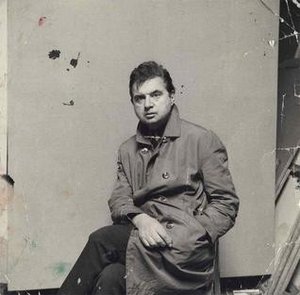
Francis Bacon
1909 - 1992 , Ireland
Quick Facts
- Artistic Movement Or Style: Expressionism, Cubism, Surrealism
- Artists Who Influenced This Artist:
- Picasso
- Matthias Grünewald
- Rembrandt
- Velázquez
- Sergei Eisenstein
- Eadweard Muybridge
- Full Name: Francis Bacon
- Nationality: Irish
- Notable Artworks:
- Three Studies for Figures at the Base of a Crucifixion
- Dog
- Study for a Portrait
- Place Of Birth: Dublin, Ireland
- Date Of Birth: 1909
- Date Of Death: 1992