Preview
 Send
Send Share
Share
 Details

 Download
 Similars
 X-Ray
X-Ray Diaporama
 Stats
StatsThe annunciation
 Read More
Hand Made Oil Reproduction
Hand-painted oil on canvas in your size and frame, made to order by our artists. ( Switch to Print Switch to Digital Image)




































Pick from our preset sizes that match the artwork's original proportions.

You may enter your own dimensions to fit a specific frame or space. If your selected size does not match the original image's proportions, we will either crop the artwork or extend the painting with additional hand-painted elements. A digital mockup will be sent for your approval before production begins.
Please note that the on-screen preview does not reflect the actual cropping or extension. Only the mockup will accurately show the final composition.
While custom sizes are available, we recommend selecting a dimension from the predefined list to preserve the original proportions.
After order, OriginalUniqueArt.com team will email client for instructions and provide a mockup preview
Worldwide Delivery () in 3/4 weeks instead of standard 5 weeks. (11 September). No compromise on quality.

Free Worldwide Express Shipping

High-Quality Linen Canvas

Full Shipping Insurance

Customs Tax Refund Guarantee

True Color Matching Guarantee

100-Day Return Policy (Defects Only)

100% Money-Back Guarantee

Bulk Discount Offer
 Glass option is only available in size under 110 CM

The annunciation
Reproduction Medium
Reproduction Size
-


Total Price
$ 300
Artist Biography
Early Life and Florentine Beginnings
Francesco Granacci, born in the Tuscan village of Villamagna in 1469, emerged during a period of extraordinary artistic ferment in Florence. His early life was deeply intertwined with the city’s burgeoning Renaissance spirit, and his formative years were spent within the esteemed workshop of Domenico Ghirlandaio—a master renowned for his clarity of line, balanced compositions, and vibrant narrative frescoes. It was here that Granacci absorbed the foundational principles of Florentine painting, honing his skills alongside a cohort of talented apprentices. However, it wasn’t solely Ghirlandaio who shaped the young artist's trajectory; a particularly close friendship with Michelangelo Buonarroti blossomed during this time. The two shared a passion for classical sculpture and frequented Lorenzo de’ Medici’s renowned garden, immersing themselves in the study of ancient forms—an experience that would subtly yet profoundly influence Granacci’s artistic development. Early works like the Madonna and Child with Saints Michael and John the Baptist, now housed in Berlin's Staatliche Museen, and the Adoration of the Child at the Honolulu Museum of Art reveal a nascent talent already demonstrating Ghirlandaio’s influence, yet hinting at a unique sensibility beginning to emerge.A Collaborative Spirit and Roman Interlude
Granacci’s artistic path wasn't solely defined by solitary practice; collaboration played a significant role in his growth. He frequently worked alongside Filippino Lippi, whose style also left an indelible mark on his early paintings. Vasari recounts that Granacci even served as a model for the nude figure in Lippi’s celebrated Raising of Theophilus within the Brancacci Chapel—a testament to the close working relationship between the two artists. In 1508, a pivotal moment arrived when Granacci journeyed to Rome. There, he joined Michelangelo and other skilled painters assisting with the monumental task of decorating the Sistine Chapel ceiling. While his direct contribution remains debated, this experience exposed him to the sheer scale and ambition of High Renaissance art, broadening his artistic horizons and instilling a greater sense of sculptural form in his compositions. Upon returning to Florence, Granacci’s work began to exhibit a newfound dynamism, evident in pieces like Rest on the Flight into Egypt, where figures possess a more robust physicality and are set within exotic landscapes rendered with radiant color.Religious Themes and Florentine Commissions
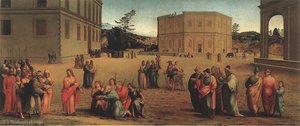
The majority of Granacci's oeuvre centers around religious subjects—frescoes, altarpieces, and devotional paintings that reflect the piety and artistic tastes of his time. He secured numerous commissions throughout Florence, working for various churches and convents. Notable examples include the Madonna with Child with Saints Francesco and Jerome, originally created for the Augustinian convent of San Gallo, and the Assumption of the Virgin commissioned for Santi Girolamo e Francesco sulla Costa—both now residing in the Galleria dell'Accademia. In 1515, he participated in a large-scale decorative project celebrating Pope Leo X’s visit to Florence, collaborating with prominent artists such as Andrea del Sarto and Jacopo Pontormo. This period saw him create Joseph Presents his Father and his Brothers to the Pharaoh, now gracing the Uffizi Gallery—a work that showcases his skill in narrative clarity and detailed composition.Later Years and Artistic Synthesis
As Granacci matured, his style underwent a subtle yet significant evolution. He began incorporating influences from artists like Fra Bartolomeo and Pietro Perugino, absorbing elements of Umbrian painting characterized by its soft modeling and harmonious color palettes. This synthesis of diverse artistic currents resulted in works that balanced the clarity of Florentine tradition with a more nuanced emotional depth. While he never achieved the widespread renown of his contemporaries, Granacci was consistently regarded as a dependable and skilled craftsman—a painter whose work stood at an important juncture between the older Florentine manner and the emerging aesthetics of the High Renaissance. He passed away in Florence in 1543, buried within the Church of Sant’Ambrogio, leaving behind a legacy of devotional paintings that continue to offer glimpses into the artistic life of Renaissance Italy.Historical Significance
Francesco Granacci's historical significance lies not in radical innovation but in his embodiment of the collaborative spirit and evolving stylistic trends of Florentine painting during the High Renaissance. He was a skilled artisan who successfully navigated the complex interplay of influences—from Ghirlandaio and Lippi to Michelangelo, Fra Bartolomeo, and Perugino—creating works that reflect the artistic diversity of his time. Though often overshadowed by more celebrated figures, Granacci’s paintings provide valuable insights into the religious sensibilities and aesthetic preferences of 16th-century Florence. His ability to blend narrative clarity with a growing emotional depth makes him a compelling figure in the broader context of Renaissance art history—a testament to the enduring power of artistic synthesis and dedicated craftsmanship.
Francesco Granacci
1469 - 1543 , Italy
Quick Facts
- Artistic Movement Or Style: Renaissance
- Artists Or Movements Influenced By This Artist: ['Botticelli']
- Artists Who Influenced This Artist: ['Andrea del Verrocchio']
- Date Of Birth: 1452-04-15
- Date Of Death: 1519-05-02
- Full Name: Leonardo di ser Piero da Vinci
- Nationality: Italian
- Notable Artworks:
- Mona Lisa
- The Last Supper
- Vitruvian Man
- Place Of Birth: Florence, Italy