Preview
 Send
Send Share
Share
 Details
 Guide
Guide

 Download
 Similars
 X-Ray
X-Ray Diaporama
 Q&A
Q&A Stats
StatsThe Nativity

- 53.0 x 60.0 cm


 Read More
Giclée / Art Print
Museum-quality giclée or canvas print with fast production and flexible finish options. ( Buy Hand Made Painting Switch to Digital Image)




P118B $10

P118H $10

P118W $10

P438Z $10

P508JH $12

P508YH $12

P805H $10

P805Z $10

P919BZ $10

P919G $10

P919XJ $10

P959ZH $10

P968JZ $12

W106C $8

W218G $10

W218JH $8

W218Y $10

W307PJ $10

W316G $10

W316PJ $8

W316Y $10

W398PJ $8

W4111J $10

W500HY $15

W500JH $15

W692G $12

W849H $8

W940BG $15

W953PJ $8




Pick from our preset sizes that match the artwork's original proportions.

Type the width and the height you need, to fit your frame or your wall. A print can only be cut, never made bigger than the picture, so a size with a different shape loses a part of the image. We send you a digital mockup to approve before we print anything. The picture shown on this page does not show the real cut — only the mockup does.
Worldwide Delivery () in 2 weeks instead of standard 4/5 weeks. (6 November)

Free Worldwide Express Shipping

High-Quality Linen Canvas

Full Shipping Insurance

Customs Tax Refund Guarantee

True Color Matching Guarantee

100-Day Return Policy (Defects Only)

100% Money-Back Guarantee

Bulk Discount Offer
 Glass option is only available in size under 110 CM

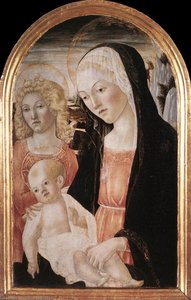
The Nativity
Giclée / Art Print
Reproduction Size
-


Total Price
$ 81
A Vision of the Sacred – Francesco di Giorgio’s ‘The Nativity’
Francesco di Giorgio Martini's “The Nativity,” a captivating panel painting from around 1475-1480, transcends mere religious depiction; it’s an immersive experience of Renaissance idealism and architectural vision. Born in Siena during a period of burgeoning artistic innovation, Di Giorgio wasn’t simply a painter; he was a polymath—an architect, engineer, theorist, and sculptor all rolled into one remarkably inventive mind. This particular work embodies his unique approach, seamlessly blending elements of Sienese tradition with the emerging principles of perspective and humanist thought. The painting isn't merely a scene from the biblical narrative; it’s a carefully constructed space, imbued with a sense of serene contemplation and profound spiritual depth.

The composition immediately draws the eye to the central figures: Mary, Joseph, and the infant Jesus, nestled within a simple manger. Di Giorgio masterfully employs a flattened perspective, characteristic of his architectural studies, creating an illusion of depth that’s both elegant and subtly unconventional. The Virgin's pose is particularly striking – a kneeling figure radiating grace and humility, while the baby Jesus rests peacefully on her lap. Joseph stands behind them, a guardian figure rendered with quiet dignity. However, it’s not just the figures themselves that command attention; the background landscape—a distant vista of rolling hills and a rudimentary structure—is equally significant, hinting at Di Giorgio's architectural inclinations.
Architectural Echoes and Northern Influences
What truly distinguishes “The Nativity” is its unusual synthesis of influences. Di Giorgio’s upper register, particularly the arrangement of the angels, clearly echoes the sculptural reliefs of Donatello, a master of dynamic form and expressive emotion. These figures are not static; they seem to be caught in moments of contemplation or perhaps even divine inspiration. Conversely, the lower portion of the painting—the manger scene itself—demonstrates a clear admiration for Girolamo da Cremona’s work on choirbooks from Siena. This juxtaposition of styles – the monumental grandeur of Donatello and the intricate detail of Cremona – creates a fascinating tension within the composition, reflecting Di Giorgio's own intellectual curiosity and his desire to synthesize diverse artistic traditions.
Symbolism and Spiritual Resonance
Beyond its formal qualities, “The Nativity” is rich in symbolic meaning. The muted color palette—primarily earth tones and subtle blues—contributes to the painting’s atmosphere of serenity and reverence. The two birds present – one near the top left corner and another towards the bottom right side – are often interpreted as symbols of hope and divine guidance, further enhancing the painting's spiritual resonance. The carefully chosen placement of these elements suggests a deeper meditation on faith, humility, and the promise of salvation. It’s not simply a depiction of a biblical event; it’s an invitation to contemplate the mysteries of the human condition.
A Legacy of Innovation
“The Nativity” stands as a testament to Francesco di Giorgio Martini's extraordinary talent and his pioneering spirit. His architectural theories, documented in his treatise *Trattato di architettura, ingegneria e arte militare*, were remarkably advanced for their time, anticipating many of the innovations that would characterize Renaissance architecture. The painting itself represents a pivotal moment in Di Giorgio’s artistic development—a transition from the more conventional styles of his early career to a more personal and visionary approach. Reproductions of this remarkable work offer a glimpse into the mind of a true Renaissance polymath, a man who sought to unite art, science, and architecture in a single, harmonious expression.
Questions & Answers
Is a high-resolution download of "The Nativity" available?
"The Nativity" is available as a high-resolution digital image download, purchased directly on its Digital Image page.
How saturated is the palette of "The Nativity"?
The palette of "The Nativity" is balanced soft in saturation.
What does "The Nativity" by Francesco di Giorgio Martini bring to an interior?
"The Nativity" by Francesco di Giorgio Martini has a calm atmosphere and is recommended for a living room. The mood is what the work brings to the space around it.
Artist Biography
The Renaissance Polymath: The Life and Vision of Francesco di Giorgio Martini
In the vibrant tapestry of the Italian Quattrocento, few figures loom as large or as multifaceted as Francesco di Giorgio Martini. A true homo universalis, his intellect spanned the boundaries between the ethereal beauty of fine art and the rigorous precision of engineering. Born in Siena in 1439, Martini emerged from a period of profound cultural transformation, where the shadows of the Middle Ages were being chased away by the light of humanism. His life was not merely a career in art, but a lifelong pursuit of understanding the underlying geometry of the universe, whether expressed through the delicate brushstroke of a Madonna or the fortified walls of an ideal city.
Martini’s artistic journey began under the watchful eye of Vecchietta, a master of the Sienese School whose style favored rhythmic, frieze-like compositions. While his early training instilled in him a deep respect for religious iconography and the graceful traditions of Siena, Francesco possessed an unquenchable thirst for innovation. He looked beyond the local traditions toward the burgeoning Florentine interest in linear perspective and classical antiquity. This intellectual curiosity allowed him to transcend the decorative nature of his predecessors, infusing his works with a newfound psychological depth and a sophisticated command of spatial relationships that would later echo the genius of Leonardo da Vinci.
A Synthesis of Spirit and Structure
The breadth of Martini’s creative output is nothing short of staggering. As a painter, he possessed a rare ability to marry the divine with the tangible. In masterpieces such as Madonna and Child with Saints and Angels, one observes a profound tenderness paired with a rigorous structural clarity. His religious works, including the monumental Coronation of the Virgin for the Siena Cathedral, demonstrate his capacity to synthesize classical grandeur with the emotive power required by sacred art. He did not merely depict holy figures; he placed them within a world that felt architecturally sound and physically present.
However, to view Martini solely through the lens of a painter is to miss the heartbeat of his true genius. His contributions to architecture and military engineering were equally transformative. Through his Trattato di architettura, he provided much more than mere technical drawings; he offered a visionary blueprint for the città ideale—the ideal city. His detailed illustrations and manuscripts reveal a mind obsessed with the harmony of proportion and the strategic necessity of defense. In these sketches, we see the seeds of modern urban planning, where beauty and utility exist in a delicate, calculated balance.
Legacy of an Architectural Visionary
The historical significance of Francesco di Giorgio Martini lies in his ability to bridge the gap between the artist's intuition and the engineer's logic. He was a man who saw no distinction between the grace of a sculpted limb and the strength of a stone bastion. His influence rippled through the Renaissance, shaping the way subsequent generations approached the concept of design as an integrated discipline. His life, which concluded in Siena in 1502, left behind a legacy that continues to resonate in the study of both art history and architectural theory.
To reflect on his enduring impact, one might consider the following pillars of his greatness:
- Mastery of Perspective: His role in transitioning Sienese art from decorative tradition to the spatial depth of the High Renaissance.
- Architectural Innovation: The development of theoretical frameworks for urban design and fortification that influenced centuries of engineering.
- Humanist Integration: The seamless blending of classical anatomical study with religious devotion and scientific inquiry.
- The Polymathic Ideal: Serving as a definitive model for the Renaissance creator, where art, science, and intellect are inseparable.

Francesco di Giorgio Martini
1439 - 1502 , Italy
Quick Facts
- Full Name: Francesco Maurizio di Giorgio Martini
- Nationality: Italian
- Date Of Birth: 1439
- Date Of Death: 1502
- Place Of Birth: Siena, Italy
- Notable Artworks:
- Nativity
- Coronation of the Virgin
- Artistic Movement Or Style: Renaissance
- Artists Who Influenced This Artist: ['Andrea del Verrocchio']
- Artists Or Movements Influenced By This Artist: ['Leonardo da Vinci']
Related Articles

25 Divine Masterpieces by Fra Angelico: The Painter of Heaven
Explore 25 divine Fra Angelico masterpieces of the Early Renaissance. Discover museum-quality art on OriginalUniqueArt.com.
Jacob Henricus Maris: A Master of Dutch Atmospheric Realism & the Intimate Landscape
Explore the captivating world of Jacob Henricus Maris, a leading figure of the Dutch Hague School. Discover his atmospheric landscapes, signature brushstrokes & lasting influence on 19th-century art. Learn more at OriginalUniqueArt.

25 Must-See Masterpieces at La Biennale di Venezia: A Journey Through Venice's Art Soul
Explore 25 iconic masterpieces from La Biennale di Venezia. Discover timeless art legends on OriginalUniqueArt.com.
Proto-Renaissance Masters: 10 Artworks That Changed History | OriginalUniqueArt
Journey back to the dawn of Renaissance art! Explore 10 iconic Proto-Renaissance masterpieces by Giotto, Cimabue & Duccio. Discover their stories, techniques & lasting impact. Find museum-quality reproductions for your home at OriginalUniqueArt.com

25 Masterpieces by Giotto di Bondone: The Father of Renaissance Art
Explore 25 iconic Giotto masterpieces that birthed the Renaissance. Discover museum-quality art on OriginalUniqueArt.com.