Preview
 Send
Send Share
Share
 Details

 Download
 Similars
 X-Ray
X-Ray Diaporama
 Stats
StatsCupid with a Tambourine
 Etching
- WallArt
- Symbolist Illustration
 19th Century
 14.0 x 10.0 cm
 Hammer Museum
 Read More
Hand Made Oil Reproduction
Hand-painted oil on canvas in your size and frame, made to order by our artists. ( Switch to Print Switch to Digital Image)




P118B $10

P118H $10

P118W $10

P438Z $10

P508JH $12

P508YH $12

P805H $10

P805Z $10

P919BZ $10

P919G $10

P919XJ $10

P959ZH $10

P968JZ $12

W106C $8

W218G $10

W218JH $8

W218Y $10

W307PJ $10

W316G $10

W316PJ $8

W316Y $10

W398PJ $8

W4111J $10

W500HY $15

W500JH $15

W692G $12

W849H $8

W940BG $15

W953PJ $8




Pick from our preset sizes that match the artwork's original proportions.

You may enter your own dimensions to fit a specific frame or space. If your selected size does not match the original image's proportions, we will either crop the artwork or extend the painting with additional hand-painted elements. A digital mockup will be sent for your approval before production begins.
Please note that the on-screen preview does not reflect the actual cropping or extension. Only the mockup will accurately show the final composition.
While custom sizes are available, we recommend selecting a dimension from the predefined list to preserve the original proportions.
After order, OriginalUniqueArt.com team will email client for instructions and provide a mockup preview
Worldwide Delivery () in 3/4 weeks instead of standard 5 weeks. (18 September). No compromise on quality.

Free Worldwide Express Shipping

High-Quality Linen Canvas

Full Shipping Insurance

Customs Tax Refund Guarantee

True Color Matching Guarantee

100-Day Return Policy (Defects Only)

100% Money-Back Guarantee

Bulk Discount Offer
 Glass option is only available in size under 110 CM

Cupid with a Tambourine
Reproduction Medium
Reproduction Size
-


Total Price
$ 300
Felicien Rops’s “Cupid with a Tambourine”: A Study in Melancholic Beauty
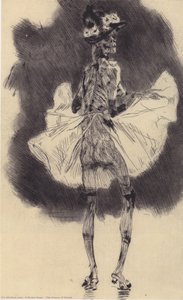
Felicien Rops's "Cupid with a Tambourine," an etching from 1875, is not merely a depiction of the Roman god of love; it’s a carefully constructed tableau of wistful contemplation and subtle unease. Rops, a pivotal figure bridging Realism, Symbolism, and the nascent world of illustrated storytelling, masterfully employs line and tone to evoke an atmosphere far deeper than simple romantic imagery. The work, now housed within the UCLA Grunwald Center for the Graphic Arts at the Hammer Museum, offers a glimpse into Rops’s uniquely shadowed vision – one that frequently explored themes of beauty intertwined with melancholy and a fascination with the darker corners of human experience.
A Technical Masterpiece: Line, Tone, and Etching
The etching itself is a testament to Rops's technical skill. The foundation lies in the meticulous process of etching – a technique involving scratching lines into a metal plate (typically copper) before applying ink and then transferring the image onto paper through pressure. Rops’s control over this medium is remarkable, evidenced by the incredibly fine, delicate lines that delineate Cupid’s features, his wings, and even the scattered leaves beneath him. The use of hatching and cross-hatching creates a rich tapestry of tones, lending depth and volume to the composition without resorting to broad, flat areas of color. Notice how the varying density of these lines subtly suggests texture – the rough surface of the ground, the smooth curve of the tambourine, and the delicate folds in Cupid’s clothing.
Symbolism and Emotional Resonance: A Quiet Lament
Beyond its technical brilliance, “Cupid with a Tambourine” is laden with symbolic meaning. The figure of Cupid himself is presented not as an exuberant embodiment of passion, but rather in a posture of quiet introspection. He’s seated cross-legged, holding the tambourine close – an instrument often associated with celebration and joy – yet his gaze is averted, suggesting a detachment from the very emotions he represents. The setting, a simple ground plane strewn with leaves, reinforces this sense of solitude. The choice of a muted color palette—primarily shades of gray, white, and black—contributes to the overall mood of melancholy. It’s as if Rops is inviting us to contemplate not the fleeting pleasures of love, but its deeper, more complex implications – perhaps even hinting at the bittersweet nature of longing and unfulfilled desire.
Contextualizing a Symbolist Vision
To fully appreciate “Cupid with a Tambourine,” it’s crucial to understand Rops's place within the broader context of 19th-century art. He was deeply influenced by Symbolism, an artistic movement that sought to express subjective emotions and ideas rather than objective reality. Rops shared this interest in exploring the darker side of human experience, often depicting scenes of beauty intertwined with decay, death, and psychological distress. His work frequently drew inspiration from mythology, folklore, and literature – particularly works by Edgar Allan Poe and Charles Baudelaire. The etching’s quiet intensity and evocative atmosphere align perfectly with the aesthetic sensibilities of the Symbolist movement, offering a poignant meditation on love, loss, and the human condition.
A Timeless Image for Collectors and Designers
“Cupid with a Tambourine” remains a powerfully resonant image today. Its exquisite craftsmanship, evocative symbolism, and haunting beauty make it an ideal choice for collectors seeking works of art that transcend mere decoration. The piece’s understated elegance also lends itself beautifully to interior design – its muted tones and contemplative mood providing a sophisticated counterpoint to brighter spaces. Reproductions, such as those offered by OriginalUniqueArt.com, allow us to experience the full impact of Rops's vision without the limitations of the original medium, ensuring that this timeless image continues to captivate audiences for generations to come.
Artist Biography
A Shadowy Visionary: The Life and Art of Félicien Rops
Félicien Victor Joseph Rops, born in 1833 in the Belgian town of Namur, emerged as a pivotal figure bridging the gap between Realism, Symbolism, and the burgeoning world of modern graphic storytelling. His life, steeped in both bourgeois comfort – his father was a prosperous textile manufacturer – and a restless artistic spirit, unfolded against a backdrop of rapid social and intellectual change. Early training at local academies provided a foundation, but it was his move to Brussels at twenty that truly ignited his creative trajectory. Though briefly enrolled at the University of Brussels, Rops found himself drawn inexorably towards the Académie de Saint-Luc, where he honed his skills not just in painting and drawing, but also in the art of satire through lithography. His early work quickly gained recognition in student magazines like *Le Crocodile* and *L'Uylenspiegel*, establishing him as a gifted caricaturist with a keen eye for societal foibles. These formative years weren’t merely about developing technical proficiency; they were about finding his voice, a voice that would soon become synonymous with challenging conventions and exploring the darker recesses of the human psyche.Parisian Encounters and the Embrace of Darkness
The year 1862 marked a turning point when Rops relocated to Paris, a city then pulsating with artistic innovation and intellectual ferment. It was here that he encountered etchers Félix Bracquemond and Jules Ferdinand Jacquemart, figures who profoundly influenced his experimentation with intaglio techniques – etching and aquatint. He largely abandoned lithography around 1865, dedicating himself to mastering these more nuanced methods of printmaking. However, the most significant encounter during this period was undoubtedly with Charles Baudelaire in 1864. The poet’s exploration of beauty within decay, of the allure of the forbidden, resonated deeply with Rops's own burgeoning artistic sensibilities. This connection culminated in Rops creating the frontispiece for Baudelaire’s *Les Épaves*, a collection of poems censored from the infamous *Les Fleurs du Mal*. This collaboration wasn’t merely illustrative; it was a meeting of minds, a shared exploration of themes that would define both artists' legacies. It propelled Rops towards an artistic path characterized by provocative subject matter – eroticism, satanic imagery, and sharp social critique – aligning him with the emerging Symbolist and Decadent movements. His commitment to avant-garde circles was further demonstrated through his founding membership in both the Société Libre des Beaux-Arts in Brussels (1868-1876) and Les XX ("the twenty," formed 1883).A Master of Printmaking and Psychological Depth
Rops’s artistic style is immediately recognizable for its intricate detail, dramatic chiaroscuro – the interplay of light and shadow – and a haunting atmosphere that permeates his work. He wasn't simply depicting scenes; he was conveying psychological states, emotional intensities often veiled in ambiguity. He frequently employed soft-ground etching, a technique rarely utilized by his contemporaries, combining it with mezzotint or aquatint, sometimes adding hand-coloring to further enhance the mood and texture of his plates. Works like “Pornokratès” (1878), a powerfully unsettling depiction of female power and transgression, “Satan Sowing Seeds” (from *Les Sataniques*, 1882), and illustrations for Jules Barbey d’Aurevilly's *Les Diaboliques* exemplify his fascination with the darker aspects of human nature. Beyond these iconic images, Rops also demonstrated a remarkable versatility, producing text comics and sequential drawings for Belgian student magazines – making him a true pioneer of the comic strip form. His illustrations for Octave Uzanne’s “Son Altesse la Femme” (1885) showcase his ability to capture both exquisite beauty and underlying decadence, reflecting the complex anxieties of the fin de siècle.Legacy and Lasting Influence
Following the dissolution of his marriage, Rops moved permanently to Paris in 1874, establishing a life with Aurélie and Léontine Duluc. Despite deteriorating eyesight beginning in 1892, he continued working tirelessly, maintaining connections within the literary world until his death in 1898. Recognition came in the form of the Légion d'honneur in 1889, acknowledging his significant contributions to the arts. However, Rops’s true legacy lies not just in accolades but in his influence on subsequent generations of artists. Edvard Munch and Max Klinger, for example, were deeply inspired by his innovative printmaking techniques and his fearless exploration of psychological themes. His work continues to resonate today, celebrated for its artistic merit, historical significance, and willingness to confront taboo subjects. Rops was a Freemason, belonging to the Grand Orient of Belgium, reflecting an intellectual curiosity that extended beyond the purely aesthetic. He captured the anxieties of a rapidly changing Europe – industrialization, urbanization, scientific advancements colliding with spiritual uncertainties – and challenged conventional norms, paving the way for future artists to push creative boundaries and explore the complexities of the human condition. He remains a key figure in the Symbolist movement and a visionary pioneer of both graphic art and comics, his shadowy world continuing to captivate and provoke audiences more than a century after his death.A Pioneer of Sequential Art
- Early Comic Strips: Rops’s contributions to the nascent field of comic strips are often overlooked, yet they are remarkably significant. His work in publications like *Le Crocodile* and *L'Uylenspiegel* featured sequential drawings with recurring characters and narratives, predating many commonly recognized milestones in the history of comics.
- Satirical Narratives: These early “comics” weren’t simply humorous; they were often biting social commentary, utilizing satire to critique political figures, societal norms, and religious institutions. This blend of entertainment and social criticism is a hallmark of Rops's artistic approach.
- Influence on Future Artists: While the direct lineage is difficult to trace definitively, Rops’s experimentation with sequential art undoubtedly laid some groundwork for later developments in the medium, influencing artists who would further refine the form in the 20th century.
- Text and Image Integration: Rops skillfully integrated text and image, creating a dynamic interplay between words and visuals that was crucial to the development of comic storytelling. His use of speech balloons and captions, though rudimentary by modern standards, demonstrated an understanding of how these elements could enhance narrative clarity.

Félicien Rops
1833 - 1898 , Belgium
Quick Facts
- Artistic Movement Or Style: Symbolism, Decadence
- Artists Or Movements Influenced By This Artist:
- Edvard Munch
- Max Klinger
- Artists Who Influenced This Artist:
- Félix Bracquemond
- Jules Jacquemart
- Charles Baudelaire
- Date Of Birth: July 7, 1833
- Date Of Death: August 23, 1898
- Full Name: Félicien Victor Joseph Rops
- Nationality: Belgian
- Notable Artworks:
- Pornokratès
- Satan Sowing Seeds
- The Temptation of St. Anthony
- Place Of Birth: Namur, Belgium
Related Articles

The Intricate World of Etching: A Historical Survey of Technique, Aesthetic Evolution, and Enduring Artistic Impact
Explore the rich history of etching, from its origins to modern practice. Discover techniques, key artists like Rembrandt, and insights for collectors. A comprehensive guide by OriginalUniqueArt.
Etching Masters: 10 Legendary Prints That Revolutionized Art | OriginalUniqueArt
Journey through 10 legendary etching masterpieces by Rembrandt, Dürer & Goya. Explore the history of printmaking and discover timeless art for your home. Find museum-quality reproductions at OriginalUniqueArt.com.

Etching: A Historical Survey of Technique, Aesthetic Qualities & Enduring Artistic Significance
Explore the rich history of etching, from its origins to Rembrandt's masterful innovations. Discover the technique, aesthetic qualities & enduring legacy of this captivating art form. Expert insights for collectors and enthusiasts.
The Art of Etching: Mastering Lines, Texture, and Depth in the Intaglio Tradition
Explore the intricate world of etching and intaglio printmaking. Discover how masters use acid and metal to create profound textures and lines, from Romanticism to modern era, through an expert lens of art history and technical mastery.
Etching Unlocked: The Sharp, High-Impact Art of Line and Shadow for the Modern Collector
Master the high-impact world of etching. Explore the transformative power of line and shadow through the intaglio tradition, from its armor-making origins to modern collecting strategies for the sophisticated art enthusiast.