Preview
 Send
Send Share
Share
 Details

 Download
 Similars
 X-Ray
X-Ray Diaporama
 Stats
StatsLesson
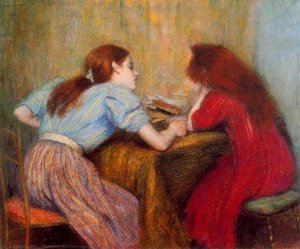
 Impressionism
 1902
1902 55.0 x 47.0 cm
 Read More
Giclée / Art Print
Museum-quality giclée or canvas print with fast production and flexible finish options. ( Buy Hand Made Painting Switch to Digital Image)




































Pick from our preset sizes that match the artwork's original proportions.

You may enter your own dimensions to fit a specific frame or space. If your selected size does not match the original image's proportions, we will either crop the artwork or extend the image with a mirrored or solid-fill edge. A digital mockup will be sent for your approval before production begins.
Please note that the on-screen preview does not reflect the actual cropping or extension. Only the mockup will accurately show the final composition.
While custom sizes are available, we recommend selecting a dimension from the predefined list to preserve the original proportions.
Worldwide Delivery () in 2 weeks instead of standard 4/5 weeks. (10 September)

Free Worldwide Express Shipping

High-Quality Linen Canvas

Full Shipping Insurance

Customs Tax Refund Guarantee

True Color Matching Guarantee

100-Day Return Policy (Defects Only)

100% Money-Back Guarantee

Bulk Discount Offer
 Glass option is only available in size under 110 CM

Lesson
Giclée / Art Print
Reproduction Size
-


Total Price
$ 81
Artist Biography
Federico Zandomeneghi: Bridging Tradition and Impressionism
Federico Zandomeneghi (1841-1917) was an Italian painter whose career beautifully illustrates the shifting currents of 19th-century art. Born in Venice on June 2, 1841, into a family steeped in artistic tradition – his father and grandfather were renowned neoclassical sculptors responsible for the magnificent Titian monument in the Frari – Zandomeneghi initially pursued sculpture but quickly gravitated towards painting, a decision that would ultimately define his legacy. His early life was marked by a desire to escape the constraints of Venetian society, leading him to briefly join Giuseppe Garibaldi’s expedition in 1860 and subsequently relocate to Florence, immersing himself in the vibrant atmosphere of the Macchiaioli movement. This period proved pivotal, exposing him to the revolutionary techniques of *plein air* painting and fostering a deep appreciation for capturing fleeting moments of light and color.The Macchiaioli and Early Influences
Zandomeneghi’s time with the Macchiaioli – a group of Tuscan painters known for their direct observation of nature and use of “dry brush” techniques – profoundly shaped his artistic development. He found kinship with artists like Telemaco Signorini, Giovanni Fattori, and Giuseppe Abbati, learning to translate the immediacy of outdoor scenes onto canvas. This exposure to *plein air* painting was a radical departure from the academic traditions he’d initially studied, encouraging him to prioritize capturing the essence of light and atmosphere over meticulous detail. The influence of these early mentors is evident in his landscapes, characterized by loose brushstrokes and an emphasis on coloristic effects – a crucial step toward his later embrace of Impressionism.A Parisian Journey and Embracing Impressionism
In 1874, Zandomeneghi embarked on a transformative journey to Paris, the epicenter of artistic innovation at the time. There, he quickly integrated himself into the burgeoning Impressionist circle, finding common ground with artists like Renoir, Cassatt, and Degas. He participated in four major Impressionist exhibitions between 1879 and 1886, solidifying his place within this groundbreaking movement. His style, while retaining elements of his Macchiaioli training – particularly a sensitivity to light and color – increasingly mirrored the Impressionists’ focus on capturing transient effects and depicting everyday life. His paintings often featured intimate scenes of women engaged in domestic activities, reflecting a quiet observation of the female experience, an influence likely drawn from artists like Mary Cassatt.Notable Works and Artistic Style
Zandomeneghi's oeuvre is characterized by a remarkable ability to convey atmosphere and emotion through subtle color variations and delicate brushwork. Works such as *At the Café (Femme au bar)* offer compelling glimpses into late 19th-century Parisian society, capturing not just the physical appearance of the subjects but also their mood and interactions. His series depicting Venetian scenes – exemplified by *Vue de Venise* – showcase his mastery of light and shadow, transforming familiar landscapes into evocative compositions. His pastel works, particularly those from the early 1890s, reveal a refined technique and a heightened sensitivity to texture and tone. The artist’s use of color was often muted and atmospheric, prioritizing mood over precise representation.Legacy and Historical Significance
Federico Zandomeneghi stands as a crucial bridge between the traditional artistic practices of his family and the revolutionary innovations of the Impressionist movement. He skillfully absorbed the lessons of the Macchiaioli while embracing the new possibilities offered by Parisian art. His work, often overlooked in mainstream narratives of Italian Impressionism, deserves greater recognition for its quiet beauty, insightful observations, and its contribution to the evolution of modern painting. His legacy lies not only in his individual paintings but also in his ability to synthesize diverse influences into a uniquely personal artistic vision – a testament to the dynamism and complexity of 19th-century art.
Federico Zandomeneghi
1841 - 1917 , Italy
Quick Facts
- Artistic Movement Or Style: Impressionism
- Artists Or Movements Influenced By This Artist: ['Macchiaioli']
- Artists Who Influenced This Artist:
- Pierre-Auguste Renoir
- Mary Cassatt
- Date Of Birth: June 2, 1841
- Date Of Death: December 31, 1917
- Full Name: Federico Zandomeneghi
- Nationality: Italian
- Notable Artworks:
- At the Café (Femme au bar)
- Vue de Venise
- Place Of Birth: Venice, Italy