Preview
 Send
Send Share
Share
 Details
 Guide
Guide

 Download
 Similars
 X-Ray
X-Ray Diaporama
 Stats
StatsFrançais L'alerte
 1884
1884 122.0 x 174.0 cm
 Read More
Giclée / Art Print
Museum-quality giclée or canvas print with fast production and flexible finish options. ( Buy Hand Made Painting Switch to Digital Image)




































Pick from our preset sizes that match the artwork's original proportions.

Type the width and the height you need, to fit your frame or your wall. A print can only be cut, never made bigger than the picture, so a size with a different shape loses a part of the image. We send you a digital mockup to approve before we print anything. The picture shown on this page does not show the real cut — only the mockup does.
Worldwide Delivery () in 2 weeks instead of standard 4/5 weeks. (26 October)

Free Worldwide Express Shipping

High-Quality Linen Canvas

Full Shipping Insurance

Customs Tax Refund Guarantee

True Color Matching Guarantee

100-Day Return Policy (Defects Only)

100% Money-Back Guarantee

Bulk Discount Offer
 Glass option is only available in size under 110 CM

Français L'alerte
Giclée / Art Print
Reproduction Size
-


Total Price
$ 81
The Artist and His Work
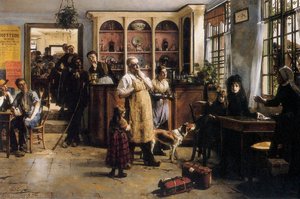
Evariste Carpentier was a Belgian painter known for his historical and genre scenes. His work often featured everyday life, landscapes, and portraits, showcasing his versatility as an artist. Français L'alerte is one of his notable works, demonstrating his ability to capture the drama and intensity of a scene.The Painting's Significance
The painting Français L'alerte is significant not only for its artistic value but also for its historical context. It provides a glimpse into the lives of people during the late 19th century, showcasing their clothing, furniture, and social interactions. The painting's attention to detail and realism make it a valuable resource for art historians and enthusiasts alike. Key Features of the Painting Some notable features of Français L'alerte include:- The use of warm colors to create a sense of comfort and intimacy
- The depiction of everyday life, showcasing the artist's attention to detail
- The emotional intensity of the scene, conveyed through the characters' facial expressions and body language
The painting Français L'alerte by Evariste Carpentier is a captivating work of art that showcases the artist's skill and attention to detail. Its historical significance and emotional intensity make it a valuable addition to any art collection. For more information on the painting and the artist, visit Wikipedia.
Questions & Answers
How is the palette of "Français L'alerte" by Évariste Carpentier described?
"Français L'alerte" by Évariste Carpentier uses an earthy color palette. The palette summarizes the work's overall color character.
Who created "Français L'alerte" and in what year?
Évariste Carpentier made "Français L'alerte" in 1884.
How harmonious are the colors of "Français L'alerte" by Évariste Carpentier?
The color harmony of "Français L'alerte" is recorded as balanced harmony.
Artist Biography
The Evolution of a Belgian Master: Évariste Carpentier
In the grand tapestry of nineteenth-century European art, few threads are as intricately woven as those of Évariste Carpentier. Born in the quiet Belgian town of Korne-le-Sain in 1845, Carpentier’s life and career served as a bridge between two vastly different worlds: the rigid, disciplined structures of Academicism and the luminous, spontaneous freedom of Impressionism. His journey was not merely one of changing styles, but a profound metamorphosis of vision, moving from the meticulous observation of tradition toward an emotive capture of light and atmosphere.
Carpentier’s early years were defined by the rigorous training he received at the École Supérieure des Beaux-Arts in Brussels. During this formative period, his brushwork was characterized by a devotion to technical precision and the classical standards of the Academy. He mastered the art of the genre scene, producing works that were highly detailed and narrative-driven. These early canvases often focused on the quiet, domestic realities of Belgian life, rendered with a level of accuracy that commanded respect but remained tethered to the formal constraints of his education.
A Transformative Encounter with Light
The trajectory of Carpentier’s artistry underwent a seismic shift in 1884, a moment precipitated by his encounter with the pioneering works of Jules Bastien-lepage. This meeting acted as a catalyst, dissolving the boundaries of his academic training and introducing him to the allure of plein air painting. Inspired by Bastien-lepage’s ability to infuse naturalism with a sense of atmospheric vitality, Carpentier began to look beyond the studio walls, seeking the fleeting, ephemeral qualities of the natural world.
This newfound passion led him on an exploratory journey through France, where he immersed himself in the landscapes surrounding Saint-Pierre-lès-Nemours and the legendary Fontainebleau forest. It was here, amidst the dappled sunlight and shifting shadows, that his style truly blossomed into what is often described as Luminism. Alongside contemporaries such as Franz Courtens and Joseph Coosemans, Carpentier began to document the subtle nuances of light, treating the atmosphere itself as a tangible subject. His travels to coastal regions like Le Tréport and Saint-Malo further expanded his palette, allowing him to experiment with the reflective brilliance of maritime light and the soft, misty textures of the seaside.
Legacy and Artistic Significance
The significance of Évariste Carpentier lies in his ability to harmonize the structural integrity of his academic roots with the sensory delights of the Impressionist movement. He did not abandon the narrative depth of his early genre scenes; instead, he infused them with a new, breathing vitality. His works often capture a sense of quiet drama—moments caught in time where the weight of human experience meets the lightness of natural illumination.
Today, Carpentier is remembered as a pivotal figure in the Belgian avant-garde, a painter who successfully navigated the transition from the old world to the new. His contributions to the development of Naturalism and Luminism remain a testament to his courage as an artist—a man willing to abandon the safety of established tradition to chase the ever-changing light of the horizon.

Évariste Carpentier
1845 - 1922 , Belgium
Quick Facts
- Artistic Movement Or Style: Impressionism & Luminism
- Artists Or Movements Influenced By This Artist: Les XX
- Artists Who Influenced This Artist: Jules Bastien-lepage
- Date Of Birth: 1845
- Date Of Death: 1922
- Full Name: Évariste Carpentier
- Nationality: Belgian
- Notable Artworks:
- Untitled (AQR9UA)
- Untitled (AQR9U4)
- Untitled (AQR9WA)
- Place Of Birth: Korne-le-Sain, Belgium