- Home

- Oil Painting Reproduction
- eugene louis lami
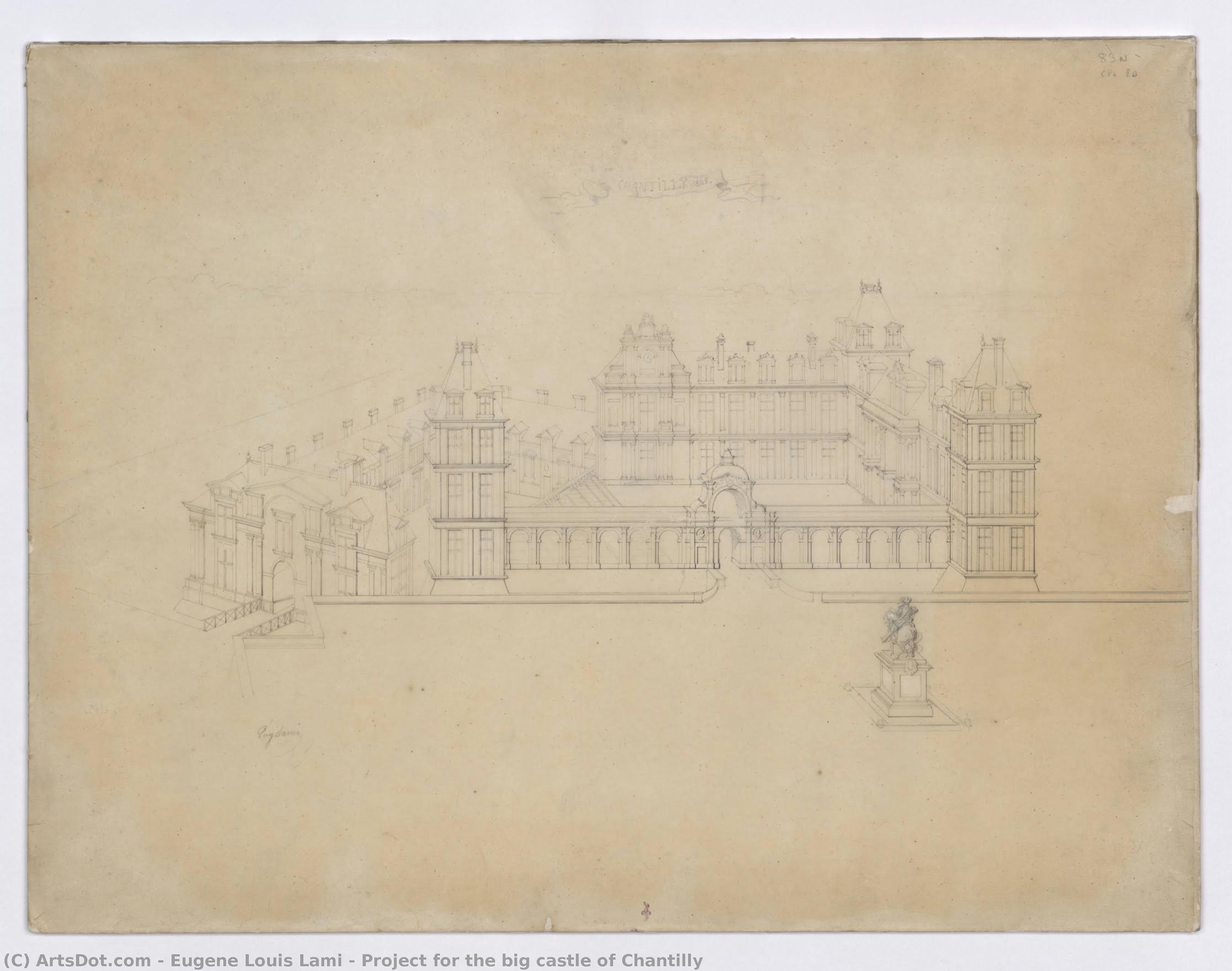
- Project for the big castle of Chantilly
 Buy print
 Send
Send Share
Share
 Details

 Download
 Similars
 X-Ray
X-Ray Diaporama
Project for the big castle of Chantilly
 Neoclassicism
 1848
1848 41.0 x 54.0 cm
 Château de Chantilly
 Read More
Hand Made Oil Reproduction
Hand-painted oil on canvas in your size and frame, made to order by our artists.




P118B $10

P118H $10

P118W $10

P438Z $10

P508JH $12

P508YH $12

P805H $10

P805Z $10

P919BZ $10

P919G $10

P919XJ $10

P959ZH $10

P968JZ $12

W106C $8

W218G $10

W218JH $8

W218Y $10

W307PJ $10

W316G $10

W316PJ $8

W316Y $10

W398PJ $8

W4111J $10

W500HY $15

W500JH $15

W692G $12

W849H $8

W940BG $15

W953PJ $8




Pick from our preset sizes that match the artwork's original proportions.

You may enter your own dimensions to fit a specific frame or space. If your selected size does not match the original image's proportions, we will either crop the artwork or extend the painting with additional hand-painted elements. A digital mockup will be sent for your approval before production begins.
Please note that the on-screen preview does not reflect the actual cropping or extension. Only the mockup will accurately show the final composition.
While custom sizes are available, we recommend selecting a dimension from the predefined list to preserve the original proportions.
After order, OriginalUniqueArt.com team will email client for instructions and provide a mockup preview
Worldwide Delivery () in 3/4 weeks instead of standard 5 weeks. (16 July). No compromise on quality.

Free Worldwide Express Shipping

High-Quality Linen Canvas

Full Shipping Insurance

Customs Tax Refund Guarantee

True Color Matching Guarantee

60-Day Return Policy (Defects Only)

100% Money-Back Guarantee

Bulk Discount Offer
 Glass option is only available in size under 110 CM

Project for the big castle of Chantilly
Reproduction Medium
Reproduction Size
-


Total Price
-
Artwork Description
A Vision of Grandeur: Lami’s Project for the Château de Chantilly
This meticulously rendered architectural drawing offers a fascinating glimpse into the planned magnificence of the Château de Chantilly. Created in 1848 by Eugène Louis Lami, this is not a finished artwork *per se*, but rather a crucial preparatory study – a ‘project’ as the title suggests – revealing the vision for one of France's most iconic châteaux. The work showcases Lami’s skill in draughtsmanship and provides valuable insight into the architectural ambitions of the period. It’s a piece that speaks to both an appreciation for historical design and the artistic process itself, making it ideal for collectors interested in architectural studies or 19th-century French art.Classical Revival & Lami's Artistic Background
The style is firmly rooted in the Classical tradition, evident in the symmetrical composition, balanced proportions, and decorative detailing of the château’s facade. This reflects a broader revival of classical aesthetics during the 19th century, particularly within French architecture. Eugène Louis Lami, though known for his depictions of fashionable Parisian life and historical scenes, was also adept at architectural rendering. His training under Horace Vernet and at the École des Beaux-Arts equipped him with a strong foundation in drawing and design principles. He further honed his skills in watercolor and lithography, techniques that informed his precise line work and tonal control evident here. Lami’s ability to seamlessly blend artistic flair with technical accuracy is what makes this study so compelling.Technique & Materiality
Executed on paper using graphite pencil, the drawing relies entirely on a monochromatic palette of greys. The artist masterfully employs hatching and cross-hatching to create texture, depth, and a sense of volume. This technique allows for subtle gradations of tone, suggesting light and shadow without relying on color. The linear perspective is expertly constructed, with lines converging towards a vanishing point, accurately conveying the scale and spatial relationships within the composition. It’s a testament to Lami's skill that he can evoke such a sense of grandeur and solidity using only graphite – a reminder of the power of draughtsmanship. The size (41 x 54 cm) is substantial enough to allow for detailed observation, yet manageable for display in a variety of settings.Beyond Representation: A Window into History
While seemingly objective in its representation, this drawing offers more than just an architectural plan. It embodies the aspirations and cultural values of 19th-century France – a period marked by restoration, romanticism, and a renewed interest in national heritage. The Château de Chantilly itself is steeped in history, having evolved over centuries. Lami’s ‘project’ represents a specific moment in that evolution, capturing a vision for its continued grandeur. For interior designers, this artwork provides a sophisticated touch of historical elegance, suitable for both traditional and contemporary spaces. A high-quality reproduction would serve as a striking focal point, adding depth and intellectual curiosity to any room.Artist Biography
Eugène Louis Lami: A Romantic Painter of Parisian Life and Military Glory
Eugène Louis Lami (1800 – 1890) stands as a prominent figure in French art history, particularly during the Romantic era and the Second Empire. Born in Paris, he honed his artistic skills under the tutelage of celebrated masters like Horace Vernet and Camille Roqueplan, establishing himself as a versatile artist adept at watercolor painting, lithography, illustration, and decorative design. His career spanned decades, marked by collaborations with luminaries of the time and enduring recognition for capturing both the elegance of Parisian society and the grandeur of military campaigns.- Early Training & Influences: Lami’s formative years were spent studying at the École des Beaux-Arts in Paris, where he absorbed techniques from Richard Parkes Bonington—a pioneer of watercolor realism—and gained invaluable experience under Antoine-Jean Gros, whose monumental history paintings profoundly impacted his artistic vision. Gros instilled a dedication to dramatic storytelling and meticulous detail, shaping Lami’s approach to portraying historical events with palpable emotion.
- Watercolor Mastery & Societal Portraiture: Lami quickly distinguished himself as a watercolorist, achieving considerable acclaim for his depictions of Parisian life—scenes of fashionable gatherings and aristocratic residences—often infused with subtle Romantic idealism. Notable amongst these are “Entry to a Drawing Room at Marlborough House” (1871), currently housed in Princeton University Art Museum, showcasing his ability to convey atmosphere and psychological nuance through delicate brushstrokes.
- Military Commissions & Lithographic Innovation: Recognizing the burgeoning interest in military subjects, Lami embraced lithography, producing groundbreaking sets of prints documenting the Spanish Cavalry (1819) and commemorating the Franco-British alliance during the Napoleonic Wars ("Collections des Uniformes des Armées Françaises de 1791 à 1814"). These projects solidified his reputation as a skilled military artist and propelled him to prominence.
- Iconic Paintings & Royal Patronage: Lami’s artistic achievements culminated in commissions from the French monarchy, notably “Portrait of Louise Marie Adélaïde de Bourbon-Penthièvre” (1840), residing in the Louvre—a testament to his ability to capture regal dignity and grace. Perhaps his most celebrated work is "Grenadier of the Royal Guard" (circa 1817), now held at Princeton University Art Museum, reflecting the artistic fervor of the Restoration period. Furthermore, “The Storming of Redoubt #10” (1829) depicting the decisive Battle of Yorktown, was purchased by Louis-Philippe I and displayed prominently in the French National Assembly from 1848 to 1969—a symbol of national pride during a turbulent era.
- Legacy & Recognition: Eugène Lami’s artistic legacy extends beyond his individual paintings; he served as a founding member of the Société des Aquarellistes Français, furthering the development of watercolor technique and establishing himself as a respected voice within the Parisian art community. His enduring fame rests on his masterful renderings of historical narratives—particularly military campaigns—and his ability to convey emotion with remarkable sensitivity. Today, “Louvre” and “Louisiana State Museum at Cabildo” proudly display his masterpieces, ensuring that Lami’s contribution to French Romanticism continues to inspire admiration and scholarly study.

eugene louis lami
1800 - 1890 , France
Quick Facts
- Artistic Movement Or Style: Romanticism
- Artists Or Movements Influenced By This Artist: ['Romanticism']
- Artists Who Influenced This Artist:
- Horace Vernet
- Richard Parkes Bonington
- Date Of Birth: 1800
- Date Of Death: 1890
- Full Name: Eugène Louis Lami
- Nationality: French
- Notable Artworks:
- Bataille de Wattignies
- Siege d'Anvers
- Project for the big castle of Chantilly
- Place Of Birth: France (Paris)
Related Articles
Eugène Lami: A Study in Academic Eclecticism & the Rise of 19th-Century Decorative Art
Explore the captivating world of Eugène Lami, a pivotal 19th-century French painter. Discover his eclectic style blending Romanticism & Academic traditions in history, fashion, and literary illustrations. Learn about his legacy today!

Academic Classicism: A Revival of Form & Narrative in 19th-Century Art
Explore the revival of Academic Classicism in 19th-century art. Discover key artists like David & Duplessis, the influence of the French Académie, and its lasting legacy. Expert insights for collectors & enthusiasts.

Academic Art: Tradition, Technique & the Pursuit of Ideal Form in the 19th Century
Explore the world of Academic Art! Discover its history, key artists like Ingres & Bouguereau, defining techniques, and lasting influence on 19th-century painting. Learn about the Salon system and its legacy.
Eugen von Blaas: Capturing Alpine Life & Sentiment in 19th-Century Austrian Painting
Discover the captivating world of Eugen von Blaas! Explore his exquisite 19th-century paintings capturing Venetian life & Alpine beauty. Learn about his Academic Classicism style and find museum-quality reproductions at OriginalUniqueArt.
Eugène Carrière: The 'Peintre d'Âme' & Symbolist Portraiture’s Intimate Vision
Explore the haunting world of Eugène Carrière, a pivotal French Symbolist artist known for his deeply intimate portraits & 'peinture d'âme'. Discover his life, style, and lasting influence on modern masters like Picasso. Shop high-quality reproductions at OriginalUniqueArt.



