Art Deco
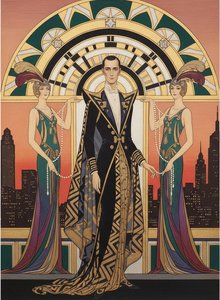
Applause (Erté)
Erté (1892–1990) made Applause. It belongs to the Art Deco movement.

 Preview

 Hand Made Oil Painting
 Send
 Share
 Fact sheet


 Download
 Similars
 X-Ray
 Diaporama
 Q&A

 Stats
Applause, in brief
High-resolution images of Applause

Protected by copyright: these files are for personal reference, not a licence to republish.
Erté, Applause.
Questions on Applause, answered
What is "Applause" about?
Can the image of "Applause" by Erté be freely reproduced?
Who created "Applause"?
What art movement does "Applause" by Erté belong to?
About the artist, Erté

1892–1990, Russia
Erté
Early Life and Artistic Awakening Romain de Tirtoff, known to the world as Erté, was born into a life of privilege and tradition in Saint Petersburg, Russia, on November 23, 1892. His lineage traced back centuries to Tatar khans, and his father served with distinction as an admiral in the Imperial Russian Fleet. Yet, young Romain’s destiny lay not on the waves but within the realm of art—a passion that blossomed early, nurtured by a mother he deeply adored and the exotic beauty of Persian miniatures found within his father's library. These intricate designs would become a subtle yet enduring influence on his later work, imbuing it with a sense of opulent detail and stylized elegance.
Also by Erté
 Evening Night
 Little Slave
 At the Theatre, Trapeze
 Fantasia
Essays around Applause
 Erté & Art Deco: The Glamorous Line Work of a Fashion IconStep into the shimmering world of Erté and Art Deco. Discover how Romain de Tirtoff redefined luxury through geometric mastery and fashion …
 Erté: The Art Deco Visionary Who Defined Modern GlamourExplore the glamorous world of Erté, the 'Father of Art Deco'. Discover his iconic fashion illustrations, stunning sculptures & enduring le…
 From Concept to Canvas: An Exploration of Emotional Sketching in Art Reproduction & Commission ProcessesExplore the art of emotional expression & bespoke creation. Commission museum-quality paintings or find unique reproductions crafted by ski…