Text size

() ·

A painting made for you, by hand

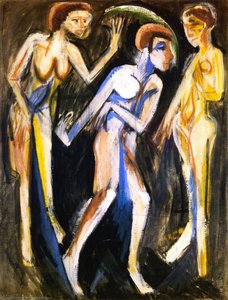
Street, Dresden

Hand Made Oil Reproduction

Hand-painted oil on canvas in your size and frame, made to order by our artists. ( Switch to Print Switch to Digital Image)

Collectible Description

Experience Ernst Ludwig Kirchner's "Street, Dresden" (1908). A vibrant depiction of urban life, capturing the energy and alienation of early 20th-century cityscapes through bold colors & expressive brushstrokes. Hand-painted reproduction available.

Artist Biography

Ernst Ludwig Kirchner (1880-1938): A leading German Expressionist & Die Brücke founder. Explore his bold, emotive paintings of urban life, nudes, and landscapes – a powerful voice of early 20th-century art.

from ·

Chapter 1

How large should it be?

Slide to change the size; the picture on the left shows the frame at its real width. The proportions of the original are kept.

Standard
custom
CM
INCH

Pick from our preset sizes that match the artwork's original proportions.

width
height

Type the width and the height you need, to fit your frame or your wall. This is hand-painted, so for a size with a different shape the artist can paint a bit more around the picture, or cut a bit — you choose. We send you a digital mockup to approve before the painting starts. The picture shown on this page does not show the real result — only the mockup does.

Chapter 2

How should it arrive?

Choose the edges of the stretched canvas

Choose your frame

Corner sample of the WhiteWrap canvas edge finish, stretched on solid wood bars
White $1
Corner sample of the BlurSideWrap canvas edge finish, stretched on solid wood bars
Blurside $1
Corner sample of the ExtendedWrap canvas edge finish, stretched on solid wood bars
Extended $1
Corner sample of the P118B picture frame: moulded polystyrene, 5 cm wide and 3 cm thick
P118B $10
Corner sample of the P118H picture frame: moulded polystyrene, 5 cm wide and 3 cm thick
P118H $10
Corner sample of the P118W picture frame: moulded polystyrene, 5 cm wide and 3 cm thick
P118W $10
Corner sample of the P438Z picture frame: moulded polystyrene, 5.5 cm wide and 3.5 cm thick
P438Z $10
Corner sample of the P508JH picture frame: moulded polystyrene, 7 cm wide and 3.5 cm thick
P508JH $12
Corner sample of the P508YH picture frame: moulded polystyrene, 7 cm wide and 3.5 cm thick
P508YH $12
Corner sample of the P805H picture frame: moulded polystyrene, 5 cm wide and 3.5 cm thick
P805H $10
Corner sample of the P805Z picture frame: moulded polystyrene, 5 cm wide and 3.5 cm thick
P805Z $10
Corner sample of the P919BZ picture frame: moulded polystyrene, 7 cm wide and 3.5 cm thick
P919BZ $10
Corner sample of the P919G picture frame: moulded polystyrene, 7 cm wide and 3.5 cm thick
P919G $10
Corner sample of the P919XJ picture frame: moulded polystyrene, 7 cm wide and 3.5 cm thick
P919XJ $10
Corner sample of the P959ZH picture frame: moulded polystyrene, 5 cm wide and 3 cm thick
P959ZH $10
Corner sample of the P968JZ picture frame: moulded polystyrene, 6 cm wide and 4 cm thick
P968JZ $12
Corner sample of the W106C picture frame: solid wood, 5 cm wide and 3 cm thick
W106C $8
Corner sample of the W218G picture frame: solid wood, 5 cm wide and 3 cm thick
W218G $10
Corner sample of the W218JH picture frame: solid wood, 5 cm wide and 3 cm thick
W218JH $8
Corner sample of the W218Y picture frame: solid wood, 5 cm wide and 3 cm thick
W218Y $10
Corner sample of the W307PJ picture frame: solid wood, 6 cm wide and 3 cm thick
W307PJ $10
Corner sample of the W316G picture frame: solid wood, 6 cm wide and 3 cm thick
W316G $10
Corner sample of the W316PJ picture frame: solid wood, 6 cm wide and 3 cm thick
W316PJ $8
Corner sample of the W316Y picture frame: solid wood, 6 cm wide and 3 cm thick
W316Y $10
Corner sample of the W398PJ picture frame: solid wood, 5 cm wide and 3 cm thick
W398PJ $8
Corner sample of the W4111J picture frame: solid wood, 6.5 cm wide and 3.5 cm thick
W4111J $10
Corner sample of the W500HY picture frame: solid wood, 7 cm wide and 5 cm thick
W500HY $15
Corner sample of the W500JH picture frame: solid wood, 7 cm wide and 5 cm thick
W500JH $15
Corner sample of the W692G picture frame: solid wood, 8 cm wide and 4 cm thick
W692G $12
Corner sample of the W849H picture frame: solid wood, 5 cm wide and 3 cm thick
W849H $8
Corner sample of the W940BG picture frame: solid wood, 7.5 cm wide and 4.5 cm thick
W940BG $15
Corner sample of the W953PJ picture frame: solid wood, 6 cm wide and 3.5 cm thick
W953PJ $8
Corner sample of the H24-GOLD picture frame: carved wood with gesso, 10 cm wide and 6 cm thick
H24-GOLD $30
Corner sample of the H24-SILVER picture frame: carved wood with gesso, 10 cm wide and 6 cm thick
H24-SILVER $30
Corner sample of the H36-GOLD picture frame: carved wood with gesso, 15 cm wide and 6.5 cm thick
H36-GOLD $45
Corner sample of the H36-SILVER picture frame: carved wood with gesso, 15 cm wide and 6.5 cm thick
H36-SILVER $45
Frame preview
Framed

Moulding: . Overall size with the frame: .

Chapter 3

Who paints it, and should anything change?

Examples of what can be changed: Replace face with customer photo; Add pet (e.g., replace cat with dog); Include hidden message in background; Change background landscape or elements.
After order, OriginalUniqueArt.com team will email client for instructions and provide a mockup preview

Worldwide Delivery () in 3/4 weeks instead of standard 5 weeks. (7 November). No compromise on quality.

Chapter 4

The finishing touches

A nameplate, as in a museum?

Engraved Bronze Plaque Details

This elegant plaque features the artist's name and the title of the artwork, finely engraved for a timeless presentation.

It is made from bronze with a refined, elegant finish. The text is precisely laser-engraved for a sharp and permanent result. Measuring 9x2 cm, the plaque is compact yet easy to read. It's built to be durable and scratch-resistant, offering a professional, museum-quality look. Mounting is simple thanks to the included adhesive backing.

Transparent Acrylic Plaque Details

The plaque includes essential engraved details such as the artist's name, the title of the artwork, the date it was created, the type of media used-like oil on canvas or watercolor-a brief description of the piece, and a QR code that links to the complete artwork information.

It is crafted from clear acrylic, offering a sleek, modern appearance. The text is UV-engraved in black to ensure strong visual contrast. With a size of 10x15 cm, it ensures optimal readability. It comes equipped with two metal hooks for secure wall mounting. The plaque is designed to be weather-resistant, making it suitable for various environments, and it includes interactive features that work seamlessly with smartphone scanning.

Black Acrylic Plaque Details

This elegant plaque includes engraved information such as the artist's name, the title of the artwork, the date it was created, the type of media used (like oil on canvas or watercolor), a short description of the artwork, and a QR code for quick access to more information.

The plaque itself is made from refined black acrylic with a premium finish. The text is laser-engraved in white for high contrast and readability. Its size is 10x15 cm, designed to be easy to read. It comes with two metal hooks for professional mounting. The design is sleek and fits any interior style. It is also weather-resistant and durable, with built-in digital integration for mobile compatibility.

A protective varnish?

When do you need it?

Chapter 5

Your painting, as you ordered it

Street, Dresden

Reproduction Medium

Reproduction Size

-

Elite Senior Artist

More detail, finesse, and extra production time

-

Reproduction Frame

-

-

For artworks or reproductions larger than 105 cm (approximately 41 inches) on any side, the frame will be shipped as a kit, disassembled. This method ensures safe delivery and prevents damage during transport.

Professional assembly required - this is not a DIY product.
The kit must be assembled and the canvas stretched by an experienced professional framer, using wood glue (not supplied), a canvas stretching plier and clamps to hold the bars square while the glue dries. Incorrect assembly or uneven canvas tension can permanently damage the artwork and is not covered by our warranty.

  • All solid wood bars are included, precisely cut to size.

  • Assembled with the screws provided, plus wood glue for the corner joints, which is not supplied and must be sourced by your framer.

  • Professional tools are required and not included: a canvas stretching plier (tensioner) and clamps to hold the bars square while the glue dries.

Important:
The corner joints require wood glue, the bars must be held with clamps until the glue is fully dry, and tightening the canvas on the assembled frame requires a canvas stretching plier. None of these are included in the kit. Please arrange an experienced professional framer before ordering this size.

Nameplate

-

-

Protective Varnish

Glossy Varnish (enhances colors, protects against light/moisture)

-

Customize My Artwork

Examples of what can be changed: Replace face with customer photo; Add pet (e.g., replace cat with dog); Include hidden message in background; Change background landscape or elements.

-

Urgent

Worldwide Delivery () in 3/4 weeks instead of standard 5 weeks. (7 November). No compromise on quality.

-

Express Shipping

Worldwide Delivery () in 5 weeks. (14 November).

Included

Total Price

$ 300

Total Price $ 300

Glass option is only available in size under 110 CM

Included with every order

  • Free Worldwide Express Shipping
  • High-Quality Linen Canvas
  • Full Shipping Insurance
  • Customs Tax Refund Guarantee
  • True Color Matching Guarantee
  • 100-Day Return Policy (Defects Only)
  • 100% Money-Back Guarantee
  • Bulk Discount Offer

A Fragmented Urban Dream: Ernst Ludwig Kirchner’s “Street, Dresden”

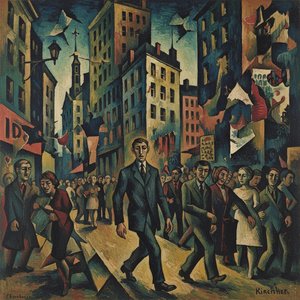
Ernst Ludwig Kirchner's "Street, Dresden," painted in 1908 and later reworked in 1919, isn’t merely a depiction of a city street; it’s a visceral exploration of modern anxiety and the alienation inherent within rapidly changing urban landscapes. This large oil on canvas, measuring 150 x 200 cm, pulsates with an unsettling energy—a feeling that immediately draws the viewer into its chaotic heart. Kirchner, a pivotal figure in the German Expressionist movement, masterfully captures not just the visual reality of Dresden’s Königstrasse but also the psychological state of those who navigated its crowded thoroughfares.

The painting's style is undeniably expressive, moving far beyond traditional academic realism. Kirchner employs bold, flattened forms and jarring color combinations—a deliberate rejection of the naturalistic palette favored by earlier generations. The pinks, oranges, blues, and greens clash dramatically, creating a sense of unease and disorientation. Brushstrokes are loose and agitated, conveying movement and a feeling of urgency. This technique wasn’t simply aesthetic; it was a conscious effort to translate inner turmoil onto the canvas, mirroring the anxieties prevalent in Germany at the turn of the century – a nation grappling with industrialization, social upheaval, and a growing sense of displacement.

The Faces of Modernity

Kirchner’s figures are not individuals; they are fragments, masks representing the anonymous masses swept along by the currents of urban life. Each face is rendered with stark simplicity – often reduced to geometric shapes and simplified features—suggesting a loss of identity within the crowd. The woman in the center, clutching her purse, stares blankly ahead, while others turn away, their backs to the viewer, embodying a profound sense of isolation. Even the little girl, seemingly the most vulnerable figure, is dwarfed by her oversized hat, further emphasizing her detachment and insignificance. The artist deliberately avoids portraying individual personalities, instead focusing on the collective experience of being adrift in a bustling city.

Interestingly, Kirchner’s own letters reveal his personal struggle with loneliness during this period. He described feeling overwhelmed by the faces he encountered, noting that “Completely strange faces pop up as interesting points through the crowd. I am carried along with the current, lacking will.” This internal experience is powerfully translated into the painting's composition and color palette – a visual representation of his own sense of alienation.

A Bridge to Expressionism

“Street, Dresden” exemplifies the core tenets of German Expressionism. The movement sought to express subjective emotions and experiences rather than objective reality. Kirchner’s use of distorted forms, exaggerated colors, and fragmented compositions directly reflects this philosophy. The painting can be seen as a bridge between the anxieties of late 19th-century realism and the emotionally charged landscapes of early 20th-century Expressionism. It's a pivotal work in understanding the movement’s exploration of urban alienation and psychological distress.

Furthermore, Kirchner’s decision to rework the painting in 1919 demonstrates his ongoing engagement with the subject matter. The subtle changes—particularly in the color palette and the arrangement of figures—suggest a deepening of his artistic vision and a continued attempt to capture the complexities of modern urban life. The work's presence in museums like the Kirchner Museum Davos underscores its enduring significance within Expressionist art history.

Bringing “Street, Dresden” into Your Space

A hand-painted reproduction of "Street, Dresden" offers a remarkable opportunity to bring this powerful and evocative artwork into your home or office. OriginalUniqueArt’s meticulous reproductions capture the painting's vibrant colors, dynamic brushstrokes, and emotional intensity with exceptional detail. Whether you are an art collector, an interior designer seeking to create a thought-provoking atmosphere, or simply someone drawn to Kirchner’s unique vision, this reproduction provides a stunning and authentic representation of a seminal work in modern art history.

Questions & Answers

Is "Street, Dresden" by Ernst Ludwig Kirchner a light or a dark artwork?

"Street, Dresden" is shadow overall, and its luminance is soft shadow.

Is Ernst Ludwig Kirchner, creator of "Street, Dresden", known under other names?

Other names recorded for Ernst Ludwig Kirchner, creator of "Street, Dresden", include Kirchner, E.L. Kirchner.

What technique was used for "Street, Dresden", and when was it created?

The medium of "Street, Dresden" by Ernst Ludwig Kirchner is acrylic on canvas, and the work is dated 1908.

More about this painting

Preview AR preview Switch to Print Switch to Digital Image Send
Details Guide Add to favorites Download Similars X-Ray Diaporama Q&A Stats

In numbers

  • 1908the year it was painted
  • 29frames to choose from
  • standard sizes, in its own proportions
  • 5weeks to paint and deliver it
Ernst Ludwig Kirchner

Ernst Ludwig Kirchner

1880 - 1938, Germany

Quick facts about Ernst Ludwig Kirchner

  • Full Name: Ernst Ludwig Kirchner
  • Nationality: German
  • Date Of Birth: 1880
  • Date Of Death: 1938
  • Place Of Birth: Aschaffenburg, Germany
  • Notable Artworks:
    • The Street (1908)
    • Leaping Dancer (1912)
    • Self-Portrait (1910)
    • Five Women (1913)
  • Artistic Movement Or Style: Expressionism
  • Artists Who Influenced This Artist:
    • Albrecht Dürer
    • Van Gogh
    • Edvard Munch
  • Artists Or Movements Influenced By This Artist:
    • Expressionism
    • Modern artists

Artist Biography

A Life Forged in Expression: The World of Ernst Ludwig Kirchner

Ernst Ludwig Kirchner, a name synonymous with the raw emotional power of German Expressionism, was born into a world poised on the brink of dramatic change. His arrival in Aschaffenburg, Bavaria, in 1880, marked the beginning of a life deeply intertwined with artistic innovation and personal turmoil. The shifting landscapes of his childhood – dictated by his father’s profession – instilled within him a sense of displacement that would later permeate his art. From Frankfurt to Perlen, and finally settling in Chemnitz, young Kirchner absorbed the burgeoning anxieties of a rapidly modernizing Germany. Though initially steered towards architecture at the Königliche Technische Hochschule in Dresden, it was the pull of painting, fueled by an admiration for masters like Albrecht Dürer and a growing dissatisfaction with academic convention, that ultimately defined his path. He found kinship with fellow rebels – Fritz Bleyl, Karl Schmidt-Rottluff, and Erich Heckel – forging bonds that would irrevocably alter the course of 20th-century art.

The Bridge Between Worlds: Die Brücke and Artistic Revolution

In 1905, Kirchner became a founding member of *Die Brücke* (“The Bridge”), an artistic collective dedicated to bridging the gap between traditional aesthetics and a more visceral, emotionally charged form of expression. This wasn’t merely a stylistic choice; it was a philosophical stance. The group sought inspiration in sources often overlooked by the established art world – primitive art from Africa and Oceania, the bold colors of Vincent van Gogh, and the haunting psychological depth of Edvard Munch. They rejected the idealized representations of beauty favored by academic painting, instead embracing distortion, jarring color palettes, and expressive brushwork to convey the anxieties and alienation of modern life. Kirchner’s early works, born from this collaborative spirit, pulsed with a restless energy, reflecting the group's shared desire to break free from artistic constraints. The studio became a crucible for experimentation, a space where social norms were challenged alongside artistic conventions. The exploration of the human form, particularly the female nude, within both urban and natural settings, became a recurring motif, allowing Kirchner to investigate movement, emotion, and the complexities of modern existence.

Urban Anxieties and Bold Visions: Defining a Style

Kirchner’s artistic style is immediately recognizable for its distinctive characteristics. He wielded color not as a means of faithful representation, but as a tool to evoke emotional responses – vibrant, often non-naturalistic hues that heightened the sense of unease or intensity within his compositions. His brushstrokes were energetic and visible, contributing to the overall feeling of immediacy and raw emotion. Figures and objects were frequently distorted or elongated, reflecting a subjective rather than objective reality. Perhaps most powerfully, Kirchner captured the psychological impact of modern urban life in early 20th-century Germany. Paintings like *The Street* (1908) are not simply depictions of city scenes; they are portraits of alienation, capturing the frenetic energy and emotional detachment of a rapidly changing world. He didn’t shy away from portraying the darker aspects of modernity – the loneliness, the anonymity, the sense of being overwhelmed by the sheer scale of urban existence. This unflinching gaze established him as a chronicler of his time, an artist who dared to confront the anxieties simmering beneath the surface of societal progress.

Tragedy and Legacy: A Lasting Impact

Kirchner’s life was tragically marked by personal struggles. The horrors of World War I triggered a severe mental breakdown, forcing him to retreat to Switzerland in search of solace. However, even in exile, he continued to create, his work reflecting the lingering trauma and isolation he experienced. The rise of Nazism brought further hardship; over 600 of his works were confiscated and branded as “degenerate” art – a devastating blow that underscored the political climate’s hostility towards modern artistic expression. Facing persecution and declining health, Kirchner tragically took his own life in Davos, Switzerland, in 1938. Despite this heartbreaking end, Ernst Ludwig Kirchner's legacy remains profoundly influential. He stands as a central figure of German Expressionism, inspiring generations of artists with his bold style, emotionally resonant depictions of modern life, and unwavering commitment to artistic truth. His work continues to be exhibited in major museums worldwide, serving as a powerful reminder of the enduring power of art to confront, challenge, and ultimately illuminate the human condition.
  • Influenced By: Albrecht Dürer, Vincent van Gogh, Edvard Munch, Primitive Art (African & Oceanic)
  • Influenced: Kirchner’s work profoundly impacted subsequent generations of Expressionist and Modern artists. His exploration of psychological themes and his innovative use of color and form continue to inspire contemporary art practices.
Current Meta Description: Ernst Ludwig Kirchner (1880-1938): Key German Expressionist & Die Brücke co-founder. Explore bold, emotive paintings of urban life, nudes & landscapes. Current Meta Keywords: Ernst Ludwig Kirchner, Kirchner paintings, German Expressionism, Die Brücke, Expressionist art, Berlin street scenes, Woodcut prints, Modern German art, Nude figures, Kirchner artwork

Quick Facts

  • Subject or theme: City life
  • Notable elements: Masklike faces
  • Artist: Ernst Ludwig Kirchner
  • Title: Street, Dresden
  • Artistic style: Urban anxiety
  • Dimensions: 150 x 200 cm

Art Quiz

There is only one correct answer for each question.

Question 1:
What is the primary subject matter depicted in Ernst Ludwig Kirchner’s ‘Street, Dresden’?
Question 2:
Kirchner’s use of bold, clashing colors in ‘Street, Dresden’ is most likely intended to convey:
Question 3:
Which art movement is Ernst Ludwig Kirchner most closely associated with?
Question 4:
The painting ‘Street, Dresden’ was created in which year?
Question 5:
What does the crowded and somewhat chaotic arrangement of figures in ‘Street, Dresden’ suggest about Kirchner's perspective on urban life?