Text size

() ·

A painting made for you, by hand

Latin Grammar digitization

Hand Made Oil Reproduction

Hand-painted oil on canvas in your size and frame, made to order by our artists. ( Switch to Print Switch to Digital Image)

Collectible Description

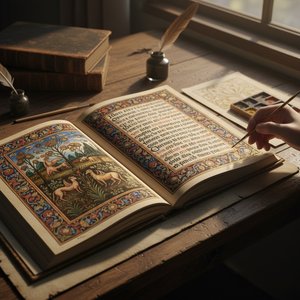
Magnificent Gothic illumination page from the 15th century! Vibrant blue & gold foliation showcases Latin script in a stunning manuscript. Explore this unique art piece – a glimpse into medieval artistry.

Artist Biography

Elio Antonio de Nebrija (1444-1522): Pioneer of Spanish linguistics & author of the first Castilian grammar. His work shaped Spain's literary traditions and influenced European scholarship.

from ·

Chapter 1

How large should it be?

Slide to change the size; the picture on the left shows the frame at its real width. The proportions of the original are kept.

Standard
custom
CM
INCH

Pick from our preset sizes that match the artwork's original proportions.

width
height

Type the width and the height you need, to fit your frame or your wall. This is hand-painted, so for a size with a different shape the artist can paint a bit more around the picture, or cut a bit — you choose. We send you a digital mockup to approve before the painting starts. The picture shown on this page does not show the real result — only the mockup does.

Chapter 2

How should it arrive?

Choose the edges of the stretched canvas

Choose your frame

Corner sample of the WhiteWrap canvas edge finish, stretched on solid wood bars
White $1
Corner sample of the BlurSideWrap canvas edge finish, stretched on solid wood bars
Blurside $1
Corner sample of the ExtendedWrap canvas edge finish, stretched on solid wood bars
Extended $1
Corner sample of the P118B picture frame: moulded polystyrene, 5 cm wide and 3 cm thick
P118B $10
Corner sample of the P118H picture frame: moulded polystyrene, 5 cm wide and 3 cm thick
P118H $10
Corner sample of the P118W picture frame: moulded polystyrene, 5 cm wide and 3 cm thick
P118W $10
Corner sample of the P438Z picture frame: moulded polystyrene, 5.5 cm wide and 3.5 cm thick
P438Z $10
Corner sample of the P508JH picture frame: moulded polystyrene, 7 cm wide and 3.5 cm thick
P508JH $12
Corner sample of the P508YH picture frame: moulded polystyrene, 7 cm wide and 3.5 cm thick
P508YH $12
Corner sample of the P805H picture frame: moulded polystyrene, 5 cm wide and 3.5 cm thick
P805H $10
Corner sample of the P805Z picture frame: moulded polystyrene, 5 cm wide and 3.5 cm thick
P805Z $10
Corner sample of the P919BZ picture frame: moulded polystyrene, 7 cm wide and 3.5 cm thick
P919BZ $10
Corner sample of the P919G picture frame: moulded polystyrene, 7 cm wide and 3.5 cm thick
P919G $10
Corner sample of the P919XJ picture frame: moulded polystyrene, 7 cm wide and 3.5 cm thick
P919XJ $10
Corner sample of the P959ZH picture frame: moulded polystyrene, 5 cm wide and 3 cm thick
P959ZH $10
Corner sample of the P968JZ picture frame: moulded polystyrene, 6 cm wide and 4 cm thick
P968JZ $12
Corner sample of the W106C picture frame: solid wood, 5 cm wide and 3 cm thick
W106C $8
Corner sample of the W218G picture frame: solid wood, 5 cm wide and 3 cm thick
W218G $10
Corner sample of the W218JH picture frame: solid wood, 5 cm wide and 3 cm thick
W218JH $8
Corner sample of the W218Y picture frame: solid wood, 5 cm wide and 3 cm thick
W218Y $10
Corner sample of the W307PJ picture frame: solid wood, 6 cm wide and 3 cm thick
W307PJ $10
Corner sample of the W316G picture frame: solid wood, 6 cm wide and 3 cm thick
W316G $10
Corner sample of the W316PJ picture frame: solid wood, 6 cm wide and 3 cm thick
W316PJ $8
Corner sample of the W316Y picture frame: solid wood, 6 cm wide and 3 cm thick
W316Y $10
Corner sample of the W398PJ picture frame: solid wood, 5 cm wide and 3 cm thick
W398PJ $8
Corner sample of the W4111J picture frame: solid wood, 6.5 cm wide and 3.5 cm thick
W4111J $10
Corner sample of the W500HY picture frame: solid wood, 7 cm wide and 5 cm thick
W500HY $15
Corner sample of the W500JH picture frame: solid wood, 7 cm wide and 5 cm thick
W500JH $15
Corner sample of the W692G picture frame: solid wood, 8 cm wide and 4 cm thick
W692G $12
Corner sample of the W849H picture frame: solid wood, 5 cm wide and 3 cm thick
W849H $8
Corner sample of the W940BG picture frame: solid wood, 7.5 cm wide and 4.5 cm thick
W940BG $15
Corner sample of the W953PJ picture frame: solid wood, 6 cm wide and 3.5 cm thick
W953PJ $8
Corner sample of the H24-GOLD picture frame: carved wood with gesso, 10 cm wide and 6 cm thick
H24-GOLD $30
Corner sample of the H24-SILVER picture frame: carved wood with gesso, 10 cm wide and 6 cm thick
H24-SILVER $30
Corner sample of the H36-GOLD picture frame: carved wood with gesso, 15 cm wide and 6.5 cm thick
H36-GOLD $45
Corner sample of the H36-SILVER picture frame: carved wood with gesso, 15 cm wide and 6.5 cm thick
H36-SILVER $45
Frame preview
Framed

Moulding: . Overall size with the frame: .

Chapter 3

Who paints it, and should anything change?

Examples of what can be changed: Replace face with customer photo; Add pet (e.g., replace cat with dog); Include hidden message in background; Change background landscape or elements.
After order, OriginalUniqueArt.com team will email client for instructions and provide a mockup preview

Worldwide Delivery () in 3/4 weeks instead of standard 5 weeks. (1 November). No compromise on quality.

Chapter 4

The finishing touches

A nameplate, as in a museum?

Engraved Bronze Plaque Details

This elegant plaque features the artist's name and the title of the artwork, finely engraved for a timeless presentation.

It is made from bronze with a refined, elegant finish. The text is precisely laser-engraved for a sharp and permanent result. Measuring 9x2 cm, the plaque is compact yet easy to read. It's built to be durable and scratch-resistant, offering a professional, museum-quality look. Mounting is simple thanks to the included adhesive backing.

Transparent Acrylic Plaque Details

The plaque includes essential engraved details such as the artist's name, the title of the artwork, the date it was created, the type of media used-like oil on canvas or watercolor-a brief description of the piece, and a QR code that links to the complete artwork information.

It is crafted from clear acrylic, offering a sleek, modern appearance. The text is UV-engraved in black to ensure strong visual contrast. With a size of 10x15 cm, it ensures optimal readability. It comes equipped with two metal hooks for secure wall mounting. The plaque is designed to be weather-resistant, making it suitable for various environments, and it includes interactive features that work seamlessly with smartphone scanning.

Black Acrylic Plaque Details

This elegant plaque includes engraved information such as the artist's name, the title of the artwork, the date it was created, the type of media used (like oil on canvas or watercolor), a short description of the artwork, and a QR code for quick access to more information.

The plaque itself is made from refined black acrylic with a premium finish. The text is laser-engraved in white for high contrast and readability. Its size is 10x15 cm, designed to be easy to read. It comes with two metal hooks for professional mounting. The design is sleek and fits any interior style. It is also weather-resistant and durable, with built-in digital integration for mobile compatibility.

A protective varnish?

When do you need it?

Chapter 5

Your painting, as you ordered it

Latin Grammar digitization

Reproduction Medium

Reproduction Size

-

Elite Senior Artist

More detail, finesse, and extra production time

-

Reproduction Frame

-

-

For artworks or reproductions larger than 105 cm (approximately 41 inches) on any side, the frame will be shipped as a kit, disassembled. This method ensures safe delivery and prevents damage during transport.

Professional assembly required - this is not a DIY product.
The kit must be assembled and the canvas stretched by an experienced professional framer, using wood glue (not supplied), a canvas stretching plier and clamps to hold the bars square while the glue dries. Incorrect assembly or uneven canvas tension can permanently damage the artwork and is not covered by our warranty.

  • All solid wood bars are included, precisely cut to size.

  • Assembled with the screws provided, plus wood glue for the corner joints, which is not supplied and must be sourced by your framer.

  • Professional tools are required and not included: a canvas stretching plier (tensioner) and clamps to hold the bars square while the glue dries.

Important:
The corner joints require wood glue, the bars must be held with clamps until the glue is fully dry, and tightening the canvas on the assembled frame requires a canvas stretching plier. None of these are included in the kit. Please arrange an experienced professional framer before ordering this size.

Nameplate

-

-

Protective Varnish

Glossy Varnish (enhances colors, protects against light/moisture)

-

Customize My Artwork

Examples of what can be changed: Replace face with customer photo; Add pet (e.g., replace cat with dog); Include hidden message in background; Change background landscape or elements.

-

Urgent

Worldwide Delivery () in 3/4 weeks instead of standard 5 weeks. (1 November). No compromise on quality.

-

Express Shipping

Worldwide Delivery () in 5 weeks. (8 November).

Included

Total Price

$ 300

Total Price $ 300

Glass option is only available in size under 110 CM

Included with every order

  • Free Worldwide Express Shipping
  • High-Quality Linen Canvas
  • Full Shipping Insurance
  • Customs Tax Refund Guarantee
  • True Color Matching Guarantee
  • 100-Day Return Policy (Defects Only)
  • 100% Money-Back Guarantee
  • Bulk Discount Offer

A Testament to Linguistic Renaissance: Examining Nebrija’s Illuminated Latin Grammar

The artwork presented here—a meticulously reproduced page from a medieval manuscript attributed to Elio Antonio de Lebrija—offers more than just visual splendor; it embodies the intellectual fervor of its time and stands as a poignant symbol of Spain's burgeoning cultural identity. Created circa 1500, this piece exemplifies Gothic illumination, a style renowned for its opulent decoration and expressive symbolism, reflecting the profound influence of religious belief on artistic production during the High Middle Ages. The visual core comprises dense blocks of Latin text encircled by elaborate foliation—decorative initials rendered in shimmering gold leaf against a pale beige background. These foliation designs aren’t merely ornamental; they represent significant passages within the manuscript's theological content, emphasizing the importance of textual interpretation and scholarly discourse. Geometric shapes dominate the composition – circles meticulously crafted to frame the illuminations and rectangular text blocks delineate sections with precision—a deliberate choice mirroring the rational order championed by humanist thinkers alongside the artistic conventions of the era. The subtle textures of parchment paper hint at the passage of time, adding an element of authenticity to this remarkable reproduction.
  • Artist: Elio Antonio de Lebrija (1444-1522) – A Scholar Dedicated to Linguistic Reform
  • Style: Gothic Illumination – Characterized by Rich Coloration and Symbolic Imagery
  • Technique: Hand-Lettering, Pigment Application (Gold Leaf & Ink), Precise Cutting and Shaping
  • Materials: Parchment Paper, Ink, Gold Leaf
The meticulous application of gold leaf speaks volumes about the artistic ambition of Lebrija’s workshop. Beyond its aesthetic beauty, gold symbolized divine grace and illumination—a visual metaphor directly reflecting the manuscript's spiritual purpose. The careful lettering demonstrates a commitment to accuracy and clarity, mirroring Nebrija’s groundbreaking work in establishing Castilian as a standardized literary language. This achievement was crucial for fostering national unity and elevating Spanish intellectual prestige during a period marked by significant political upheaval. Symbolism & Emotional Impact: This artwork transcends mere visual representation; it encapsulates the spirit of its time—a fervent desire to preserve Christian faith amidst turbulent circumstances. The luminous gold and serene blue hues evoke feelings of reverence and contemplation, inviting viewers to appreciate not only the artistry but also the intellectual legacy embedded within this exquisite reproduction. It serves as a reminder that art can illuminate history and inspire us to contemplate timeless themes of knowledge and devotion.
  • Ideal for Interior Design: Adds Elegance & Depth
  • Perfect Gift for Scholars & Art Enthusiasts
  • A Stunning Showcase of Medieval Artistic Tradition

Questions & Answers

Is "Latin Grammar digitization" a famous Gothic Illumination artwork?

"Latin Grammar digitization" is recorded as recognized among the Gothic Illumination works in the catalog.

Is "Latin Grammar digitization" by Elio Antonio De Lebrija kept in the artist's home country?

Yes - the artwork is kept in the artist's home country. The birth country of Elio Antonio De Lebrija is Spain, and the museum holding the original of "Latin Grammar digitization" is in Spain.

How can I get a print of "Latin Grammar digitization" by Elio Antonio De Lebrija?

A print of "Latin Grammar digitization" by Elio Antonio De Lebrija can be ordered directly on its Fine Art Print page: a fine art print on cotton canvas or archival canvas paper.

More about this painting

Preview AR preview Switch to Print Switch to Digital Image Send
Details Guide Add to favorites Download Similars X-Ray Diaporama Q&A Stats

In numbers

  • 29frames to choose from
  • standard sizes, in its own proportions
  • 5weeks to paint and deliver it
Elio Antonio De Lebrija

Elio Antonio De Lebrija

1444 - 1522, Spain

Quick facts about Elio Antonio De Lebrija

  • Artistic Movement Or Style: Humanism, Linguistics
  • Artists Or Movements Influenced By This Artist:
    • Spanish linguistics
    • European scholarship
  • Artists Who Influenced This Artist: ['Classical literature']
  • Date Of Birth: 1444
  • Date Of Death: 1522
  • Full Name: Elio Antonio de Nebrija
  • Nationality: Spanish
  • Notable Artworks:
    • Gramática de la lengua castellana
    • Vocabulario en Romance y Latín
    • Introductiones Latinae
  • Place Of Birth: Lebrija, Spain

Artist Biography

A Pioneer of Spanish Linguistics: The Life and Legacy of Elio Antonio de Nebrija

Born in the sun-drenched lands of Lebrija, Spain, in 1444, *Elio Antonio de Nebrija*, also known as Antonio de Nebrija, emerged as a monumental figure not merely within Spanish literary history but as a foundational architect of modern linguistics. His life unfolded during a period of immense transformation for the Iberian Peninsula—the culmination of the Reconquista and the dawn of a new era under the Catholic Monarchs. This dynamic context profoundly shaped his intellectual pursuits, driving him to codify and elevate the Castilian language from a vernacular tongue to a vehicle of national identity and scholarly prestige. Nebrija wasn’t simply observing linguistic evolution; he was actively steering it, recognizing the power inherent in a standardized and understood language. His dedication stemmed not just from academic curiosity but from a deep-seated belief that language held the key to cultural cohesion and intellectual advancement.

From Salamanca to Bologna: The Shaping of a Humanist

Nebrija’s early education laid the groundwork for his future achievements, beginning in Salamanca where he immersed himself in classical studies. However, it was his subsequent journey to Italy—specifically, the University of Bologna—that truly ignited his intellectual fervor. This exposure to Italian Humanism proved transformative. He delved into the intricacies of Latin and classical literature, absorbing the Renaissance spirit that emphasized human potential and a return to ancient wisdom. The vibrant intellectual atmosphere of Bologna fostered in him a critical approach to knowledge and a passion for linguistic precision. Upon returning to Spain, he secured a professorship at the University of Salamanca, a position that provided both stability and a platform to disseminate his burgeoning ideas. Teaching Latin, Greek, and Hebrew allowed him not only to share his expertise but also to observe firsthand the challenges faced by students grappling with language acquisition—a challenge that would ultimately inspire his most significant work.

The *Gramática de la Lengua Castellana*: A Landmark Achievement

The year 1492 resonates throughout history for many reasons, including Christopher Columbus’s voyage to the Americas. However, within Spain, it also marked the publication of Nebrija's magnum opus: the *Gramática de la lengua castellana* (Grammar of the Castilian Language). This was not merely a descriptive analysis of existing linguistic patterns; it was a deliberate attempt to establish rules and norms for correct usage, effectively standardizing the language. It stands as the first grammar written for a Romance language—a groundbreaking achievement that set a precedent for linguistic scholarship across Europe. Nebrija understood that a unified language would foster a stronger sense of national identity, particularly crucial during a period of political consolidation. The *Gramática* wasn’t simply an academic exercise; it was a nation-building project, subtly but powerfully shaping the cultural landscape of Spain. His work established norms that resonated through generations of writers and scholars, influencing the very evolution of modern Spanish.

Beyond Grammar: Lexicography and Enduring Influence

Nebrija’s contributions extended far beyond his seminal grammar. He also produced a *Vocabulario en Romance y Latín* (Vocabulary in Romance and Latin), an early bilingual dictionary that facilitated learning and cross-referencing between the two languages, proving invaluable to scholars and translators. Furthermore, his *Introductiones Latinae*, a textbook designed for teaching Latin, gained widespread popularity throughout Europe, demonstrating the reach of his pedagogical influence. He was not confined to linguistic pursuits alone; Nebrija’s intellectual curiosity led him to write on diverse subjects including medicine, law, and theology—a testament to his broad humanist interests. Today, he is rightfully regarded as the “father of Spanish linguistics,” a title earned through his pioneering work in codifying and standardizing the language. His legacy continues to inspire linguists and historians alike, solidifying his place as a key figure not only in the development of the Spanish language but also in the broader history of European intellectual thought. His impact on Spain’s literary and intellectual traditions is immeasurable, fostering a sense of linguistic unity and pride that endures to this day.

A Lasting Testament

  • Early Life & Education: Born in Lebrija, Spain (1444), Nebrija received his initial education in Salamanca before pursuing advanced studies at the University of Bologna.
  • Key Work: *Gramática de la Lengua Castellana* (1492): This groundbreaking work was the first grammar dedicated to a Romance language, establishing rules and norms for Castilian Spanish.
  • Other Contributions: Nebrija authored a Spanish-Latin dictionary (*Vocabulario en Romance y Latín*) and *Introductiones Latinae*, a widely used Latin textbook.
  • Humanist Scholar: His interests extended beyond linguistics to encompass medicine, law, and theology, reflecting the breadth of Renaissance Humanism.
  • Historical Significance: Nebrija is considered the "father of Spanish linguistics" for his pivotal role in standardizing the language and fostering a sense of national identity.
His work continues to be studied, analyzed, and celebrated, ensuring that Elio Antonio de Nebrija’s name remains synonymous with linguistic innovation and cultural preservation.

Quick Facts

  • Artist: elio antonio de lebrija
  • Subject or theme: Religious text
  • Title: Latin Grammar digitization
  • Medium: Illumination
  • Artistic style: Medieval manuscript illustration