Preview
 Send
Send Share
Share
 Details
 Guide
Guide

 Download
 Similars
 X-Ray
X-Ray Diaporama
 Stats
StatsVive la Commune 1871


 Read More
Giclée / Art Print
Museum-quality giclée or canvas print with fast production and flexible finish options. ( Buy Hand Made Painting Switch to Digital Image)




P118B $10

P118H $10

P118W $10

P438Z $10

P508JH $12

P508YH $12

P805H $10

P805Z $10

P919BZ $10

P919G $10

P919XJ $10

P959ZH $10

P968JZ $12

W106C $8

W218G $10

W218JH $8

W218Y $10

W307PJ $10

W316G $10

W316PJ $8

W316Y $10

W398PJ $8

W4111J $10

W500HY $15

W500JH $15

W692G $12

W849H $8

W940BG $15

W953PJ $8




Pick from our preset sizes that match the artwork's original proportions.

Type the width and the height you need, to fit your frame or your wall. A print can only be cut, never made bigger than the picture, so a size with a different shape loses a part of the image. We send you a digital mockup to approve before we print anything. The picture shown on this page does not show the real cut — only the mockup does.
Worldwide Delivery () in 2 weeks instead of standard 4/5 weeks. (23 October)

Free Worldwide Express Shipping

High-Quality Linen Canvas

Full Shipping Insurance

Customs Tax Refund Guarantee

True Color Matching Guarantee

100-Day Return Policy (Defects Only)

100% Money-Back Guarantee

Bulk Discount Offer
 Glass option is only available in size under 110 CM

Vive la Commune 1871
Giclée / Art Print
Reproduction Size
-


Total Price
$ 81
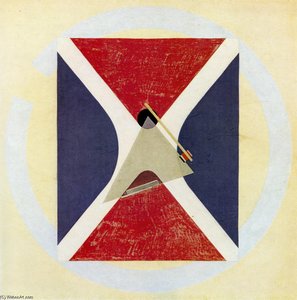
A Bold Declaration in Collage: Exploring El Lissitzky’s “Vive la Commune 1871”
El Lissitzky's "Vive la Commune 1871" isn’t merely a painting; it’s an audacious manifesto rendered in visual form. Created in 1921, shortly after the Bolshevik Revolution reshaped Russia, this artwork embodies the fervor and complexity of that transformative era—a testament to Lissitzky's unwavering belief in art as a tool for social change. The piece immediately captivates with its unconventional approach: eschewing traditional representation for a dynamic collage composed of photographs interwoven with geometric abstractions. This deliberate disruption of artistic conventions speaks volumes about Lissitzky’s intellectual engagement with the burgeoning modernist movement and his desire to communicate ideas beyond conventional visual language.Style and Technique: Geometric Abstraction Meets Photographic Documentation
Lissitzky's stylistic choices are deliberately provocative. He abandons realistic depiction, opting instead for a geometric abstraction that prioritizes form and color over detailed representation. The dominant shapes—primarily rectangles and triangles—are meticulously arranged to create a visual rhythm that echoes the energy of the revolution itself. These geometric forms aren’t simply decorative; they serve as conduits for conveying concepts of unity and progress – mirroring the aspirations of the Bolshevik leadership. Simultaneously, Lissitzky incorporates photographic images, capturing fragments of Parisian life during the Commune. This juxtaposition creates a fascinating tension between documentation and abstraction, forcing viewers to confront both the tangible realities of history and the conceptual framework through which Lissitzky interprets them. The printing technique employed—likely offset lithography—ensures color vibrancy and precision, crucial for conveying the emotional intensity of the composition.Historical Context: Echoes of Revolution and Artistic Experimentation
“Vive la Commune 1871” sits firmly within the context of Russia’s turbulent post-revolutionary years. The Bolshevik government sought to disseminate propaganda effectively, utilizing visual media to galvanize support for their ideology. Lissitzky recognized this imperative and responded with an artwork that transcends mere illustration; it's a deliberate attempt to communicate a powerful message about solidarity and defiance. The Commune itself represented a radical experiment in self-governance—a brief but significant challenge to Tsarist authority—and Lissitzky’s collage reflects this spirit of rebellion. Furthermore, the painting aligns with broader trends in European art at the time, where artists were actively exploring new forms of expression influenced by Cubism and Futurism. Lissitzky's work stands as a beacon of artistic innovation amidst political upheaval.Symbolism: Geometric Shapes as Representations of Ideals
The geometric shapes employed within “Vive la Commune 1871” are laden with symbolic significance. Rectangles represent stability and order—a deliberate contrast to the chaos of revolution—while triangles symbolize aspiration and upward movement, mirroring the Bolshevik vision for Russia’s future. Lissitzky consciously utilizes these forms to communicate abstract concepts – unity, progress, and resistance – transforming them into visual emblems that resonate powerfully with viewers. The careful placement of these shapes contributes to the overall composition's dynamism and reinforces its message of optimism amidst adversity.Emotional Impact: A Visual Anthem for Collective Action
Ultimately, “Vive la Commune 1871” succeeds in conveying a profound emotional response. Its bold colors—primarily reds and yellows—evoke feelings of passion and determination, mirroring the fervor of the revolutionary movement. The collage’s fragmented imagery captures the multifaceted nature of experience during this pivotal moment in history – celebrating triumph while acknowledging the difficulties encountered along the way. Lissitzky's artwork isn’t simply aesthetically pleasing; it compels viewers to contemplate the role of art in shaping social consciousness and inspiring collective action—a legacy that continues to inspire artists and collectors alike.Questions & Answers
Who is the author of "Vive la Commune 1871", and in which movement?
El Lissitzky created "Vive la Commune 1871" within the Constructivism movement.
Can I watch "Vive la Commune 1871" as a full-screen slideshow?
A slideshow is available: the Diaporama page of "Vive la Commune 1871" by El Lissitzky.
What mood does "Vive la Commune 1871" by El Lissitzky express within Constructivism?
The reflective emotion of "Vive la Commune 1871" accompanies its Constructivism style.
Artist Biography
A Revolutionary Vision: The Life and Art of El Lissitzky
El Lissitzky, born Lazar Markovich Lissitzky in 1890 in the small Russian town of Pochinok, emerged as a pivotal figure in the tumultuous landscape of early 20th-century art. His journey was one of constant reinvention, driven by a fervent belief in the power of art to shape society and reflect the dynamism of the modern world. From his initial training as an architect and engineer – pursuits hampered by restrictions placed upon Jewish students – Lissitzky’s path diverged towards artistic expression, initially through illustrations steeped in Jewish folklore. These early works, like his cover for ‘Chad Gadya’, reveal a nascent talent already grappling with narrative and visual storytelling, hinting at the profound cultural roots that would continue to inform his aesthetic. A move to Berlin and Darmstadt broadened his horizons, but it was upon returning to Russia that Lissitzky truly found his artistic voice, becoming inextricably linked with the revolutionary fervor sweeping through the nation.The Embrace of Abstraction: Suprematism and Proun
A defining moment arrived with his encounter with Kazimir Malevich and the embrace of Suprematism. This radical movement, dedicated to pure geometric abstraction, resonated deeply with Lissitzky’s desire to transcend representational art and tap into a universal visual language. He became a key member of UNovis, the Suprematist group established in Vitebsk, actively disseminating its principles through teaching and artistic production. However, Lissitzky didn't simply replicate Malevich’s style; he forged his own distinct path with the development of *Proun*. This unique series, born from a fusion of Suprematism and Constructivism, explored spatial relationships and geometric forms in dynamic compositions that often resembled architectural blueprints or exploded diagrams. Proun wasn't merely painting; it was an investigation into the very structure of space itself, a premonition of future architectural possibilities. These works, with their floating planes and intersecting lines, embodied Lissitzky’s belief in art as a force capable of constructing new realities. The influence of his engineering background is palpable here, lending a structural logic to the abstract forms.Art as Propaganda and Social Commentary
Lissitzky's artistic vision extended far beyond the canvas. He passionately believed that art should serve a social purpose, actively engaging with political ideologies and seeking ways to integrate design into everyday life. This conviction led him to become deeply involved in Soviet propaganda efforts, creating powerful posters and graphic designs intended to mobilize public support for the Bolshevik regime. His 1941 poster calling for tank construction stands as a testament to this commitment – a stark, impactful image reflecting the urgency of wartime. Beyond propaganda, Lissitzky revolutionized typography, exhibition design, and photomontage. He understood that effective communication required innovative visual strategies, and he fearlessly experimented with new techniques to convey his message. His photomontages, such as ‘The Constructor’ (1924), are particularly striking – self-portraits that blend photography with geometric abstraction, offering a complex commentary on identity and the role of the artist in society.A Cultural Ambassador: Spreading Constructivist Ideals
Lissitzky's influence transcended national borders. He served as a crucial cultural ambassador for Soviet art, disseminating Constructivist ideas throughout Western Europe, particularly in Germany. His innovative exhibition designs challenged traditional gallery spaces, creating immersive environments that actively engaged viewers. These exhibitions weren’t simply displays of artwork; they were carefully constructed experiences designed to provoke thought and inspire action. His work had a profound impact on the Bauhaus and De Stijl movements, influencing generations of artists and designers with its emphasis on geometric abstraction, functionalism, and social responsibility. He collaborated with figures like Kurt Schwitters and Theo van Doesburg, fostering a cross-cultural exchange that enriched the artistic landscape of the era.Legacy and Enduring Influence
El Lissitzky’s life was tragically cut short in 1941 in Moscow, but his legacy continues to resonate today. He bridged the gap between art and architecture, abstraction and social purpose, leaving behind a body of work that is both intellectually stimulating and visually captivating. The establishment of the Lissitzky Foundation in 2014 underscores the ongoing commitment to preserving his artistic heritage and preparing a comprehensive catalogue raisonné of his creations. His innovations in typography, exhibition design, and photomontage continue to inspire contemporary artists and designers, while his unwavering belief in the power of art as a force for social change remains profoundly relevant.- His work is held in numerous international collections
- Museums featuring his works include the Taganrog Art Museum and Novokuznetsk Art Museum.

El Lissitzky
1890 - 1941 , Russia
Quick Facts
- Artistic Movement Or Style:
- Suprematism
- Constructivism
- Proun
- Artists Or Movements Influenced By This Artist:
- Bauhaus
- De Stijl
- Artists Who Influenced This Artist: ['Kazimir Malevich']
- Full Name: Lazar Markovich Lissitzky
- Nationality: Russian and Soviet
- Notable Artworks:
- Chad Gadya cover
- The Constructor
- Beat the Whites with the Red Wedge
- Iron in Clouds
- Place Of Birth: Pochinki, Russia
- Date Of Birth: 1890
- Date Of Death: 1941