Switch to Print
 Read More







































 For artworks or reproductions larger than 105 cm (approximately 41 inches) on any side, the frame will be shipped as a kit, disassembled. This method ensures safe delivery and prevents damage during transport.


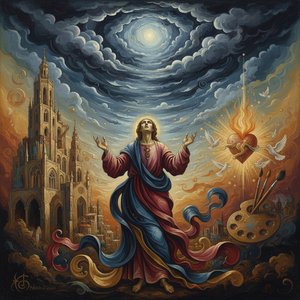
A Vision of Suffering: El Greco’s ‘Untitled (2300)’
El Greco's “Untitled (2300)” is not merely a depiction of Christ; it’s an embodiment of profound spiritual anguish, rendered with the raw intensity that defined the artist’s unique vision. The painting immediately confronts the viewer with the iconic image of Jesus carrying the cross – a motif central to Christian iconography since the earliest centuries. Yet, within this familiar subject matter, El Greco elevates the scene through his masterful manipulation of form and emotion, creating an experience far removed from traditional religious art. The figure’s elongated proportions, characteristic of El Greco's style, contribute to a sense of heightened drama and vulnerability. His youthful appearance, juxtaposed with the weight of the cross, intensifies the feeling of suffering, suggesting not just physical pain but also the immense burden of sacrifice.
The Crucible of Toledo: Style and Technique
Born Doménikos Theotokópoulos in Crete, El Greco’s artistic journey was a relentless pursuit of innovation. His early training within the Byzantine tradition – evident in his meticulous detail and understanding of religious symbolism – provided a solid foundation. However, it was in Toledo, Spain, that he truly forged his distinctive style. This city, a melting pot of cultures and faiths, profoundly influenced his work. El Greco’s technique is immediately recognizable: broad, sweeping brushstrokes applied with a deliberate lack of blending create a sense of movement and energy. The use of intense color – predominantly deep blues, reds, and ochres – amplifies the emotional impact of the scene. Notice how he uses light to sculpt the figure, emphasizing his muscular form and highlighting the textures of the crown of thorns and the rough wood of the cross. This technique anticipates later movements like Expressionism, demonstrating El Greco’s prescience in exploring heightened emotional states through artistic representation.
Symbolic Weight: Faith, Suffering, and Redemption
The symbolism within “Untitled (2300)” is layered and deeply rooted in Christian theology. The cross itself represents sacrifice, redemption, and the ultimate act of love. The crown of thorns symbolizes Christ’s suffering during his crucifixion, a tangible representation of humanity's sin. The two figures flanking Jesus – their identities deliberately ambiguous – may represent onlookers, witnesses to this pivotal event, or perhaps even representations of human doubt and despair. El Greco frequently employed ambiguity in his work, inviting viewers to contemplate the complexities of faith and the nature of suffering. The inclusion of a cloudy sky adds to the atmosphere of drama and foreboding, suggesting both the earthly limitations of Christ’s ordeal and the transcendent spiritual realm he represents.
A Legacy of Emotion: El Greco's Enduring Impact
El Greco’s work continues to resonate with viewers today because it taps into universal human emotions – pain, compassion, faith, and hope. His dramatic style, combined with his profound understanding of religious symbolism, created a body of art that is both intensely personal and universally relevant. Reproductions of “Untitled (2300)” offer an opportunity to experience this powerful artwork firsthand, bringing its emotional intensity into any setting. OriginalUniqueArt’s hand-painted reproductions meticulously recreate El Greco's original techniques, ensuring the highest quality and authenticity for discerning collectors and interior designers seeking a piece that speaks volumes about human experience.
Questions & Answers
Are the colors of "untitled (2300)" by El Greco vivid or muted?
"untitled (2300)" by El Greco is recorded with a muted saturation and a monochromatic intensity.
What atmosphere does "untitled (2300)" have?
"untitled (2300)" by El Greco is described as dramatic in mood. This classification can help match the work to a setting.
Is "untitled (2300)" available as a fine art print?
To get a print of "untitled (2300)" by El Greco, simply order it on its Fine Art Print page: a fine art print on cotton canvas or archival canvas paper.
More about this painting
 Preview
 Send
Send Share
Share
 Details
 Guide
Guide

 Download
 Similars
 X-Ray
X-Ray Diaporama
 Q&A
Q&A Stats
Stats