Preview
 Send
Send Share
Share
 Details

 Download
 Similars
 X-Ray
X-Ray Diaporama
James Meakin (1807–1852)
 1889
1889 126.0 x 100.0 cm
 Read More
Giclée / Art Print
Museum-quality giclée or canvas print with fast production and flexible finish options. ( Buy Hand Made Painting Buy Image)




































Pick from our preset sizes that match the artwork's original proportions.

You may enter your own dimensions to fit a specific frame or space. If your selected size does not match the original image's proportions, we will either crop the artwork or extend the image with a mirrored or solid-fill edge. A digital mockup will be sent for your approval before production begins.
Please note that the on-screen preview does not reflect the actual cropping or extension. Only the mockup will accurately show the final composition.
While custom sizes are available, we recommend selecting a dimension from the predefined list to preserve the original proportions.
Worldwide Delivery () in 2 weeks instead of standard 4/5 weeks. (25 August)

Free Worldwide Express Shipping

High-Quality Linen Canvas

Full Shipping Insurance

Customs Tax Refund Guarantee

True Color Matching Guarantee

60-Day Return Policy (Defects Only)

100% Money-Back Guarantee

Bulk Discount Offer
 Glass option is only available in size under 110 CM

James Meakin (1807–1852)
Giclée / Art Print
Reproduction Size
-


Total Price
$ 81
Artist Biography
The Architect of Character: The Life and Legacy of Edwin Arthur Ward
In the golden twilight of the Victorian and Edwardian eras, a period defined by rigid social hierarchies and an unwavering respect for institutional dignity, few artists captured the essence of British prestige as masterfully as Edwin Arthur Ward. Born in 1859 in the quiet town of Basford, Nottinghamshire, Ward’s journey from the Midlands to the heart of London’s vibrant art scene is a testament to a life dedicated to the pursuit of technical perfection and the subtle nuances of human character. His early years were steeped in the influence of his father, a man involved in the decorative arts, which planted the seeds of a lifelong fascination with design, texture, and the meticulous rendering of form.
Upon arriving in London at the age of nineteen, Ward sought to refine his burgeoning talents within the prestigious halls of the Slade School of Fine Art. It was here that he encountered the legendary Frederic Leighton, a pivotal moment that would forever shape his artistic philosophy. Under Leighton’s tutelage, Ward embraced the classical ideals of anatomical precision and compositional balance, learning that a truly great portrait does more than merely replicate a face; it must evoke the very soul and social standing of the sitter. This rigorous training in drawing and etching provided him with the foundational tools to navigate the competitive London art world, eventually leading to his election as a member of the Royal Society of Portrait Painters in 1891.
A Mastery of Muted Grandeur
Ward’s career was defined by a remarkable period of consistent excellence, particularly between 1884 and 1903, when his works became staples of the Royal Academy exhibitions. He possessed a rare ability to navigate the complexities of society portraiture, moving seamlessly between the depiction of high-ranking military officers, members of the aristocracy, and influential civic leaders. His style was never one of flashy bravado; instead, he favored a sophisticated, muted tonal palette that allowed the subject's inherent gravitas to take center stage. Through a profound understanding of drapery and light, Ward could render the heavy velvet of a formal robe or the crisp linen of a uniform with such tactile realism that the viewer could almost feel the weight of the fabric.
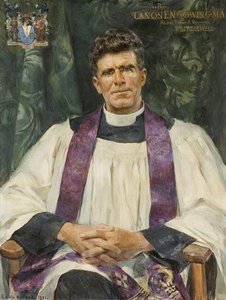
The brilliance of his technique lay in his ability to balance physical accuracy with psychological depth. While his hands were skilled in the meticulous rendering of anatomy, his eyes were attuned to the subtle shifts in expression that reveal a subject's inner life. Whether he was capturing the solemnity of The Reverend Canon E. N. Gowing or the youthful energy of a young Winston Churchill, Ward’s brushwork served to elevate his subjects, imbuing them with a sense of timelessness and historical importance. His work did not merely document a person; it constructed a legacy.
Enduring Impressions and Historical Significance
The true measure of an artist often lies in the permanence of their impact on the cultural landscape. Ward’s reputation was cemented through prestigious commissions that saw his portraits gracing the halls of town halls, museums, and private estates across Britain. His depictions of figures such as Thomas Bescoby for Retford Town Hall stand as enduring monuments to a bygone era of British civic pride. Even as the world moved toward the more fragmented styles of modernism, Ward remained a steadfast guardian of the classical tradition, ensuring that the dignity of his subjects was preserved through the medium of oil on canvas.
Though he passed away in 1933 in Dorset, leaving behind a legacy that includes notable works held within the Nottingham Castle Museum, Ward’s influence continues to resonate. He remains a vital figure for historians and art enthusiasts alike, representing a bridge between the meticulous craftsmanship of the nineteenth century and the evolving portraiture of the twentieth. His life's work serves as a window into the social fabric of his time, offering a gaze into the faces of those who shaped the British identity during one of its most transformative epochs.

edwin arthur ward
1859 - 1933
Quick Facts
- Artistic Movement Or Style: Victorian Portraiture
- Artists Or Movements Influenced By This Artist: ['']
- Artists Who Influenced This Artist: ['']
- Date Of Birth: 1859
- Date Of Death: 1933
- Full Name: Edwin Arthur Ward
- Nationality: British
- Notable Artworks:
- Portrait of Thomas Bescoby
- Mrs Morton Jackson
- Place Of Birth: Basford, Nottinghamshire