

 Preview
 Send
Send Share
Share
 Details
 Guide
Guide

 Download
 Similars
 X-Ray
X-Ray Diaporama
 Stats
StatsBerthe Morisot


 Read More
Purchase a high-resolution, enhanced digital image, far superior to the online preview.
Each file is meticulously prepared by our in-house specialists using advanced tools and expert manual retouching. We ensure every image has exceptional clarity, precise color accuracy, and fine detail.
The final file is delivered via email within 72 hours, optimized for immediate use in professional, editorial, and print environments. This is the same quality trusted by top-tier design studios, publishers, and galleries.
Digital Image
Download a high-resolution file for personal display, printing, and creative projects. ( Switch to Print Buy Hand Made Painting)
Included in Every Digital Image Order
Expert Digital Delivery, Guaranteed
When you choose OriginalUniqueArt.com, you're not just getting an image - you're receiving a professionally enhanced digital artwork, crafted with precision and backed by a satisfaction guarantee. Here's everything that comes with your order, automatically:

Fast Email Delivery
Your high-resolution digital image file will be emailed to you within 72 hours of ordering - ready for immediate use.

AI-Enhanced Digital File
Your artwork is professionally optimized using advanced AI tools and manual editing, ensuring maximum detail, clarity, and color accuracy.

Free Lifetime Re-Delivery
Accidentally deleted or lost your file? No worries - we'll resend it to you anytime, free of charge.

No Import Fees - Ever
Enjoy your artwork instantly with zero customs, duties, or delivery fees - digital downloads are always tax-free.

Color Accuracy Guarantee
We ensure your digital image reflects the original colors as closely as possible using professional tools and color management.

100-Day Satisfaction Guarantee
If you're not satisfied with your digital image, we'll revise it or refund 100% within 100 days - no questions asked.

100% Money-Back Guarantee
Not satisfied? Get a full refund within 100 days of receiving your digital file - no questions asked.

Bulk Order Discounts
Buy 3 images, save 10% - Buy 5, save 15% - Buy 10+, save 20%. Great for creative projects, galleries, and agencies.
A Moment Frozen in Time: Édouard Manet’s Portrait of Berthe Morisot
This captivating black and white drawing, often attributed to Édouard Manet – though the precise authorship remains subtly debated within art historical circles – offers a poignant glimpse into the life of Berthe Morisot, a pivotal figure in the Impressionist movement. More than simply a likeness, it’s a carefully constructed tableau brimming with quiet observation and an undeniable sense of intimacy. The image depicts Morisot holding her own elaborate hat, its prominent ball a focal point that draws the eye upward, mirroring perhaps a contemplative gaze directed downward. The drawing isn't about grand gestures or dramatic poses; instead, Manet masterfully captures a fleeting moment – a pause in conversation, a shared glance, a simple act of self-possession.
Manet’s Revolutionary Approach to Portraiture
Édouard Manet (1832-1883), a Parisian rebel who challenged the established norms of 19th-century art, fundamentally altered the conventions of portraiture. Unlike his academic predecessors, he wasn't interested in meticulously recreating idealized beauty or adhering to rigid historical narratives. Instead, he sought to depict modern life with startling honesty and immediacy. His work was often met with resistance from critics who found his loose brushwork, unconventional compositions, and unflinching portrayal of contemporary subjects jarringly unfamiliar. Manet’s influence stemmed not just from his subject matter but also from his innovative technique – a deliberate rejection of academic precision in favor of capturing the ephemeral qualities of light and atmosphere. He studied the masters, particularly Caravaggio and Velázquez, absorbing their understanding of chiaroscuro (the dramatic contrast between light and dark) to sculpt form and imbue his paintings with a remarkable sense of realism.
The Symbolism of Form and Gesture
Consider the details within this drawing. The hat itself is more than just an accessory; it’s a symbol of status, perhaps even a subtle declaration of femininity within the constraints of Victorian society. The ball atop the hat draws attention to Morisot's face – her expression is one of quiet contemplation, almost melancholic. Her hands, delicately poised around the hat, reveal a sense of control and grace. Manet’s use of line is particularly noteworthy; he employs loose, expressive strokes that suggest movement and texture without resorting to detailed rendering. The shading creates a subtle three-dimensionality, giving the figure a tangible presence despite the monochromatic palette. The downward gaze hints at introspection – a moment of private thought amidst the bustle of Parisian life.
A Window into the Impressionist World
Berthe Morisot herself was an accomplished Impressionist painter, known for her intimate domestic scenes and portraits of women and children. Her work shared Manet’s commitment to capturing fleeting moments and portraying everyday life with a fresh, modern sensibility. This drawing by Manet offers a fascinating insight into the artistic circle surrounding Morisot – a world characterized by experimentation, intellectual debate, and a desire to break free from traditional artistic conventions. It's a testament to Manet’s ability to not only document his contemporaries but also to imbue them with a profound sense of humanity. The reproduction offered here allows us to appreciate the subtle nuances of this remarkable portrait, bringing a touch of Parisian elegance and quiet contemplation into any space.
Bringing This Masterpiece Home
OriginalUniqueArt offers meticulously crafted hand-painted reproductions of Édouard Manet’s Portrait of Berthe Morisot. Each reproduction is created by skilled artists using archival quality materials, ensuring that the rich details and subtle tonal variations of the original drawing are faithfully preserved. Whether you're an art collector, a design enthusiast, or simply seeking to add a touch of timeless beauty to your home, this reproduction provides an authentic connection to one of the most influential figures in modern art. Explore our collection today and discover the perfect way to celebrate the legacy of Manet and Morisot.
Questions & Answers
How do I download the image of "Berthe Morisot" by Édouard Manet?
A download is available for "Berthe Morisot": the artwork's Download page offers a high-resolution digital image download.
How do I discover artworks close to "Berthe Morisot" by Édouard Manet?
The Similars page of "Berthe Morisot" by Édouard Manet presents related artworks.
Does the copyright of "Berthe Morisot" by Édouard Manet allow reproductions?
The original "Berthe Morisot" is at the Detroit Institute of Arts, and the work is in the public domain - its copyright has expired.
Artist Biography
The Architect of Modernity
To look at a canvas by Édouard Manet is to witness the precise moment when the polished illusions of the past collapsed under the weight of contemporary reality. He did not seek to decorate the walls of the bourgeoisie; he sought to confront them. While his contemporaries often retreated into mythological safety, Manet forced the viewer to acknowledge the grit and the glare of 19th-century Paris. His work functions as a blunt instrument that dismantled the academic hierarchy of subjects. He stripped away the comfortable distance provided by historical allegory, replacing it with the unsettling directness of a woman staring back from a modern street or a café.
The impact of his technique remains visible in every brushstroke that prioritizes the physical reality of paint over the illusion of depth. He rejected the seamless, invisible finish demanded by the Salon, opting instead for facture—a visible, energetic application of pigment. By using stark contrasts and a flattened pictorial space, he reminded anyone looking at his work that they were observing a constructed image on a flat surface. This was not an error in perspective; it was a deliberate rejection of the window-like transparency that had dominated Western art since the Renaissance.
A Rebellion Rooted in Tradition
Manet’s radicalism was not born from ignorance of the past, but from a deep, analytical study of it. His time spent copying Old Masters in the Louvre provided him with a technical foundation that he would later use to subvert tradition. He drew heavily from the bold compositions and light manipulation found in the works of Caravaggio and Velázquez. From the Spanish masters, he learned how to utilize black as a positive color and how to employ fluid brushwork to suggest form without excessive detail. This was not an imitation of the past, but a dissection of it.
His early life in Paris suggested a path far removed from the studio. Born into a comfortable family, his father initially pushed for a career in the navy or law. After failing his entrance exams for the naval academy, Manet turned toward the arts under the instruction of Thomas Couture. This tension between his bourgeois origins and his revolutionary output created a unique friction in his work. He possessed the social standing to navigate Parisian intellectual circles, yet he used that access to promote an aesthetic that many found vulgar or incompetent.
The Scandal of the Real
The mid-1860s provided the stage for Manet’s most significant confrontations with the public. The 1863 Salon des Refusés became a site of intense controversy, largely due to his inclusion in the exhibition of rejected works. His painting Le Déjeuner sur l'herbe shocked audiences not merely because of its nudity, but because of its lack of mythological context. The figures were undeniably modern, stripped of the divine or the ancient, leaving only the raw presence of contemporary Parisians. This refusal to idealize his subjects was met with widespread condemnation from critics who found his realism too blunt.
This pattern of provocation continued with Olympia in 1865. By reimagining Titian’s Venus of Urbino through the lens of a contemporary prostitute, Manet stripped away the protective layer of myth. The subject did not invite a gaze of admiration for a goddess; she demanded recognition of a person. This period of his career established the fundamental shift from Realism toward the beginnings of Impressionism. His influence on the movement was structural rather than purely stylistic:
- He championed the use of alla prima painting, or wet-on-wet technique, to capture immediate atmospheric effects.
- He introduced a flattened perspective that challenged the mathematical precision of academic composition.
- He utilized strong, contrasting tones to create a sense of modern, fragmented light.
The Enduring Verdict
Manet’s career was cut short by his death in 1883, yet the trajectory of art had already been irrevocably altered. He acted as the essential bridge between the heavy, grounded themes of Realism and the fleeting, light-focused explorations of the Impressionists. While he never fully adopted the label of an Impressionist and continued to seek recognition from the official Salon, his methods provided the vocabulary for the avant-garde. He proved that the artist's duty was not to provide a beautiful escape, but to document the complexities and contradictions of the era.
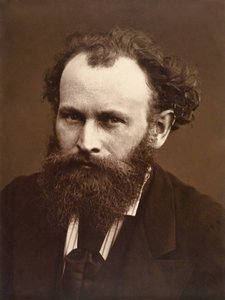
Édouard Manet
1832 - 1883 , France
Quick Facts
- Full Name: Édouard Manet
- Nationality: French
- Date Of Birth: 1832
- Date Of Death: 1883
- Place Of Birth: Paris, France
- Notable Artworks:
- Le Déjeuner sur l'herbe
- Olympia
- A Bar at the Folies-Bergère
- Artistic Movement Or Style: Realism, Impressionism
- Artists Who Influenced This Artist:
- Caravaggio
- Diego Velázquez
- Gustave Courbet
- Artists Or Movements Influenced By This Artist:
- Claude Monet
- Pierre-Auguste Renoir
- Edgar Degas
- Impressionism