Switch to Print
 Read More







































 For artworks or reproductions larger than 105 cm (approximately 41 inches) on any side, the frame will be shipped as a kit, disassembled. This method ensures safe delivery and prevents damage during transport.


A Moment Frozen in Marble
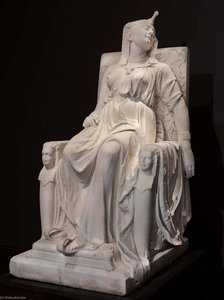
The white marble holds a quiet tension, as if the air around these two figures is thick with concentration. An elder man kneels upon a circular base, his hands occupied with the delicate task of shaping an arrow. Beside him, a younger person watches closely, eyes fixed on the movement of the craftsman. There is a shared focus here, a stillness that suggests the world outside this small circle has ceased to exist. The smooth, polished surfaces of the stone catch the light, tracing the curves of the man's anatomy and the soft folds of the woman's garments. Every line carved into the stone speaks of a singular purpose.
The texture of the sculpture shifts between the sleekness of skin and the more rugged details found in the clothing and the base. Fine lines define individual strands of hair, while the weight of the marble gives the figures a sense of permanence. In this frozen second, the act of creation is all that matters. The arrow being fashioned serves as a linear anchor within the organic shapes of the human forms.
Echoes of Legend and Identity
This scene draws its breath from the verses of The Song of Hiawatha, bringing a literary moment into the physical realm. The figures embody a connection to ancestral traditions, seen in the subtle details of their attire, such as the Anishinaabe deer-hide moccasins and vests. A Dakota bear-claw necklace rests against the stone, adding a layer of specific cultural detail to the neoclassical forms. While the style follows the smooth, idealized traditions of neoclassicism, the subject matter remains deeply rooted in Indigenous storytelling.
The interaction between the elder and the youth carries an emotional weight that transcends the coldness of the medium. There is a sense of passing knowledge, a silent dialogue between generations through the medium of craft. The way the younger figure leans toward the maker suggests curiosity or perhaps a quiet reverence for the skill being demonstrated. Through this work, the struggle for identity and the preservation of tradition are rendered in stone, making the ephemeral act of teaching feel enduring.
Questions & Answers
From which country does the Neoclassicism work "Old Arrow Maker" come?
The Neoclassicism work "Old Arrow Maker" was made by an artist born in United States of America.
What stage of Edmonia Lewis's development does "Old Arrow Maker" represent?
Within Edmonia Lewis's career, "Old Arrow Maker" falls in the Mature Period. The phase helps compare it with the artist's other works.
Is "Old Arrow Maker" by Edmonia Lewis a portrait, landscape or square composition?
The format of "Old Arrow Maker" is portrait. This is useful when planning where a reproduction will be placed.


 Send
Send Share
Share
 Details
 Guide
Guide

 Download
 Similars
 Diaporama
 Q&A
Q&A Stats
Stats