Send
Send Share
Share
 Details

 Download
 Similars
 Diaporama
 Stats
StatsSt George


 Read More
Giclée / Art Print
Museum-quality giclée or canvas print with fast production and flexible finish options. ( Buy Hand Made Painting Switch to Digital Image)




































Pick from our preset sizes that match the artwork's original proportions.

You may enter your own dimensions to fit a specific frame or space. If your selected size does not match the original image's proportions, we will either crop the artwork or extend the image with a mirrored or solid-fill edge. A digital mockup will be sent for your approval before production begins.
Please note that the on-screen preview does not reflect the actual cropping or extension. Only the mockup will accurately show the final composition.
While custom sizes are available, we recommend selecting a dimension from the predefined list to preserve the original proportions.
Worldwide Delivery () in 2 weeks instead of standard 4/5 weeks. (8 September)

Free Worldwide Express Shipping

High-Quality Linen Canvas

Full Shipping Insurance

Customs Tax Refund Guarantee

True Color Matching Guarantee

100-Day Return Policy (Defects Only)

100% Money-Back Guarantee

Bulk Discount Offer
 Glass option is only available in size under 110 CM

St George
Giclée / Art Print
Reproduction Size
-


Total Price
$ 81
A Testament to Faith and Form: Donatello’s *Saint George*
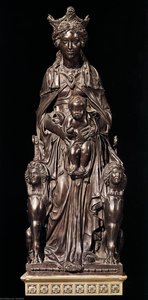
Donatello's *Saint George*, sculpted in 1416 during the nascent Renaissance, is more than just a marble statue; it’s a potent distillation of classical ideals interwoven with burgeoning humanist thought. Housed within the imposing niche of the Bargello Museum in Florence, this figure commands attention not merely through its scale – though its height is undeniably impressive – but through the profound sense of dignity and restrained power it embodies. The sculpture depicts Saint George slaying the dragon, a scene steeped in Christian symbolism and echoing the heroic narratives of antiquity. Donatello masterfully captures the moment of decisive action, yet avoids melodrama, presenting a portrait of resolute courage rather than outright violence.
The Sculptor’s Hand: Technique and Materials
Donatello's genius lies not just in his subject matter but in his unparalleled technical skill. Crafted from pristine white marble, the statue showcases an extraordinary command of material. The surface is remarkably smooth, achieved through meticulous polishing – a technique perfected by Donatello himself. Notice how he renders the folds of George’s drapery; they aren't simply decorative but sculpted with a deep understanding of fabric’s weight and movement. The musculature of the figure is rendered with anatomical precision, reflecting his study of classical sculpture and his commitment to representing the human form realistically. The subtle gradations in tone – achieved through careful carving and highlighting – create an illusion of volume and depth, bringing the statue to life. The choice of marble itself speaks volumes; its purity and luminosity enhance the sense of nobility and spiritual significance.
Symbolism and Narrative: A Medieval Icon
The story of Saint George is rich with symbolic meaning. He was martyred for his Christian faith, slaying a dragon that threatened the city of Silene in Egypt. This narrative resonated deeply within the medieval period, representing the triumph of good over evil, faith over heresy, and courage against overwhelming odds. Donatello’s depiction reinforces these themes. The dragon itself is not depicted as monstrous but rather as a formidable challenge to be overcome with unwavering resolve. George's stance – poised and determined – conveys a sense of righteous action. The inclusion of the lance and shield, symbols of Christian defense and faith, further solidifies the statue’s religious message. It’s important to note that this wasn’t simply a retelling of a biblical story; it was an embodiment of civic virtue and spiritual fortitude, values highly prized in Renaissance Florence.
A Bridge Between Eras: Donatello's Legacy
*Saint George* stands as a pivotal work in the transition from Gothic to Renaissance sculpture. While retaining elements of traditional Byzantine iconography – particularly in the stylized features and the emphasis on frontal presentation – it demonstrates a shift towards greater naturalism, anatomical accuracy, and psychological depth. Donatello’s influence can be seen in subsequent generations of sculptors, who drew inspiration from his innovative approach to depicting human form and emotion. His willingness to experiment with new techniques and subject matter paved the way for the High Renaissance masters. Studying *Saint George* offers a profound insight into the artistic currents shaping Florence during this transformative period – a moment when faith, classical ideals, and burgeoning humanist thought converged to create one of the most enduring legacies in Western art.
Artist Biography
early life and career
donato di niccolò di betto bardi, known as donatello, was born in florence, italy around 1386. he studied classical sculpture, which heavily influenced his development of an early renaissance style. this new approach to art and culture would eventually become the hallmark of the florentine renaissance.key works and innovations
donatello's most famous work, david, was the first freestanding nude male sculpture since antiquity. commissioned by the medici family, it showcased his innovative style and technical expertise. other notable works include:- st. louis of toulouse (now in the museum of the basilica di santa croce), which featured a classical frame designed by donatello.
- the sacrifice of isaac, created for the campanile of santa maria del fiore in florence, characterized by strong portrait details.
- crucifix (1425) for santa croce, which portrayed christ in a moment of agony.
artistic style and legacy
donatello's style can be divided into broad phases, beginning with the development of expressiveness and classical monumentality. his work was not immediately accepted by the community but eventually became the most popular, influencing other italian courts and european artists. key art movements:personal life and working style
donatello was known for being amiable and well-liked, but poor at the business side of his career. he tended to accept more commissions than he could handle, often completing works late or handing them over to other sculptors. notable artworks and artists:- leonardo da vinci: annunciation (detail)
- amico aspertini: statua di pan/leone che azzanna un cavallo
- michelangelo buonarroti: tondo pitt
museums and art collections:
- museo della collegiata (empoli, italy): a hidden gem of the renaissance, featuring works by francesco botticini and raffaello botticini.
- the early italian renaissance art movement

Donatello
1386 - 1466 , Italy
Quick Facts
- Artistic Movement Or Style: Early Renaissance
- Artists Or Movements Influenced By This Artist:
- Italian Renaissance
- Early Renaissance
- Florentine Renaissance
- Artists Who Influenced This Artist: ['Classical sculpture']
- Date Of Birth: c. 1386
- Date Of Death: 1466
- Full Name: Donatello di Niccolò
- Nationality: Italian
- Notable Artworks:
- David
- St. Louis of Toulouse
- Sacrifice of Isaac
- Crucifix
- Place Of Birth: Florence, Italy
Related Articles

Georges Seurat's Masterpieces: 25 Paintings That Defined Pointillism | OriginalUniqueArt
Explore 25 iconic Georges Seurat paintings & discover the brilliance of Pointillism. From 'La Grande Jatte' to his harbor scenes, delve into art history with OriginalUniqueArt.com. Find museum-quality reproductions for your home decor. Explore the full collection online!

Georges Braque's Masterpieces: 25 Paintings That Defined Cubism & Modern Art | OriginalUniqueArt
Explore 25 iconic Georges Braque paintings that revolutionized Cubism & modern art. Discover the stories behind his masterpieces, from Fauvism to Analytical Cubism. Find museum-quality reproductions & elevate your home decor with OriginalUniqueArt.com.
Timeless Elegance: A Complete Guide to the Sublime Beauty and Artistry of Marble Sculpture
Discover the sublime beauty of marble art through an expert exploration of Renaissance and Neoclassical masterpieces. From the delicate textures of Carpeaux to the grandeur of Sansovino, immerse yourself in a guide to timeless elegance and sculptural perfection.

The Enduring Allure of Marble in Art History: From Classical Sculpture to Modern Abstraction
Explore the captivating history of marble sculpture from ancient Greece to modern art. Discover renowned artists like Canova & Michelangelo, carving techniques, and investment insights at OriginalUniqueArt.

Bronze Sculptures That Defined Art History | OriginalUniqueArt
Journey through art history with our Top 10 bronze sculptures! Explore masterpieces by Rodin, Michelangelo & more. Discover stories behind iconic statues and find museum-quality reproductions for your home decor at OriginalUniqueArt.com.