
 Preview
 Send
Send Share
Share
 Details
 Guide
Guide

 Download
 Similars
 X-Ray
X-Ray Diaporama
 Stats
StatsInformal Settlement


 Read More
The artwork displayed on this page is protected by copyright law, which means we cannot legally create or sell an identical reproduction. This protection is enforced under international agreements such as the Berne Convention and by national laws, including those outlined by the U.S. Copyright Law - Title 17.
This method fully complies with copyright regulations because it does not involve copying or duplicating the protected artwork. Instead, it is a creative reinterpretation - a new painting that is influenced by the original but not identical to it.
Giclée / Art Print
Museum-quality giclée or canvas print with fast production and flexible finish options. ( Buy Hand Made Painting Switch to Digital Image)




P118B $10

P118H $10

P118W $10

P438Z $10

P508JH $12

P508YH $12

P805H $10

P805Z $10

P919BZ $10

P919G $10

P919XJ $10

P959ZH $10

P968JZ $12

W106C $8

W218G $10

W218JH $8

W218Y $10

W307PJ $10

W316G $10

W316PJ $8

W316Y $10

W398PJ $8

W4111J $10

W500HY $15

W500JH $15

W692G $12

W849H $8

W940BG $15

W953PJ $8




Pick from our preset sizes that match the artwork's original proportions.

Type the width and the height you need, to fit your frame or your wall. A print can only be cut, never made bigger than the picture, so a size with a different shape loses a part of the image. We send you a digital mockup to approve before we print anything. The picture shown on this page does not show the real cut — only the mockup does.
Worldwide Delivery () in 2 weeks instead of standard 4/5 weeks. (26 October)

Free Worldwide Express Shipping

High-Quality Linen Canvas

Full Shipping Insurance

Customs Tax Refund Guarantee

True Color Matching Guarantee

100-Day Return Policy (Defects Only)

100% Money-Back Guarantee

Bulk Discount Offer
 Glass option is only available in size under 110 CM

Informal Settlement
Giclée / Art Print
Reproduction Size
-


Total Price
$ 81
A Vibrant Tapestry of Life: Exploring Đoko Mazalić’s Informal Settlement
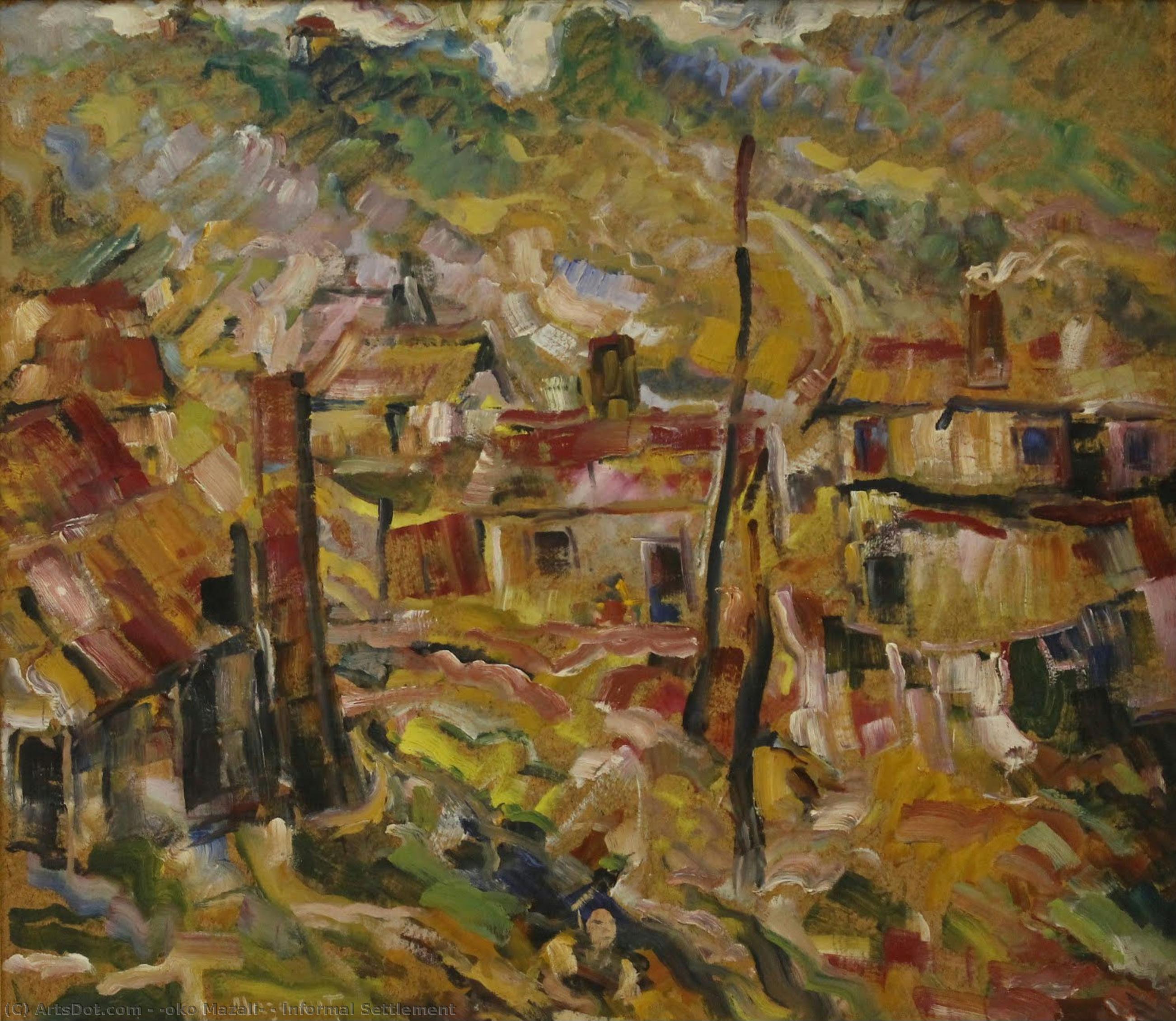
In the evocative masterpiece Informal Settlement, painted in 1962, the renowned Bosnian master Đoko Mazalić invites us into a world that breathes with the rhythm of communal existence. This work is far more than a mere depiction of a mountain village; it is a soulful window into a way of life where humanity, nature, and architecture exist in a delicate, bustling harmony. As the eye wanders across the canvas, one is immediately struck by the vividness of the scene, where the rugged contours of the mountains serve as a protective cradle for a community teeming with vitality. Mazali::ć captures a moment frozen in time, yet vibrating with the energy of a thousand small, daily interactions.
The composition is a masterclass in narrative layering. Within this mountainous enclave, the artist meticulously places elements that suggest both movement and stillness. A dog rests near the threshold of a home, while a horse stands poised on the periphery, grounding the scene in the rustic reality of pastoral life. The presence of a church, marked by its humble cross, provides a spiritual anchor to the landscape, suggesting that faith and tradition are the bedrock upon which these dwellings are built. Through his brush, the village becomes a living organism, where every figure—whether standing in quiet contemplation or moving through the streets—contributes to a larger story of resilience and togetherness.
Technique and the Mastery of Light
Mazalić’s technique in Informal Settlement showcases the stylistic versatility that defined his illustrious career. Having refined his skills at the Academy of Fine Arts in Budapest, he brought a sophisticated understanding of color theory and light to the Bosnian landscape. In this piece, the artist employs a palette that is both earthy and luminous, using light to define the textures of stone, wood, and fabric. The interplay of shadows across the hills creates a sense of depth that pulls the viewer into the heart of the settlement, making the mountains feel tangible and immense.
The brushwork serves to enhance the atmosphere of the piece; it is deliberate yet fluid, capturing the "lively and bustling" essence mentioned in historical accounts. There is a rhythmic quality to how he depicts the various buildings, ranging from simple huts to more structured dwellings, creating a visual cadence that mimics the heartbeat of the village itself. For collectors and interior designers, this painting offers a profound sense of warmth and structural complexity, making it an ideal centerpiece for spaces that require a touch of historical depth and organic beauty.
A Legacy of Connection and Nostalgia
To behold Informal Settlement is to experience a deep sense of nostalgia for a simpler, more interconnected era. Mazalić, a pivotal figure in the Bosnian art scene, had an unparalleled ability to interpret the natural world through a lens of human emotion. This painting does not merely document a location; it celebrates the spirit of the community. The way the figures are scattered throughout the landscape suggests a lack of isolation, emphasizing a social fabric that is tightly woven and inseparable from the land itself.
For those seeking to adorn their homes with art that inspires conversation and emotional resonance, this reproduction offers an unparalleled opportunity. It brings into a modern interior the timeless charm of the 1960s Balkan landscape, providing a sophisticated balance of rustic character and academic excellence. Owning a piece of Mazalić’s legacy is an invitation to reflect on our own connections to place, community, and the enduring beauty of the natural world.
Questions & Answers
Where is the landscape format of "Informal Settlement" recommended to be displayed?
The landscape format of "Informal Settlement" by Đoko Mazalić is recommended for a coffee shop. Format and space together guide the placement of a reproduction.
Can "Informal Settlement" by Đoko Mazalić, held at the National Gallery of Bosnia and Herzegovina, be legally reproduced?
The original "Informal Settlement" is at the National Gallery of Bosnia and Herzegovina, and the work is still protected by copyright.
What stage of Đoko Mazalić's career does "Informal Settlement" (1962) belong to?
Given its 1962 date, "Informal Settlement" falls in Đoko Mazalić's Late Period.
Artist Biography
early life and education
đoko mazalić, a renowned bosnian artist, was born in 1888 in bosanska kostajnica. he was one of the first generation of art school-trained painters, alongside notable artists like gabrijel jurkić, petar tiješić, and špiro bocarić. mazalić's artistic journey began with his studies at the academy of fine arts in budapest from 1910 to 1914.artistic career and style
mazalić's body of work is characterized by its stylistic versatility and qualitative consistency. his paintings, particularly landscapes, are among his best works, showcasing his unique interpretation of nature. motif from vranduk (1920), a landscape piece, demonstrates his ability to capture the essence of the natural world. notable works:- landscape (1913), national gallery of bosnia and herzegovina
- motif from vogošća (1930), national gallery of bosnia and herzegovina
- village under snow (1930), national gallery of bosnia and herzegovina
teaching and legacy
from 1923 to 1945, mazalić worked as a teacher in sarajevo, leaving an indelible mark on the art scene. his influence can still be seen in the works of younger artists who followed in his footsteps. view more works by đoko mazalić:- đoko mazalić's artworks
- the istván dobó museum (eger, hungary) - a rich cultural heritage (featuring a different artist, but showcasing the museum's art collection)
conclusion
đoko mazalić's artistic legacy is a testament to his innovative approach and dedication to capturing the beauty of bosnia and herzegovina. his works continue to inspire artists and art enthusiasts alike, cementing his place in the annals of bosnian art history. related artists: view more:
Đoko Mazalić
1888 - 1975 , Bosnia and Herzegovina
Quick Facts
- Full Name: Đoko Mazalić
- Nationality: Bosnian
- Date Of Birth: 1888
- Date Of Death: 1975
- Place Of Birth: Bosanska Kostunica, Bosnia and Herzegovina
- Notable Artworks:
- Motif from Vranduk (1920)
- Motif from Vogošća (1930)
- Village under snow (1930)
- Artistic Movement Or Style: Landscape & Portrait
- Artists Who Influenced This Artist:
- Gabrijel Jurkić
- Petar Tiješić
- Špiro Bočarić
- Artists Or Movements Influenced By This Artist: ['Expressionism Influence']
Related Articles

Romantic Landscapes: 10 Masterpieces for Your Home | OriginalUniqueArt
Journey through 10 Romantic landscape masterpieces by Friedrich, Turner & Cole. Explore emotional art, sublime nature scenes & iconic 19th-century paintings. Find museum-quality reproductions for your home at OriginalUniqueArt.com – discover the full collection online!

Evocations of Place: A Historical Journey Through Landscape Art
Explore the rich history of landscape art with OriginalUniqueArt. Discover renowned artists, movements like Impressionism & Romanticism, and expert guidance for collecting timeless pieces. Find your perfect serene escape today!

Hokusai's Masterpieces: 25 Iconic Prints & Paintings for Art Lovers | OriginalUniqueArt
Journey through Katsushika Hokusai’s 25 most iconic artworks, including *The Great Wave*. Explore the ukiyo-e master's history, style & timeless Japanese woodblock prints. Find museum-quality reproductions for your home at OriginalUniqueArt.com.

John Constable's Masterpieces: Explore 25 Iconic Landscapes for Your Home
Journey through John Constable's 25 most celebrated landscapes. Explore Romanticism, Dedham Vale & his masterful use of light in iconic paintings like 'Hay Wain'. Find museum-quality art reproductions and elevate your home decor on OriginalUniqueArt.com.

Capturing Nostalgia: The Timeless Allure and Art History of Village Scene Landscapes
Explore the profound beauty of village scene art. From Impressionist light to pastoral realism, discover how timeless landscapes capture nostalgia through expert artistry and historical depth. Perfect for collectors seeking evocative, museum-quality landscape inspirations.


