Text size

() ·

A painting made for you, by hand

Landscape with House

Hand Made Oil Reproduction

Hand-painted oil on canvas in your size and frame, made to order by our artists. ( Switch to Print Switch to Digital Image)

Collectible Description

Experience tranquility with David Johnson's "Landscape with House" (1864), a serene Hudson River School painting showcasing luminism and rural beauty. Explore the idyllic scene today!

Artist Biography

Explore the luminous landscapes of David Johnson, a Hudson River School painter known for his detailed depictions of Northeastern scenery & luminism style.

from ·

Chapter 1

How large should it be?

Slide to change the size; the picture on the left shows the frame at its real width. The proportions of the original are kept.

Standard
custom
CM
INCH

Pick from our preset sizes that match the artwork's original proportions.

width
height

Type the width and the height you need, to fit your frame or your wall. This is hand-painted, so for a size with a different shape the artist can paint a bit more around the picture, or cut a bit — you choose. We send you a digital mockup to approve before the painting starts. The picture shown on this page does not show the real result — only the mockup does.

Chapter 2

How should it arrive?

Choose the edges of the stretched canvas

Choose your frame

Corner sample of the WhiteWrap canvas edge finish, stretched on solid wood bars
White $1
Corner sample of the BlurSideWrap canvas edge finish, stretched on solid wood bars
Blurside $1
Corner sample of the ExtendedWrap canvas edge finish, stretched on solid wood bars
Extended $1
Corner sample of the P118B picture frame: moulded polystyrene, 5 cm wide and 3 cm thick
P118B $10
Corner sample of the P118H picture frame: moulded polystyrene, 5 cm wide and 3 cm thick
P118H $10
Corner sample of the P118W picture frame: moulded polystyrene, 5 cm wide and 3 cm thick
P118W $10
Corner sample of the P438Z picture frame: moulded polystyrene, 5.5 cm wide and 3.5 cm thick
P438Z $10
Corner sample of the P508JH picture frame: moulded polystyrene, 7 cm wide and 3.5 cm thick
P508JH $12
Corner sample of the P508YH picture frame: moulded polystyrene, 7 cm wide and 3.5 cm thick
P508YH $12
Corner sample of the P805H picture frame: moulded polystyrene, 5 cm wide and 3.5 cm thick
P805H $10
Corner sample of the P805Z picture frame: moulded polystyrene, 5 cm wide and 3.5 cm thick
P805Z $10
Corner sample of the P919BZ picture frame: moulded polystyrene, 7 cm wide and 3.5 cm thick
P919BZ $10
Corner sample of the P919G picture frame: moulded polystyrene, 7 cm wide and 3.5 cm thick
P919G $10
Corner sample of the P919XJ picture frame: moulded polystyrene, 7 cm wide and 3.5 cm thick
P919XJ $10
Corner sample of the P959ZH picture frame: moulded polystyrene, 5 cm wide and 3 cm thick
P959ZH $10
Corner sample of the P968JZ picture frame: moulded polystyrene, 6 cm wide and 4 cm thick
P968JZ $12
Corner sample of the W106C picture frame: solid wood, 5 cm wide and 3 cm thick
W106C $8
Corner sample of the W218G picture frame: solid wood, 5 cm wide and 3 cm thick
W218G $10
Corner sample of the W218JH picture frame: solid wood, 5 cm wide and 3 cm thick
W218JH $8
Corner sample of the W218Y picture frame: solid wood, 5 cm wide and 3 cm thick
W218Y $10
Corner sample of the W307PJ picture frame: solid wood, 6 cm wide and 3 cm thick
W307PJ $10
Corner sample of the W316G picture frame: solid wood, 6 cm wide and 3 cm thick
W316G $10
Corner sample of the W316PJ picture frame: solid wood, 6 cm wide and 3 cm thick
W316PJ $8
Corner sample of the W316Y picture frame: solid wood, 6 cm wide and 3 cm thick
W316Y $10
Corner sample of the W398PJ picture frame: solid wood, 5 cm wide and 3 cm thick
W398PJ $8
Corner sample of the W4111J picture frame: solid wood, 6.5 cm wide and 3.5 cm thick
W4111J $10
Corner sample of the W500HY picture frame: solid wood, 7 cm wide and 5 cm thick
W500HY $15
Corner sample of the W500JH picture frame: solid wood, 7 cm wide and 5 cm thick
W500JH $15
Corner sample of the W692G picture frame: solid wood, 8 cm wide and 4 cm thick
W692G $12
Corner sample of the W849H picture frame: solid wood, 5 cm wide and 3 cm thick
W849H $8
Corner sample of the W940BG picture frame: solid wood, 7.5 cm wide and 4.5 cm thick
W940BG $15
Corner sample of the W953PJ picture frame: solid wood, 6 cm wide and 3.5 cm thick
W953PJ $8
Corner sample of the H24-GOLD picture frame: carved wood with gesso, 10 cm wide and 6 cm thick
H24-GOLD $30
Corner sample of the H24-SILVER picture frame: carved wood with gesso, 10 cm wide and 6 cm thick
H24-SILVER $30
Corner sample of the H36-GOLD picture frame: carved wood with gesso, 15 cm wide and 6.5 cm thick
H36-GOLD $45
Corner sample of the H36-SILVER picture frame: carved wood with gesso, 15 cm wide and 6.5 cm thick
H36-SILVER $45
Frame preview
Framed

Moulding: . Overall size with the frame: .

Chapter 3

Who paints it, and should anything change?

Examples of what can be changed: Replace face with customer photo; Add pet (e.g., replace cat with dog); Include hidden message in background; Change background landscape or elements.
After order, OriginalUniqueArt.com team will email client for instructions and provide a mockup preview

Worldwide Delivery () in 3/4 weeks instead of standard 5 weeks. (1 November). No compromise on quality.

Chapter 4

The finishing touches

A nameplate, as in a museum?

Engraved Bronze Plaque Details

This elegant plaque features the artist's name and the title of the artwork, finely engraved for a timeless presentation.

It is made from bronze with a refined, elegant finish. The text is precisely laser-engraved for a sharp and permanent result. Measuring 9x2 cm, the plaque is compact yet easy to read. It's built to be durable and scratch-resistant, offering a professional, museum-quality look. Mounting is simple thanks to the included adhesive backing.

Transparent Acrylic Plaque Details

The plaque includes essential engraved details such as the artist's name, the title of the artwork, the date it was created, the type of media used-like oil on canvas or watercolor-a brief description of the piece, and a QR code that links to the complete artwork information.

It is crafted from clear acrylic, offering a sleek, modern appearance. The text is UV-engraved in black to ensure strong visual contrast. With a size of 10x15 cm, it ensures optimal readability. It comes equipped with two metal hooks for secure wall mounting. The plaque is designed to be weather-resistant, making it suitable for various environments, and it includes interactive features that work seamlessly with smartphone scanning.

Black Acrylic Plaque Details

This elegant plaque includes engraved information such as the artist's name, the title of the artwork, the date it was created, the type of media used (like oil on canvas or watercolor), a short description of the artwork, and a QR code for quick access to more information.

The plaque itself is made from refined black acrylic with a premium finish. The text is laser-engraved in white for high contrast and readability. Its size is 10x15 cm, designed to be easy to read. It comes with two metal hooks for professional mounting. The design is sleek and fits any interior style. It is also weather-resistant and durable, with built-in digital integration for mobile compatibility.

A protective varnish?

When do you need it?

Chapter 5

Your painting, as you ordered it

Landscape with House

Reproduction Medium

Reproduction Size

-

Elite Senior Artist

More detail, finesse, and extra production time

-

Reproduction Frame

-

-

For artworks or reproductions larger than 105 cm (approximately 41 inches) on any side, the frame will be shipped as a kit, disassembled. This method ensures safe delivery and prevents damage during transport.

Professional assembly required - this is not a DIY product.
The kit must be assembled and the canvas stretched by an experienced professional framer, using wood glue (not supplied), a canvas stretching plier and clamps to hold the bars square while the glue dries. Incorrect assembly or uneven canvas tension can permanently damage the artwork and is not covered by our warranty.

  • All solid wood bars are included, precisely cut to size.

  • Assembled with the screws provided, plus wood glue for the corner joints, which is not supplied and must be sourced by your framer.

  • Professional tools are required and not included: a canvas stretching plier (tensioner) and clamps to hold the bars square while the glue dries.

Important:
The corner joints require wood glue, the bars must be held with clamps until the glue is fully dry, and tightening the canvas on the assembled frame requires a canvas stretching plier. None of these are included in the kit. Please arrange an experienced professional framer before ordering this size.

Nameplate

-

-

Protective Varnish

Glossy Varnish (enhances colors, protects against light/moisture)

-

Customize My Artwork

Examples of what can be changed: Replace face with customer photo; Add pet (e.g., replace cat with dog); Include hidden message in background; Change background landscape or elements.

-

Urgent

Worldwide Delivery () in 3/4 weeks instead of standard 5 weeks. (1 November). No compromise on quality.

-

Express Shipping

Worldwide Delivery () in 5 weeks. (8 November).

Included

Total Price

$ 300

Total Price $ 300

Glass option is only available in size under 110 CM

Included with every order

  • Free Worldwide Express Shipping
  • High-Quality Linen Canvas
  • Full Shipping Insurance
  • Customs Tax Refund Guarantee
  • True Color Matching Guarantee
  • 100-Day Return Policy (Defects Only)
  • 100% Money-Back Guarantee
  • Bulk Discount Offer

A Serene Vision of Rural Life: David Johnson's "Landscape with House"

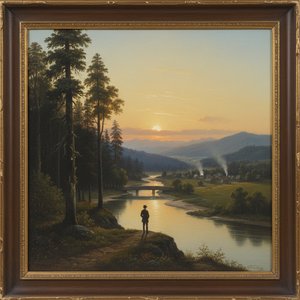
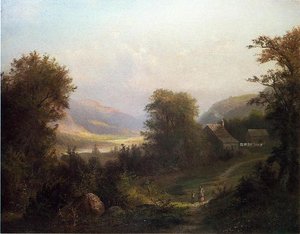
Step into a tranquil world captured by American artist David Johnson in his 1864 painting, “Landscape with House.” This evocative work exemplifies the hallmarks of the Hudson River School and showcases Johnson’s mastery of Luminism. The scene unfolds as an idyllic panorama: a charming house nestled near water's edge, framed by a majestic central tree and surrounded by a scattering of other trees and figures engaged in everyday activities. It is more than just a depiction of nature; it's a window into the heart of rural American life during the mid-19th century.

Luminism and Artistic Technique

Johnson, alongside artists like John Frederick Kensett and John William Casilear, was instrumental in developing Luminism—a subgenre within the Hudson River School characterized by its emphasis on atmospheric effects, soft light, and a sense of stillness. Notice how Johnson uses subtle gradations of color to create an almost ethereal quality. The painting’s strength lies not in dramatic brushstrokes or bold contrasts, but in the delicate handling of light and shadow, which imbues the scene with a quiet luminosity. The tightly painted details, meticulously rendered from preliminary studies of specific trees—a practice Johnson was known for—demonstrate his commitment to accuracy and observation. This meticulous approach contributes to the painting's overall sense of realism while maintaining an idealized beauty.

Historical Context & The Hudson River School

Painted in 1864, "Landscape with House" reflects a period of significant change and expansion in America. The Hudson River School emerged as a response to the rapid industrialization and urbanization occurring during the mid-19th century. Artists sought refuge and inspiration in the vast, unspoiled landscapes of the Northeastern United States, celebrating the beauty and grandeur of nature as a symbol of national identity and spiritual renewal. Johnson’s work aligns with this movement's desire to capture the sublime power and tranquility of the American wilderness, offering viewers an escape from the burgeoning complexities of modern life. His early studies alongside Kensett and Casilear further cemented his place within this influential artistic circle.

Symbolism & Emotional Resonance

Beyond its aesthetic appeal, "Landscape with House" carries subtle symbolic weight. The house represents domesticity, stability, and the promise of a peaceful life. The prominent tree often symbolizes strength, longevity, and connection to nature—a recurring motif in 19th-century American art. The figures scattered throughout the landscape suggest community and shared experience. Collectively, these elements evoke feelings of serenity, nostalgia, and appreciation for the simple pleasures of rural existence. Johnson’s masterful use of light creates a sense of harmony and balance, inviting viewers to immerse themselves in this tranquil scene and contemplate the beauty of the natural world.

Questions & Answers

What color intensity does "Landscape with House" by David Johnson have?

The colors in "Landscape with House" by David Johnson have a balanced intensity.

What does "Landscape with House" share with the rest of David Johnson's output?

"Landscape with House" belongs to David Johnson's Hudson River School work, whose recorded themes include jasper francis cropsey mentorship, hudson river school traditions, luminism movement principles, idealized rural american life, appreciation of natural beauty, quiet contemplation & serenity, typical of johnson's small-scale works.

Is "Landscape with House" by David Johnson a light or a dark artwork?

The recorded values for "Landscape with House" by David Johnson are: brilliant brightness, bright balance luminance.

More about this painting

Preview AR preview Switch to Print Switch to Digital Image Send
Details Guide Add to favorites Download Similars X-Ray Diaporama Q&A Stats

In numbers

  • 1864the year it was painted
  • 29frames to choose from
  • standard sizes, in its own proportions
  • 5weeks to paint and deliver it
David Johnson

David Johnson

1827 - 1908, United States of America

Quick facts about David Johnson

  • Full Name: David Johnson
  • Nationality: American
  • Date Of Birth: 1827
  • Date Of Death: 1908
  • Place Of Birth: New York, United States of America
  • Notable Artworks:
    • View of Dresden, Lake George
    • Schooley’s Mountain, NJ
    • Pear Blossoms
  • Artistic Movement Or Style: Hudson River School, Luminism, Barbizon influence
  • Artists Who Influenced This Artist:
    • Jasper Francis Cropsey
    • John Frederick Kensett
    • John William Casilear
  • Artists Or Movements Influenced By This Artist: ['Barbizon School']

Artist Biography

David Johnson: Weaver of Northeastern Light

David Johnson, born in New York City in 1827, wasn’t a name etched into the public consciousness during his lifetime, yet his contributions to American landscape painting are profoundly significant. He belonged to the second generation of the Hudson River School, a movement that sought to capture the sublime beauty and spirit of America's natural world – a legacy he inherited and subtly reshaped over a remarkably productive career spanning nearly five decades. Unlike some of his more flamboyant contemporaries, Johnson’s approach was characterized by quiet observation, meticulous detail, and an almost meditative quality, earning him recognition as a master of Luminism, a style emphasizing subtle tonal variations and atmospheric effects to evoke mood and atmosphere rather than dramatic spectacle.

Johnson's early artistic journey began with limited formal training. He registered at the National Academy of Design in 1845 and 1846, initially studying antique art before gravitating towards landscape painting. Crucially, he apprenticed briefly under Jasper Francis Cropsey, a pivotal figure in the Hudson River School known for his dramatic depictions of wilderness scenes. However, Johnson’s artistic philosophy leaned toward a more restrained approach, influenced by his own direct engagement with nature. His first significant work, “Hanes Fall, Kauterskill Clove” (1849), painted alongside Cropsey and John William Casilear, marked the beginning of his professional career and demonstrated his nascent talent for capturing the nuances of light and shadow in the Adirondack mountains. This early collaboration underscored a shared commitment to observing and translating nature’s complexities onto canvas – a foundation upon which Johnson would build his distinctive style.

The Luminist Touch

Johnson's artistic development during the 1850s saw him refine his technique, moving away from the overtly romanticized landscapes of earlier Hudson River painters. He began to prioritize accuracy and subtlety, meticulously rendering details like tree bark, rock formations, and reflections in water. This period witnessed a shift towards Luminism – a style characterized by soft, diffused light, atmospheric perspective, and an emphasis on capturing the fleeting effects of sunlight. His paintings during this time often featured solitary figures dwarfed by the vastness of nature, evoking feelings of tranquility, contemplation, and a deep connection to the natural world. The influence of artists like Casilear and Kensett was evident, but Johnson developed his own unique voice within the Luminist framework – one marked by an almost photographic realism combined with a profound sense of atmosphere.

Notable works from this era include depictions of Lake George, where he captured the shimmering surface of the water and the surrounding forests with remarkable precision. These scenes weren’t merely representations of scenery; they were imbued with a palpable sense of mood – the cool stillness of dawn, the hazy warmth of afternoon light, the dramatic shadows cast by towering pines. Johnson's ability to translate these subtle shifts in light and atmosphere onto canvas is what truly sets his work apart.

A Shift Towards Barbizon Influence

As the 1870s unfolded, Johnson’s artistic style underwent a noticeable transformation. He began to incorporate elements of the French Barbizon School, known for its emphasis on plein air painting and the depiction of rural landscapes bathed in soft, diffused light. This stylistic shift, while initially met with mixed reactions from his colleagues within the Hudson River School, reflected a broader trend among American artists seeking to engage with European artistic developments. Johnson’s paintings during this period often featured pastoral scenes of central New York State – rolling hills, farms, and small villages – rendered in a muted palette and characterized by a sense of quiet intimacy.

Despite the Barbizon influence, Johnson never entirely abandoned his Luminist roots. His later works retained a sensitivity to light and atmosphere, but with a greater emphasis on tonal values and subtle color variations. He continued to paint iconic landscapes like “Schooley’s Mountain, New Jersey” (1874), showcasing his mastery of capturing the essence of Northeastern scenery – a testament to his lifelong dedication to observing and translating nature's beauty onto canvas.

Legacy and Recognition

David Johnson’s career spanned nearly half a century, during which he exhibited extensively in major American art centers, including Chicago, Boston, and Philadelphia. While he never achieved the widespread fame of some of his contemporaries, his work gained renewed appreciation in the late 20th century, largely due to the efforts of scholars who recognized his unique contribution to the Hudson River School and Luminism. Today, Johnson’s paintings are valued for their technical skill, atmospheric quality, and evocative depictions of Northeastern scenery – a quiet but enduring legacy that continues to resonate with art lovers.

His work is now housed in prestigious collections such as the Herbert F. Johnson Museum of Art at Cornell University and the Piasecka-Johnson Collection in Princeton, ensuring that his contributions to American landscape painting will be enjoyed by generations to come.

Quick Facts

  • Artist: David Johnson
  • Subject or theme: Rural landscape, tranquility
  • Influences: Jasper Francis Cropsey
  • Title: Landscape with House

Art Quiz

There is only one correct answer for each question.

Question 1:
David Johnson is recognized as a member of which artistic movement?
Question 2:
What is a defining characteristic of David Johnson's signature works, according to the provided biography?
Question 3:
The description of 'Landscape with House' highlights a sense of what atmosphere?
Question 4:
What is Luminism, which Johnson helped develop alongside Kensett and Casilear?
Question 5:
Based on the image description, what is located near the house in the background?