 Preview
 Send
Send Share
Share
 Details
 Guide
Guide

 Download
 Similars
 X-Ray
X-Ray Diaporama
 Q&A
Q&A Stats
StatsB1119d469eec73ca06a2d9f9e9f65708


 Read More
Get a print-ready file that goes far beyond the web preview. Every digital image we sell comes from a high-resolution master in our stock database — usually 5,000 to 15,000 pixels wide — so you can print large, crop tightly, or reproduce fine detail with confidence.
No file leaves our studio untouched. A digital expert checks the colors against the original painting and corrects them if needed, then improves clarity and detail with professional retouching tools — always staying faithful to the artist's brushwork and style. The result is an image that looks like the painting, not like a filtered scan.
You approve before you're done: our expert sends the image by e-mail within 72 hours for your review. Not satisfied? Ask for improvements or corrections, or request a refund if the quality falls short.
This is the quality relied on by publishers, design studios, galleries and print shops.
Digital Image
Download a high-resolution file for personal display, printing, and creative projects. ( Switch to Print Buy Hand Made Painting)
Included in Every Digital Image Order
Expert Digital Delivery, Guaranteed
When you choose OriginalUniqueArt.com, you're not just getting an image - you're receiving a professionally enhanced digital artwork, crafted with precision and backed by a satisfaction guarantee. Here's everything that comes with your order, automatically:

Fast Email Delivery
Your high-resolution digital image file will be emailed to you within 72 hours of ordering - ready for immediate use.

AI-Enhanced Digital File
Your artwork is professionally optimized using advanced AI tools and manual editing, ensuring maximum detail, clarity, and color accuracy.

Free Lifetime Re-Delivery
Accidentally deleted or lost your file? No worries - we'll resend it to you anytime, free of charge.

No Import Fees - Ever
Enjoy your artwork instantly with zero customs, duties, or delivery fees - digital downloads are always tax-free.

Color Accuracy Guarantee
We ensure your digital image reflects the original colors as closely as possible using professional tools and color management.

100-Day Satisfaction Guarantee
If you're not satisfied with your digital image, we'll revise it or refund 100% within 100 days - no questions asked.

100% Money-Back Guarantee
Not satisfied? Get a full refund within 100 days of receiving your digital file - no questions asked.

Bulk Order Discounts
Buy 3 images, save 10% - Buy 5, save 15% - Buy 10+, save 20%. Great for creative projects, galleries, and agencies.
A Symphony of Light and Color
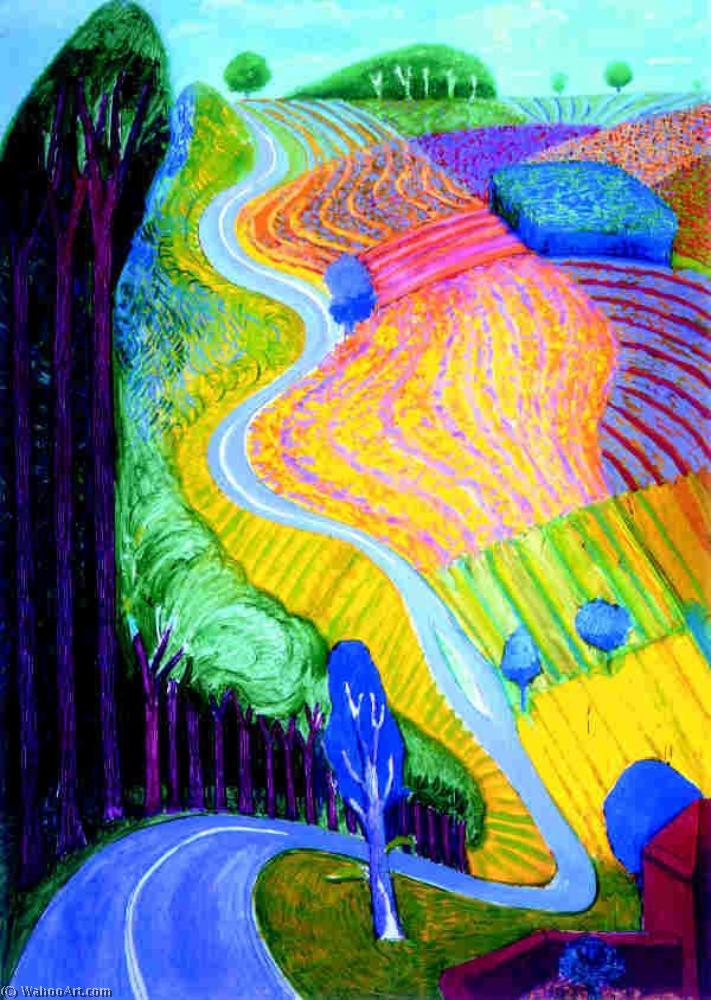
In the vast landscape of contemporary art, few names resonate with as much vibrancy and visual joy as David Hockney. His work, particularly in pieces like this breathtaking landscape, serves as a profound celebration of the act of seeing. The painting presents a sweeping, idyllic countryside where a winding road meanders through lush fields of crops, inviting the viewer to embark on a journey alongside the figures scattered throughout the scene. It is not merely a depiction of a place, but an invitation into a moment of pure, sun-drenched tranquility. Through a masterful use of color, Hockney captures the very essence of warmth, utilizing a bold palette of yellows and oranges that suggests sunlight filtering through dense foliage, evoking the radiant atmosphere of his beloved California as much as the rolling hills of England.
The emotional resonance of this work lies in its ability to bridge the gap between observation and feeling. While the subject matter—a peaceful pastoral setting—might appear simple at first glance, the execution is deeply complex. There is a palpable energy within the brushwork that mirrors the vitality of nature itself. For the collector or interior designer, this piece offers more than just decoration; it provides a window into a state of reverie. It possesses a quiet dignity that can anchor a room, offering a sense of optimism and light that transforms any space it inhabits.
Technique and the Art of Perspective
To understand the brilliance of this work, one must look closer at the innovative techniques that define Hockney’s late-career mastery. Moving away from the traditional single-canvas format, Hockney often employs a method he refers to as “joinery.” By meticulously layering multiple canvases together—sometimes up to six—he creates expansive, panoramic views that defy the standard boundaries of a frame. This technique allows for a synthesized perspective, mimicking the way the human eye naturally scans a horizon, capturing multiple viewpoints within a single, cohesive vision. The resulting surface is beautifully textured and subtly uneven, adding a physical dimension to the light and shadow depicted.
This approach places the work firmly within the lineage of Impressionism, yet it is infused with a distinctly Postmodern sensibility. Unlike the soft, hazy edges of the nineteenth-century masters, Hockney’s lines are often more defined and his colors more saturated, reflecting a modern fascination with clarity and visual sensation. He rejects the heavy intellectualism of much contemporary art in favor of a direct, visceral connection to the natural world. This makes the piece an ideal choice for those seeking high-quality reproductions that bring both sophisticated technique and an approachable, luminous beauty into their homes or galleries.
A Legacy of Observation
Historically, Hockney’s work emerged as a vital response to the dominance of Abstract Expressionism, reintroducing the importance of the figure and the landscape through a lens of stylized realism. His career has been a lifelong exploration of how light transforms reality, a pursuit that has made him one of the most influential artists of the twentieth and twenty-first centuries. This particular landscape stands as a testament to his ability to find extraordinary beauty in the ordinary, turning a simple country road into a monumental study of light, space, and human presence.
For those looking to invest in art that inspires wonder, this reproduction captures the soul of Hockney’s vision. It is a piece that celebrates the enduring beauty of our world and the profound importance of taking the time to truly observe it. Whether placed in a sunlit living area or a curated professional studio, the painting acts as a constant reminder of the warmth and vibrancy that can be found when we look at the world with open eyes.
Questions & Answers
Where do the visitors of "B1119d469eec73ca06a2d9f9e9f65708" by David Hockney come from?
A Stats page exists for "B1119d469eec73ca06a2d9f9e9f65708". It charts the monthly visits of the artwork and of the artist's other works, with country and language breakdowns.
How do I preview a reproduction of "B1119d469eec73ca06a2d9f9e9f65708" by David Hockney?
To preview a reproduction of "B1119d469eec73ca06a2d9f9e9f65708" by David Hockney, open the artwork's Preview page.
What other names is David Hockney known by?
Other names recorded for David Hockney, creator of "B1119d469eec73ca06a2d9f9e9f65708", include Mr. David Hockney.
Artist Biography
The Life and Early Years of David Hockney
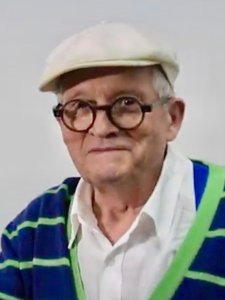
David Hockney arrived on July 9, 1937, in Bradford, West Yorkshire, England. He grew up in a household of five children, the fourth of the group. His father, Kenneth Hockney, worked as an accountant's clerk and had been a conscientious objector during the Second World War. His mother, Laura, was a Methodist and a strict vegetarian. These early years were spent in the industrial landscape of Yorkshire, a place of brick factories and bustling markets.
His schooling began at Wellington Primary School and continued at Bradford Grammar School. During this time, the surroundings of Bradford shaped his way of seeing. The grit of the industrial heartland and the specific light of the region provided a backdrop to his formative years. He was a child of a family that valued independent thought, influenced by his father's convictions during the war.
Artistic Training and Education in Britain
The foundation of his practice was built through years of looking closely at the world. From 1953 to 1957, he studied at the Bradford School of Art. This period focused on the mechanics of seeing. He spent his time practicing drawing from life and portraiture, honing the traditional skills of observation that would remain central to his work for decades. There was a heavy emphasis on the precision of the line and the way a subject sits in space.
Moving from the industrial landscape of Yorkshire to London, he entered the Royal College of Art. This was a time of intense technical development. He worked through the curriculum with a focus on the fundamentals of form and the nuances of light. By 1962, he graduated from the Royal College of Art with a Gold Medal distinction. This recognition marked the end of his formal education in Britain and the beginning of a career defined by a constant, restless curiosity about how to represent the things he saw.
The Pop Art Movement and Los Angeles
The 1960s saw Hockney becoming a central figure in the Pop Art movement. While others in the movement leaned into the commercial aesthetics of American mass culture, his approach remained personal. He moved from London to Los Angeles in 1964, a shift that changed the way he saw color and light. The intense Californian light became a constant presence in his work, stripping away the muted tones of his earlier years. He began to document the city's charm from the perspective of an outsider, focusing on the way light hits surfaces and the specific, saturated blues of a swimming pool.
This period is defined by his fascination with leisure and the geometry of suburban life. He spent much of his time looking at the way water moves and reflects, a challenge he met through his celebrated swimming pool series. These paintings captured the hedonistic stillness of poolside life with crisp lines. He moved away from the abstract trends of the time, choosing instead to paint people and recognizable objects. His work from this era often explored the quiet intimacy of relationships and the way space is perceived through a lens of bright, direct light.
- A Bigger Splash (1967)
- Beverly Hills Housewife (1966)
- Portrait of an Artist (Pool with Two Figures) (1972)
Technique and Evolving Visual Language
Hockney’s practice is a continuous movement between different ways of seeing. He has never stayed within the limits of a single medium, moving through painting, drawing, printmaking, and photography. His approach often begins with direct observation and drawing from life. He uses portraiture to study the way a face holds a likeness, but he also experiments with how space is structured. By using reverse perspective, he disrupts the traditional way we look at a scene, creating a sense of depth that feels different from a standard photograph. He has often used photography as a preparatory medium, using the camera to capture a moment before translating it into a painting.
The way he handles color and light has changed as his tools have changed. In his earlier years, he worked with acrylics to achieve saturated hues, particularly when depicting the movement of water in swimming pools. Later, he turned toward digital media. Using iPads, he began to reimagine landscapes, finding a new way to capture the shifting light and color of the natural world. This shift from physical paint to digital screens shows a persistent interest in how technology can change our perception of a place. His work is a record of these technical shifts, from the precise line of a drawing to the layered compositions of a digital landscape.
- A bigger splash (1967)
- Portrait of an Artist (Pool with Two Figures) (1972)
- The Arrival of Spring in Woldgate (undated)
Key Works and Iconic Paintings
The way light hits a surface often dictates the direction of a painting. In 1961, We Two Boys Together Clinging explored the intimacy of connection through a lens of symbolism and text. This early work shows a focus on the relationships between people and the marks left by their presence. Later, the shift toward the bright, saturated colors of California changed the way water was handled on canvas. A Bigger Splash, created in 1967, captures a moment of movement in a swimming pool, using crisp lines to define the way light and liquid interact.
The focus often shifts between the landscape and the people within it. In 1971, Mr and Mrs Clark and Percy brought together a sense of companionship and character. This approach to portraiture continued with Portrait of an Artist (Pool with Two Figures in 1972, where the use of photography as a preparatory medium helped define the spatial arrangement. These works show a persistent interest in how we see space and how people occupy it.
- We Two Boys Together Clinging (1961)
- A Bigger Splash (1967)
- Mr and Mrs Clark and Percy (1971)
- Portrait of an Artist (Pool with Two Figures) (1972)
Stage Design and Opera Commissions
The visual language Hockney developed on canvas often found a different rhythm within the theater. His work in stage design involved long periods of concentration, sometimes lasting more than a year for a single production. He moved from the flat surface of a painting to the three-dimensional space of the stage, creating sets for Mozart's The Magic Flute. This transition required a shift in how he handled light and movement, translating his interest in perspective into environments that could accommodate live performance.
His involvement with opera included the staging of Igor Stravinsky’s The Rake’s Progress in 1975. Later, in 1990, he created designs for Giacomo Puccini’s Turandot. These projects required him to think about how a character moves through a space and how a set can change as the music shifts. He also applied his eye for composition to fashion, designing the cover and pages for the December 1985 issue of the French edition of Vogue. In these instances, the focus remained on how a subject is framed and how color interacts with the viewer's eye.
Legacy and Global Recognition
The weight of a long career often settles in the honors bestowed by institutions. In 2000, the Laureate of the Praemium Imperiale for Painting was awarded to him. Later, in 2003, he was elected a Fellow of the Royal Society. These recognitions arrived alongside a steady presence in the public eye, moving from the early days of the Pop Art movement into a position as one of the most influential British artists of the 20th and 21st centuries.
His place in the cultural landscape was further marked in 2018 when he was appointed Order of the Companion of Honour. This recognition follows decades of work that moved from the grit of Yorkshire to the bright light of California, and eventually into the digital realm of iPad drawings. His influence is felt not only in the galleries but in the way he changed the way we look at space and perspective through his various mediums.
- A bigger splash (1967)
- American Collectors (Fred and Marcia Weisman) (1968)
- Portrait of an artist pool with two figures (1971)
- A bigger grand canyon (1998)
Where to See His Works Today
To see his work in person, one might travel to the 1853 Gallery at Salts Mill in Saltaire. This space holds many of his pieces, keeping a connection to the industrial landscape of his youth. The David Hockney Foundation also maintains a large group of his works, preserving much of his output for study and viewing.
His paintings and drawings are scattered through major institutions across different continents. In the United Kingdom, the Tate collection includes his pieces. Across the Atlantic, his presence is felt in the Metropolitan Museum of Art and the Museum of Modern Art. These collections hold various stages of his career, from his early figurative works to his later explorations of light and color.
- A bigger splash
- American Collectors (Fred and Marcia Weisman)
- Portrait of an artist pool with two figures
- A bigger grand canyon
- Place furstenberg, paris
David Hockney
1937 - , United Kingdom
Quick Facts
- Artists Who Influenced This Artist: ['Frank Lisle']
- Full Name: David Hockney
- Nationality: British
- Notable Artworks:
- A Bigger Splash
- American Collectors
- We Two Boys Together Clinging
- Portrait of an Artist
- The Arrival of Spring in Woldgate
- Place Of Birth: Bradford, United Kingdom
- Date Of Birth: 1937