Preview
 Send
Send Share
Share
 Details
 Guide
Guide

 Download
 Similars
 X-Ray
X-Ray Diaporama
 Q&A
Q&A Stats
StatsThe Death of Nelson

- 35300.0 x 9850.0 cm


 Read More
Giclée / Art Print
Museum-quality giclée or canvas print with fast production and flexible finish options. ( Buy Hand Made Painting Switch to Digital Image)




P118B $10

P118H $10

P118W $10

P438Z $10

P508JH $12

P508YH $12

P805H $10

P805Z $10

P919BZ $10

P919G $10

P919XJ $10

P959ZH $10

P968JZ $12

W106C $8

W218G $10

W218JH $8

W218Y $10

W307PJ $10

W316G $10

W316PJ $8

W316Y $10

W398PJ $8

W4111J $10

W500HY $15

W500JH $15

W692G $12

W849H $8

W940BG $15

W953PJ $8




Pick from our preset sizes that match the artwork's original proportions.

Type the width and the height you need, to fit your frame or your wall. A print can only be cut, never made bigger than the picture, so a size with a different shape loses a part of the image. We send you a digital mockup to approve before we print anything. The picture shown on this page does not show the real cut — only the mockup does.
Worldwide Delivery () in 2 weeks instead of standard 4/5 weeks. (8 November)

Free Worldwide Express Shipping

High-Quality Linen Canvas

Full Shipping Insurance

Customs Tax Refund Guarantee

True Color Matching Guarantee

100-Day Return Policy (Defects Only)

100% Money-Back Guarantee

Bulk Discount Offer
 Glass option is only available in size under 110 CM

The Death of Nelson
Giclée / Art Print
Reproduction Size
-


Total Price
$ 81
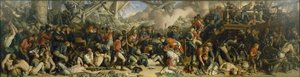
A Dramatic Tableau of Heroic Sacrifice: Daniel Maclise’s “The Death of Nelson”
Daniel Maclise's monumental fresco, "The Death of Nelson," commissioned for the House of Lords in 1864, stands as a testament to Victorian artistic ambition and a poignant depiction of one of Britain’s greatest naval victories. More than just a historical record, it’s an emotionally charged scene meticulously crafted to convey the profound grief and solemn remembrance felt by those who witnessed Lord Nelson's final moments aboard HMS Victory during the Battle of Trafalgar. This artwork isn’t merely observed; it’s experienced—a visceral portrayal of loss interwoven with grandeur.A Masterpiece of Composition and Detail
Maclise, a prolific artist known for his portraits and historical paintings, approached this ambitious project with unwavering dedication to accuracy and theatrical presentation. He consulted firsthand accounts from Trafalgar veterans, incorporating realistic naval equipment – including a dismantled cannon – to ensure the fresco resonated with authenticity. The sheer scale of the painting (35300 x 9850 cm) immediately commands attention, immersing viewers in a panoramic vista of sorrowful faces and heroic gestures. Maclise’s masterful use of perspective creates depth and dynamism, guiding the eye across the tableau and emphasizing the central figure—Nelson himself—a man brought low by mortal injury yet upheld by the unwavering support of Captain Hardy.Symbolism Rooted in Victorian Values
The fresco's symbolism speaks powerfully to the Victorian ethos of duty, honor, and sacrifice. Nelson’s body lies prone amidst a sea of mourners – officers, sailors, and civilians—each reacting with palpable emotion. The tangled rigging of the Victory serves as a visual anchor, representing not only the battlefield but also the inescapable grip of fate. The inclusion of Dr Beattie, Lieutenant Ram, Captain Adair, and Sergeant Secker underscores the universality of human experience in confronting mortality. These figures are not merely participants; they embody the collective grief of a nation mourning its hero.Technique: Oil Paintsmanship Elevated
Maclise employed oil paint on canvas—a technique favored for its ability to capture subtle tonal variations and achieve luminous effects—to convey the solemn atmosphere of the scene. His brushstrokes are deliberate and expressive, meticulously layering colors to build up texture and depth. The artist’s attention to anatomical detail is remarkable, reflecting his rigorous training in anatomy at the Royal Academy Schools. Furthermore, Maclise skillfully utilized chiaroscuro – dramatic contrasts between light and dark – to heighten emotional impact, highlighting Nelson's vulnerability against the backdrop of heroic figures and conveying the overwhelming sadness of the occasion.Legacy and Reproduction
Today, “The Death of Nelson” resides in the Walker Art Gallery in Liverpool, a testament to Maclise’s enduring artistic legacy. Its influence extends beyond its original context, inspiring countless reproductions that allow audiences worldwide to appreciate its grandeur and contemplate its profound themes. OriginalUniqueArt.com offers exceptional high-quality prints of this iconic artwork, capturing the essence of Maclise's vision and transporting viewers back to Victorian England—a moment frozen in time, forever etched with sorrow and remembrance.Questions & Answers
How strong are the colors of "The Death of Nelson"?
"The Death of Nelson" by Daniel Maclise is recorded with a subtle color saturation and a balanced intensity.
Where can I buy a hand-painted reproduction of "The Death of Nelson" by Daniel Maclise?
You can order a hand-painted reproduction of "The Death of Nelson" by Daniel Maclise directly on its Hand-Painted Reproduction page: a hand-painted oil reproduction on linen canvas, made to order.
What is "The Death of Nelson" about?
The subjects of "The Death of Nelson" are battle trafalgar, nelson death, victorian painting, military history, portrait composition, british art, marine scene.
Artist Biography
Early Life and Education
- Born: January 25, 1806, Cork, Ireland
- Died: April 25, 1870, London, England
- Parents: Alexander McLish (tanner/shoemaker) and Rebecca McLeish
- Early education in Cork; showed artistic talent from a young age.
- Studied at the Cork School of Art, focusing on drawing and anatomy.
- Self-funded move to London in 1827 to pursue art studies.
- Entered the Royal Academy Schools in 1828, excelling in life drawing and history painting.
Career and Major Works
- Rapidly gained recognition for his portrait skills, notably depicting Charles Kean and Niccolò Paganini.
- Contributed significantly to *Fraser's Magazine* under the pseudonym "Alfred Croquis," creating a series of character portraits that enhanced his reputation.
- Became an Associate of the Royal Academy in 1835 and a full member in 1840.
- Notable Works:
- The Meeting of Wellington and Blücher after the Battle of Waterloo (located at Westminster Palace)
- The Death of Nelson (located at Westminster Palace) – A monumental fresco considered one of his masterpieces.
- The Chivalric Vow of the Ladies and the Peacock
- Illustrations for Charles Dickens' Christmas books and other works.
Artistic Style and Influences
- Maclise’s style blended historical narrative with elements of realism and portraiture.
- Influenced by French and classical art, particularly after his visit to Paris in 1830.
- His work often depicted scenes from history, literature (Shakespeare), and mythology.
- Demonstrated a keen eye for detail and characterization in both portraits and historical compositions.
Later Life and Legacy
- Intense dedication to his art took a toll on his health.
- Declined the presidency of the Royal Academy in 1865 due to declining health.
- Died in Chelsea, London, in 1870.
- A memoir was published by William Justin O'Driscoll in 1871.
- Maclise’s murals at Westminster Palace remain significant contributions to British art and architecture.
- His illustrations for Dickens helped popularize the author's works.
- Considered a key figure in Victorian-era history painting, bridging the gap between Neoclassicism and Realism.
Historical Significance
- Maclise played a crucial role in documenting significant historical events and figures for a wider audience.
- His work reflects the cultural and artistic trends of the 19th century, particularly the Victorian era's fascination with history and literature.
- He helped establish the tradition of large-scale narrative painting within British art.
- His contributions to Westminster Palace’s decoration are integral to the building's aesthetic and symbolic importance.

Daniel Maclise
1806 - 1870 , Ireland
Quick Facts
- Artistic Movement Or Style: Historical narrative, realism and portraiture
- Artists Who Influenced This Artist:
- French art
- Classical art
- Full Name: Daniel Maclise
- Nationality: Irish
- Notable Artworks:
- The Death of Nelson
- The Meeting of Wellington and Blücher
- The Chivalric Vow of the Ladies and the Peacock
- King Cophetua and the Beggar Maid
- The Sleeping Beauty
- Place Of Birth: Cork, Ireland
- Date Of Birth: 1806
- Date Of Death: 1870
Related Articles

The Enduring Legacy of Fresco: Technique, History & Artistic Expression Across Cultures
Explore the rich history & enduring legacy of fresco painting! Discover ancient techniques, Giotto's masterpieces, and modern applications. Expert insights for art lovers & professionals.

The Fresco as Family Legacy: Preserving Heritage Through Wall Art
Explore the rich history & enduring legacy of fresco painting. Discover how to preserve family heritage through stunning wall art. Expert insights & restoration guidance.

Art That Lives With You: The Emotional Power of a Custom Interior Fresco
Discover the emotional power & timeless beauty of custom interior frescoes. Explore history, design tips & expert guidance from – creating lasting legacies.
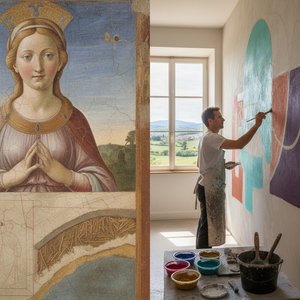
The Enduring Legacy of Fresco Painting: Techniques, History & Contemporary Relevance
Explore the rich history & enduring artistry of fresco painting – from Giotto to Michelangelo! Discover techniques, conservation efforts, & modern applications. Learn how OriginalUniqueArt brings this timeless art form to your home.

Daniel Maclise: Historical Narratives & Romantic Ideals in 19th-Century British Art
Explore the life & works of Daniel Maclise, a leading Victorian historical painter. Discover his captivating murals, Shakespearean scenes, and portraits at OriginalUniqueArt.com – handmade oil paintings & museum-quality prints.