
 Preview
 Send
Send Share
Share
 Details
 Guide
Guide

 Download
 Similars
 X-Ray
X-Ray Diaporama
 Q&A
Q&A Stats
StatsEcho and Narcissus

 Read More
Giclée / Art Print
Museum-quality giclée or canvas print with fast production and flexible finish options. ( Buy Hand Made Painting Switch to Digital Image)




































Pick from our preset sizes that match the artwork's original proportions.

Type the width and the height you need, to fit your frame or your wall. A print can only be cut, never made bigger than the picture, so a size with a different shape loses a part of the image. We send you a digital mockup to approve before we print anything. The picture shown on this page does not show the real cut — only the mockup does.
Worldwide Delivery () in 2 weeks instead of standard 4/5 weeks. (10 November)

Free Worldwide Express Shipping

High-Quality Linen Canvas

Full Shipping Insurance

Customs Tax Refund Guarantee

True Color Matching Guarantee

100-Day Return Policy (Defects Only)

100% Money-Back Guarantee

Bulk Discount Offer
 Glass option is only available in size under 110 CM

Echo and Narcissus
Giclée / Art Print
Reproduction Size
-


Total Price
$ 81
Echo and Narcissus by Pier Francesco Mola: A Baroque Masterpiece
- Artist: Pier Francesco Mola (Il Ticinese)
- Date: Unknown
- Medium: Oil on Canvas (likely, based on similar works)
A Scene of Despair and Reflection
Pier Francesco Mola's "Echo and Narcissus" presents a poignant moment from Greek mythology. The painting depicts Narcissus, a strikingly handsome youth, consumed by his own reflection in a pool of water. He appears to be in distress or discomfort, his head bowed as he gazes at the image before him. The scene is set outdoors, suggested by the trees visible in the background, creating a naturalistic backdrop for this psychological drama. Two dogs are present – one near the left side and another closer to the right – seemingly observing Narcissus with an almost unsettling curiosity. Their presence adds a layer of complexity to the narrative, hinting at a world beyond Narcissus's self-absorption.
Baroque Style and Technique
"Echo and Narcissus" exemplifies the High Baroque style prevalent in 17th-century Rome, where Mola spent much of his career. Mola’s work is characterized by dynamic compositions, dramatic lighting (though subtle here), and a focus on emotional intensity. While known for his frescoes, Mola also excelled in smaller paintings like this one, demonstrating his skill in capturing nuanced expressions and atmospheric detail. The loose style, influenced by Titian, Albani, and Guercino, is evident in the brushwork and the rendering of textures – particularly in the foliage and Narcissus’s garments. The painting likely utilizes oil paints on canvas, a common technique for achieving rich colors and subtle gradations of tone during that period.
Mythological Significance and Symbolism
The subject matter itself is deeply symbolic. The myth of Echo and Narcissus explores themes of vanity, self-love, unrequited love, and the destructive nature of obsession. Narcissus's inability to look beyond his own beauty leads to his demise – he wastes away gazing at his reflection until only a flower remains. Echo, who was cursed to only repeat the words of others, represents lost communication and unattainable desire. Mola’s interpretation focuses primarily on Narcissus’s internal struggle, emphasizing the psychological torment rather than the tragic outcome. The dogs could symbolize fidelity or perhaps even a commentary on the indifference of nature to human suffering.
Emotional Impact and Artistic Legacy
Mola's "Echo and Narcissus" evokes a sense of melancholy and introspection. The painting’s power lies in its ability to convey complex emotions through subtle gestures and facial expressions. The downward gaze, the slumped posture, and the overall atmosphere of quiet despair create a deeply moving image. As a painter active around Rome, Mola's work bridged classicism with looser handling, influencing subsequent generations of artists. Owning a reproduction of this painting offers an opportunity to bring a touch of Baroque drama and timeless beauty into any space, inviting contemplation on the human condition.
Questions & Answers
Is "Echo and Narcissus" available as a fine art print?
A print of "Echo and Narcissus" by Da Pier Francesco Mola can be ordered directly on its Fine Art Print page: a fine art print on cotton canvas or archival canvas paper.
What is the perceived brightness of "Echo and Narcissus" by Da Pier Francesco Mola?
Overall, "Echo and Narcissus" is recorded as deep_shadow. Perceived brightness describes how light or dark the work appears.
Is "Echo and Narcissus" by Da Pier Francesco Mola a light or a dark artwork?
"Echo and Narcissus" is deep_shadow overall, and its luminance is dark.
Artist Biography
The Legacy of Il Ticinese: A Master of Baroque Light and Landscape
Born in the quiet Swiss enclave of Coldrerio in 1612, Pietro Francesco Mola, famously known as Il Ticinese, emerged from the shadows of the Alps to become a luminous presence in the heart of the Roman Baroque. His artistic identity was forged through a sophisticated blend of influences, beginning with the rigorous training under the Mannerist master Cavalier d'Arpino. This early education instilled in him a profound respect for disegno—the disciplined art of drawing and anatomical precision—which would serve as the structural backbone for his later, more fluid explorations of nature. As he moved into the orbit of Francesco Albani, Mola’s style began to shed its rigid Mannerist skin, embracing a burgeoning naturalism that sought to capture the breathing essence of the world around him.
Mola’s evolution as an artist is characterized by a remarkable transition from the structured classical ideals of the Renaissance toward the emotive, theatrical dynamism of the Baroque era. While many of his contemporaries focused on the monumental scale of frescoed ceilings, Mola found a unique voice in smaller, more intimate canvases that allowed for a meticulous study of light and atmosphere. His work often serves as a bridge between the intellectual rigor of composition and the visceral beauty of the natural landscape. This duality is perhaps most evident in his ability to weave complex allegorical themes into settings that feel tangibly real, inviting the viewer to step into a world where the divine and the earthly intersect through soft shadows and rich, evocative textures.
Mastery of Narrative and Allegory
The true brilliance of Mola lies in his capacity to infuse biblical and mythological narratives with a sense of profound human emotion. His paintings are rarely mere illustrations; they are dramatic stages where light acts as a primary protagonist. In works such as L'Ange Apparissant à Agar dans le Désert, one can witness his mastery of evocative lighting, using chiaroscuro to highlight moments of divine grace and spiritual vulnerability. Similarly, his depictions of historical or legendary scenes, such as the poignant Herminie et Valfrino soignent les blessures de Tancrede après le combat d'Argante, demonstrate a deep empathy for his subjects, capturing the tender nuances of care and compassion amidst the harsh realities of conflict.
Beyond the purely religious or heroic, Mola possessed a keen intellect for the allegorical. His Allegory of Geography stands as a testament to his ability to utilize the Baroque language of symbolism to celebrate human curiosity and the era's spirit of exploration. Through rich colors and detailed realism, he transformed abstract concepts like cartography into visual spectacles. This ability to synthesize disparate elements—the scientific, the mythological, and the naturalistic—ensured that his work resonated with the sophisticated patrons of Rome, from high-ranking clergy to the intellectual elite of the seventeenth century.
Historical Significance and Artistic Triumph
The zenith of Mola’s professional recognition was undoubtedly his contribution to the Roman architectural landscape, most notably his monumental fresco cycle in the Gallery of Alexander VII at the Quirinal Palace. This commission, featuring works such as Joseph Making Himself Proclaimed to His Brethren, solidified his status among the foremost painters of his generation. In these large-scale works, Mola successfully merged the theatricality required by Baroque aesthetics with a refined sense of classical balance, proving that he could command the grandest of stages just as effectively as the most intimate canvas.
Though his career was defined by the prolific output of smaller works, his impact on the development of landscape painting in Italy cannot be overstated. By moving away from the purely decorative and toward a more observational, atmospheric approach, he paved the way for future generations of landscape artists to find beauty in the subtle shifts of light and the rugged textures of the earth. Today, the legacy of da Pier Francesco Mola remains etched in the history of art as a testament to the power of a painter who could capture both the grandeur of the heavens and the quiet, breathing reality of the world below.

Da Pier Francesco Mola
1612 - 1666 , Switzerland
Quick Facts
- Full Name: Pier Francesco Mola
- Nationality: Swiss-Italian
- Date Of Birth: 1612
- Date Of Death: 1666
- Place Of Birth: Ticino, Switzerland
- Notable Artworks:
- Flight into Egypt
- Saint Jean Baptiste Prechant Dans Le Desert
- La Vision De Saint Bruno
- Herminie Gardant Ses Troupeaux Grave Sur Un Arbre Le Nom De Tancrede
- Artistic Movement Or Style: Baroque
- Artists Who Influenced This Artist:
- Cavalier d'Arpino
- Francesco Albani
- Artists Or Movements Influenced By This Artist: ['Michelangelo Merisi Caravaggio']
Related Articles

The Dramatic Flourish: Exploring the Baroque Movement's Enduring Legacy in Art History
Explore the dramatic world of Baroque art! Discover iconic artists like Caravaggio & Rubens, defining techniques, and its lasting impact on art history. Expert insights for collectors & enthusiasts at OriginalUniqueArt.
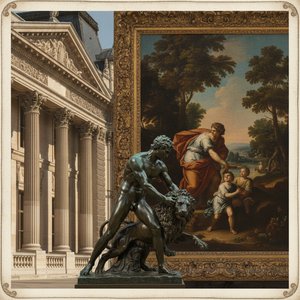
Baroque Classicism: The Grandeur of Order and Drama in 17th-Century Art History
Explore the profound elegance of Baroque Classicism. Discover how 17th-century masters synthesized dramatic emotion with classical order through the lens of the Counter-Reformation and the works of legends like Carlo Maratta and Andrea Sacchi.

Baroque Masterpieces: 10 Paintings That Defined an Era |
Journey through the drama & grandeur of Baroque art! Explore 10 masterpieces by Caravaggio, Rembrandt, Rubens & more. Discover stunning oil paintings, rich colors & timeless stories. Find museum-quality reproductions at .

Baroque Drama: Bringing Opulence & Emotion into Contemporary Interiors
Explore the opulent world of Baroque interior design! Discover key elements, modern applications & how to bring dramatic elegance into your home with OriginalUniqueArt.com's authentic reproductions.

Theatricality & Triumph: Baroque Drama in Painting & Sculpture
Explore the dramatic world of Baroque art! Discover its history, defining characteristics, & lasting influence on painting & sculpture. Expert insights into Caravaggio, Zurbarán, and Bernini – plus high-quality reproductions at OriginalUniqueArt.


