Read More


 For artworks or reproductions larger than 105 cm (approximately 41 inches) on any side, the frame will be shipped as a kit, disassembled. This method ensures safe delivery and prevents damage during transport.


More about this painting
Text size

() ·
A painting made for you, by hand
Hand Made Oil Reproduction
Hand-painted oil on canvas in your size and frame, made to order by our artists. ( Switch to Print Switch to Digital Image)
Artist Biography
Discover Da Loria Norman (1872-1935), an American artist renowned for illuminated books & mystical paintings. Explore her unique style & legacy in Smithsonian collections.
from ·
Chapter 1
How large should it be?
Slide to change the size; the picture on the left shows the frame at its real width. The proportions of the original are kept.
Standard
custom
CM
INCH
Pick from our preset sizes that match the artwork's original proportions.
Loading sizes...

width
height
Type the width and the height you need, to fit your frame or your wall. This is hand-painted, so for a size with a different shape the artist can paint a bit more around the picture, or cut a bit — you choose. We send you a digital mockup to approve before the painting starts. The picture shown on this page does not show the real result — only the mockup does.
Chapter 2
How should it arrive?
Choose the edges of the stretched canvas
Choose your frame

White $1

Blurside $1

Extended $1

P118B $10

P118H $10

P118W $10

P438Z $10

P508JH $12

P508YH $12

P805H $10

P805Z $10

P919BZ $10

P919G $10

P919XJ $10

P959ZH $10

P968JZ $12

W106C $8

W218G $10

W218JH $8

W218Y $10

W307PJ $10

W316G $10

W316PJ $8

W316Y $10

W398PJ $8

W4111J $10

W500HY $15

W500JH $15

W692G $12

W849H $8

W940BG $15

W953PJ $8

H24-GOLD $30

H24-SILVER $30

H36-GOLD $45

H36-SILVER $45
Framed
Moulding: . Overall size with the frame: .
Chapter 3
Who paints it, and should anything change?
Examples of what can be changed: Replace face with customer photo; Add pet (e.g., replace cat with dog); Include hidden message in background; Change background landscape or elements.
After order, OriginalUniqueArt.com team will email client for instructions and provide a mockup preview
After order, OriginalUniqueArt.com team will email client for instructions and provide a mockup preview
Worldwide Delivery () in 3/4 weeks instead of standard 5 weeks. (1 November). No compromise on quality.
Chapter 4
The finishing touches
A nameplate, as in a museum?
Engraved Bronze Plaque Details
This elegant plaque features the artist's name and the title of the artwork, finely engraved for a timeless presentation.
It is made from bronze with a refined, elegant finish. The text is precisely laser-engraved for a sharp and permanent result. Measuring 9x2 cm, the plaque is compact yet easy to read. It's built to be durable and scratch-resistant, offering a professional, museum-quality look. Mounting is simple thanks to the included adhesive backing.
Transparent Acrylic Plaque Details
The plaque includes essential engraved details such as the artist's name, the title of the artwork, the date it was created, the type of media used-like oil on canvas or watercolor-a brief description of the piece, and a QR code that links to the complete artwork information.
It is crafted from clear acrylic, offering a sleek, modern appearance. The text is UV-engraved in black to ensure strong visual contrast. With a size of 10x15 cm, it ensures optimal readability. It comes equipped with two metal hooks for secure wall mounting. The plaque is designed to be weather-resistant, making it suitable for various environments, and it includes interactive features that work seamlessly with smartphone scanning.
Black Acrylic Plaque Details
This elegant plaque includes engraved information such as the artist's name, the title of the artwork, the date it was created, the type of media used (like oil on canvas or watercolor), a short description of the artwork, and a QR code for quick access to more information.
The plaque itself is made from refined black acrylic with a premium finish. The text is laser-engraved in white for high contrast and readability. Its size is 10x15 cm, designed to be easy to read. It comes with two metal hooks for professional mounting. The design is sleek and fits any interior style. It is also weather-resistant and durable, with built-in digital integration for mobile compatibility.
A protective varnish?
When do you need it?
Chapter 5
Your painting, as you ordered it
Untitled
Reproduction Medium
Reproduction Size
-
Elite Senior Artist
More detail, finesse, and extra production time
-
Reproduction Frame
-
-
For artworks or reproductions larger than 105 cm (approximately 41 inches) on any side, the frame will be shipped as a kit, disassembled. This method ensures safe delivery and prevents damage during transport.
Professional assembly required - this is not a DIY product.
The kit must be assembled and the canvas stretched by an experienced professional framer, using wood glue (not supplied), a canvas stretching plier and clamps to hold the bars square while the glue dries. Incorrect assembly or uneven canvas tension can permanently damage the artwork and is not covered by our warranty.
All solid wood bars are included, precisely cut to size.
Assembled with the screws provided, plus wood glue for the corner joints, which is not supplied and must be sourced by your framer.
Professional tools are required and not included: a canvas stretching plier (tensioner) and clamps to hold the bars square while the glue dries.
Important:
The corner joints require wood glue, the bars must be held with clamps until the glue is fully dry, and tightening the canvas on the assembled frame requires a canvas stretching plier. None of these are included in the kit. Please arrange an experienced professional framer before ordering this size.
Nameplate
-
-
Protective Varnish
Glossy Varnish (enhances colors, protects against light/moisture)
-
Customize My Artwork
Examples of what can be changed: Replace face with customer photo; Add pet (e.g., replace cat with dog); Include hidden message in background; Change background landscape or elements.
-
Urgent
Worldwide Delivery () in 3/4 weeks instead of standard 5 weeks. (1 November). No compromise on quality.
-
Express Shipping
Worldwide Delivery () in 5 weeks. (8 November).
Included
Total Price
$ 300
Glass option is only available in size under 110 CM
Included with every order
- Free Worldwide Express Shipping
- High-Quality Linen Canvas
- Full Shipping Insurance
- Customs Tax Refund Guarantee
- True Color Matching Guarantee
- 100-Day Return Policy (Defects Only)
- 100% Money-Back Guarantee
- Bulk Discount Offer
 Preview
 Send
Send Share
Share
 Details
 Guide
Guide

 Download
 Similars
 X-Ray
X-Ray Diaporama
 Q&A
Q&A Stats
StatsIn numbers
- 29frames to choose from
- standard sizes, in its own proportions
- 5weeks to paint and deliver it
About the original

Da Loria Norman
1872 - 1935
Quick facts about Da Loria Norman
- Artistic Movement Or Style: Theosophical Art
- Artists Or Movements Influenced By This Artist: ['Art Nouveau']
- Artists Who Influenced This Artist: ['Walter Crane']
- Date Of Birth: 1872
- Date Of Death: 1935
- Full Name: Da Loria Norman
- Nationality: American
- Notable Artworks:
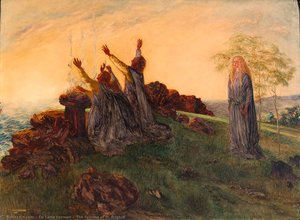
- Shipwreck
- Child of the Ages
- The Passing of St. Brighid
- Place Of Birth: New York City, USA
Artist Biography
A Luminary of Illuminated Mysticism: The Life and Art of Da Loria Norman
Da Loria Norman, born in 1872 and passing in 1935, remains a captivating figure on the periphery of established art history—a testament to the power of individual vision and dedication to esoteric themes. While biographical details are scarce, her work speaks volumes, revealing an artist deeply immersed in the currents of late 19th and early 20th-century spiritualism, Theosophy, and a profound love for the medieval tradition of illuminated manuscripts. Norman wasn’t merely replicating historical styles; she was actively *reviving* them, imbuing them with her own unique symbolism and personal philosophy. Her art offers a rare glimpse into a world where artistic expression served as a conduit to deeper spiritual understanding. She is primarily known for her exquisitely crafted illuminated books and paintings that explore mystical concepts, often drawing upon imagery from various religious traditions and esoteric schools of thought.Early Influences and Artistic Development
Norman’s path toward becoming an artist was likely shaped by the Arts and Crafts movement, which emphasized handcrafted objects and a return to pre-industrial methods of production. The influence of Walter Crane, a prominent figure in the movement known for his decorative designs and commitment to social reform through art, is evident in her meticulous attention to detail and flowing compositions. However, Norman’s artistic journey extended beyond aesthetic considerations; she was profoundly drawn to the spiritual teachings of Theosophy, a philosophical system that sought to uncover universal truths by synthesizing Eastern and Western religious traditions. This fascination with esoteric knowledge became central to her work. She didn't simply illustrate texts; she *transformed* them into visual experiences, using color, form, and symbolism to unlock hidden meanings. Her early works demonstrate a careful study of medieval manuscript illumination, particularly the intricate borders, vibrant colors, and stylized figures characteristic of the Book of Kells and other illuminated manuscripts from the Middle Ages. She wasn’t content with imitation; she sought to create something new—a contemporary expression of ancient wisdom.The Illuminated Books: A Synthesis of Art and Spirituality
Norman's most significant achievements lie in her series of illuminated books, each a labor-intensive undertaking that combined calligraphy, painting, and intricate gold leaf detailing. These were not mass-produced items but unique works of art created with painstaking care. She often wrote the texts herself, or selected passages from mystical poets and philosophers, then meticulously transcribed them onto vellum using traditional calligraphic techniques. The surrounding illustrations weren’t merely decorative; they served as visual commentaries on the text, expanding upon its themes and revealing hidden layers of meaning. The symbolism employed is rich and multifaceted, drawing upon a wide range of sources including Kabbalah, astrology, alchemy, and various Eastern religions. Her books are not easily categorized—they represent a personal synthesis of diverse spiritual traditions, expressed through the language of art. The use of gold leaf wasn’t simply for aesthetic effect; it symbolized enlightenment and divine illumination, reflecting her belief in the transformative power of artistic creation.Themes and Symbolism in Norman's Work
Recurring themes in Norman’s work include the search for spiritual truth, the interconnectedness of all things, and the journey of self-discovery. She frequently depicted celestial beings, mythical creatures, and symbolic landscapes that evoke a sense of wonder and mystery. The Tree of Life, a central symbol in Kabbalistic cosmology, appears repeatedly in her paintings and illuminated books, representing the path to enlightenment and the interconnectedness of all creation. Floral motifs, often rendered with exquisite detail, symbolize growth, transformation, and the beauty of the natural world. Her use of color is also significant—deep blues and purples evoke a sense of spirituality and transcendence, while vibrant reds and golds represent energy, passion, and divine illumination. Norman’s work isn't about providing answers; it’s about prompting questions—inviting viewers to embark on their own journey of self-discovery.Legacy and Historical Significance
Despite the relative obscurity surrounding her life, Da Loria Norman’s work has gained increasing recognition in recent years. Her illuminated books are now held in prestigious collections, including those of the Smithsonian Art Museums, attesting to their artistic merit and historical significance. She represents a fascinating example of an artist who successfully integrated spiritual beliefs into her creative practice, creating works that are both visually stunning and intellectually stimulating. Norman’s legacy lies not only in her exquisite craftsmanship but also in her ability to revive the art of illuminated manuscripts for a modern audience. She demonstrated that art could be more than just decoration—it could be a powerful tool for spiritual exploration and personal transformation. Her work continues to inspire artists and scholars alike, offering a unique glimpse into a world where art and spirituality were inextricably linked.- Known for: Illuminated Books, Mystical Paintings
- Influences: Walter Crane, Arts and Crafts Movement, Theosophy, Medieval Manuscript Illumination
- Key Themes: Spiritual Truth, Interconnectedness, Self-Discovery, Alchemy, Kabbalah
- Collections: Smithsonian Art Museums
Explore artworks organized by themes, styles, and characteristics.