 Preview
 Send
Send Share
Share
 Details
 Guide
Guide

 Download
 Similars
 X-Ray
X-Ray Diaporama
 Q&A
Q&A Stats
StatsThe Kiss


 Read More
The artwork displayed on this page is protected by copyright law, which means we cannot legally create or sell an identical reproduction. This protection is enforced under international agreements such as the Berne Convention and by national laws, including those outlined by the U.S. Copyright Law - Title 17.
This method fully complies with copyright regulations because it does not involve copying or duplicating the protected artwork. Instead, it is a creative reinterpretation - a new painting that is influenced by the original but not identical to it.
Giclée / Art Print
Museum-quality giclée or canvas print with fast production and flexible finish options. ( Buy Hand Made Painting Switch to Digital Image)




































Pick from our preset sizes that match the artwork's original proportions.

Type the width and the height you need, to fit your frame or your wall. A print can only be cut, never made bigger than the picture, so a size with a different shape loses a part of the image. We send you a digital mockup to approve before we print anything. The picture shown on this page does not show the real cut — only the mockup does.
Worldwide Delivery () in 2 weeks instead of standard 4/5 weeks. (7 November)

Free Worldwide Express Shipping

High-Quality Linen Canvas

Full Shipping Insurance

Customs Tax Refund Guarantee

True Color Matching Guarantee

100-Day Return Policy (Defects Only)

100% Money-Back Guarantee

Bulk Discount Offer
 Glass option is only available in size under 110 CM

The Kiss
Giclée / Art Print
Reproduction Size
-


Total Price
$ 81
Introduction to Expressionism and Constantin Brancusi
Expressionism is a modernist movement that emerged in the early 20th century, primarily in Northern Europe. The term was first used by art critic and historian, Wilhelm Worringer, in 1911 to describe the works of artists who were more interested in expressing their inner emotions and experiences than in accurately depicting physical reality. Expressionism developed as a reaction against positivism and other artistic styles such as Naturalism and Impressionism. One of the most prominent expressionist artists was Constantin Brancusi, a Romanian-born sculptor who spent much of his career in France. Brancusi's works are characterized by their simplicity, elegance, and emotional intensity. He is best known for his abstract sculptures, but he also created several figurative works, including 'The Kiss'.Brancusi's 'The Kiss': An Expressionist Masterpiece
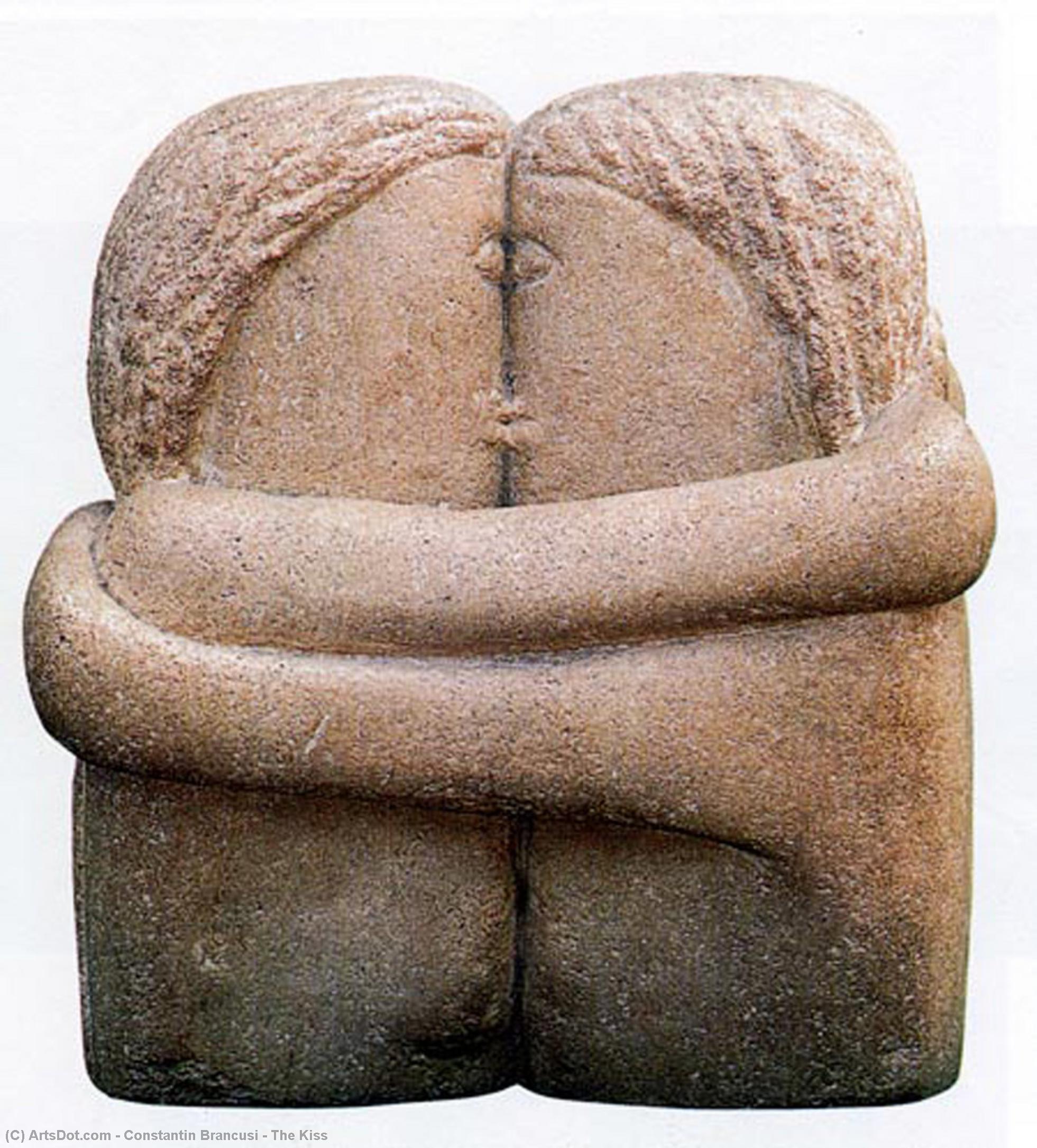
Constantin Brancusi: The Kiss (Expressionism,) is a powerful and evocative sculpture that exemplifies the principles of expressionism. Created in 1912, the work depicts two figures locked in an intimate embrace, their bodies merging into a single form. The simplicity of the forms and the smoothness of the surfaces contrast with the emotional intensity of the subject matter. The figures' faces are barely distinguishable from each other, suggesting a complete union of souls. The lack of detail in the bodies emphasizes the abstract nature of the work, inviting viewers to interpret the sculpture in their own way. Brancusi's use of materials is also significant. The sculpture is carved out of limestone, a material that is both durable and malleable. The choice of limestone gives the work a sense of timelessness, as if it has always existed. At the same time, the smoothness of the surfaces suggests a sense of fluidity and movement, as if the figures are in a constant state of transformation.Expressionism Around the World
Expressionism was not limited to Northern Europe but was also influential in other parts of the world, including the United States. The movement declined in Germany with the rise of Adolf Hitler in the 1930s, but there were subsequent expressionist works in other countries. In the United States, Abstract Expressionism emerged as a distinct art movement in the immediate aftermath of World War II and gained mainstream acceptance in the 1950s. Key figures in the New York School, which was the epicenter of this movement, included such artists as Jackson Pollock, Franz Kline, Mark Rothko, Norman Lewis, Willem de Kooning, and Theodoros Stamos among others.Conclusion
Expressionism is a modernist movement that emerged in the early 20th century and extended to a wide range of the arts. Expressionist artists sought to express the meaning of emotional experience rather than physical reality, often distorting or exaggerating forms, colors, and perspectives for emotional effect. The movement was influential in Northern Europe and other parts of the world, including the United States. Brancusi's 'The Kiss' is a prime example of expressionism in sculpture. Its simplicity, elegance, and emotional intensity make it a powerful and evocative work that continues to inspire artists and viewers today.- For more information on the Expressionism Art Movement, please visit The Expressionism Art Movement
- To learn about the Top 5 Famous Expressionism Artists of All Time, please visit Top 5 Famous Expressionism Artists of All Time
- For more information on Constantin Brancusi and his works, please visit Constantin Brancusi
- To learn about the Peggy Guggenheim Collection, please visit Peggy Guggenheim Collection
Questions & Answers
Is "The Kiss" available as a fine art print?
A print of "The Kiss" by Constantin Brâncuși can be ordered directly on its Fine Art Print page: a fine art print on cotton canvas or archival canvas paper.
What explains the copyright situation of "The Kiss" by Constantin Brâncuși?
The copyright status of "The Kiss" - still protected by copyright - follows from the artist's death in 1957.
Who is the author of "The Kiss", and in which movement?
Behind "The Kiss" stand Constantin Brâncuși and the Expressionism movement.
Artist Biography
The Essence of Form: The Life and Legacy of Constantin Brâncuși
Constantin Brâncuși stands as a monumental figure in the history of modern sculpture, recognized globally for his groundbreaking approach to form and his unwavering dedication to distilling artistic expression into its purest essence. Born in 1876 in Hădărămaș, Romania, Brâncuși embarked on an extraordinary journey from humble beginnings to become one of the foremost innovators of abstract art. His early years were deeply rooted in the textures of Romanian folklore and mythology, a foundation that instilled in him a lifelong appreciation for organic shapes and symbolic representations. This connection to his heritage would later permeate his artistic vision, providing a spiritual depth that distinguished his work from the purely mechanical abstractions of his contemporaries.
The trajectory of Brânuidade's career underwent a profound transformation during his time in Paris between 1906 and 1914. Immersed in the burgeoning avant-garde scene, he engaged with the vibrant energy of the École de Paris, fostering a dialogue that propelled him toward increasingly reductive forms. While his early experimentation included figurative sculpture—notably portraits depicting Romanian peasants that demonstrated a commitment to realism—he soon moved decisively toward a stylistic hallmark of his oeuvre: the pursuit of "spiritual abstraction." Brâncuși famously stated, "I sculpt what I see. But I also sculpt what I dream," a conviction that drove him to prioritize form over ornamentation and to capture universal concepts through simplified geometric shapes.
A Mastery of Material and Symbolism
Brâncuși’s genius lay in his ability to manipulate diverse materials—marble, bronze, and wood—to evoke profound emotional responses. His technique was not merely about carving or casting, but about revealing the soul within the medium. In works such as The Kiss, he achieved a tender depiction of intertwined figures rendered in polished bronze, creating a masterpiece that embodies intimacy and timeless beauty through its block-like, primitive simplicity. This ability to balance weight and grace is equally evident in his more ethereal creations.
His exploration of movement and transcendence reached its zenith in the Bird in Space series. These sculptures, characterized by their upward curves and delicate balance, serve as an aerodynamic representation of avian flight, symbolizing human aspiration and the soul's ascent. Beyond the celestial, Brâncuși also found profound meaning in the terrestrial and the serene. His work White Negress II utilizes minimalist marble to embody duality and serenity, while Sleeping Muse II showcases a mesmerizing bronze form with a golden hue, capturing a sense of profound peace through smooth, uninterrupted lines.
Historical Significance and the Modernist Revolution
The historical significance of Constantin Brâncuși cannot be overstated; he was a pioneer who redefined the very boundaries of what sculpture could be. By stripping away the superfluous, he paved the way for much of 20th-century abstraction. His influence can be traced through several key artistic developments:
- The Reduction of Form: He moved sculpture away from the narrative and anatomical complexity of Rodin toward a language of pure geometry.
- Integration of Materiality: His respect for the inherent properties of stone, wood, and metal influenced generations of modernists to treat material as a primary subject.
- The Concept of the Pedestal: Brâncuși often treated the base of his sculptures as part of the artwork itself, blurring the line between the object and its environment.
Ultimately, Brâncuși’s legacy is one of profound simplification. He did not merely create objects; he created icons of modernism that continue to resonate with their quiet power and spiritual clarity. Through his dedication to the essence of beauty, he transformed the landscape of contemporary art, leaving behind a body of work that remains as vital and evocative today as it was during his lifetime.

Constantin Brâncuși
1876 - 1957 , Romania
Quick Facts
- Artistic Movement Or Style: Modernism
- Artists Or Movements Influenced By This Artist: École des Beaux-Arts
- Artists Who Influenced This Artist: Jacques Hérold
- Date Of Birth: 1876
- Date Of Death: 1957
- Full Name: Constantin Brâncuși
- Nationality: Romanian
- Notable Artworks:
- The Kiss
- Bird in Space
- Place Of Birth: Hădărămaș, Romania