Send
Send Share
Share
 Details
 Guide
Guide

 Download
 Similars
 Diaporama
 Stats
StatsThe cock


 Read More
The artwork displayed on this page is protected by copyright law, which means we cannot legally create or sell an identical reproduction. This protection is enforced under international agreements such as the Berne Convention and by national laws, including those outlined by the U.S. Copyright Law - Title 17.
This method fully complies with copyright regulations because it does not involve copying or duplicating the protected artwork. Instead, it is a creative reinterpretation - a new painting that is influenced by the original but not identical to it.
Giclée / Art Print
Museum-quality giclée or canvas print with fast production and flexible finish options. ( Buy Hand Made Painting Switch to Digital Image)




































Pick from our preset sizes that match the artwork's original proportions.

Type the width and the height you need, to fit your frame or your wall. A print can only be cut, never made bigger than the picture, so a size with a different shape loses a part of the image. We send you a digital mockup to approve before we print anything. The picture shown on this page does not show the real cut — only the mockup does.
Worldwide Delivery () in 2 weeks instead of standard 4/5 weeks. (23 October)

Free Worldwide Express Shipping

High-Quality Linen Canvas

Full Shipping Insurance

Customs Tax Refund Guarantee

True Color Matching Guarantee

100-Day Return Policy (Defects Only)

100% Money-Back Guarantee

Bulk Discount Offer
 Glass option is only available in size under 110 CM

The cock
Giclée / Art Print
Reproduction Size
-


Total Price
$ 81
The Essence of Flight: An Encounter with Brâncuși's "The Cock"
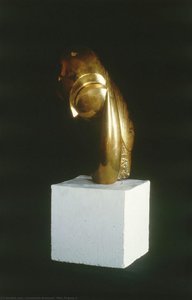
To stand before Constantin Brâncuși’s The Cock is not merely to view a sculpture; it is to witness the very distillation of motion into immutable form. Created in 1924, this bronze masterpiece transcends the mere depiction of an avian creature. Instead, Brâncuși has captured the exhilarating moment of ascent—the pure, unburdened spirit of flight itself. The work confronts the viewer with a highly abstracted vision, stripping away the superfluous details of naturalism to reveal what remains: the essential geometry of energy. Its vertical thrust commands attention, drawing the eye upward in an almost breathless trajectory.
Mastery of Form and Materiality
Technically, The Cock is a profound study in simplification. Brâncuși’s signature genius lay in his ability to reduce complex subjects to their most fundamental planes and angles. The bronze itself—rendered here in rich, reddish-brown tones—is treated not just as a material, but as an active participant in the composition. Observe how the surface texture catches the light, suggesting both the hardness of metal and the organic resilience of bone and feather. The lines are sharp, decisive, and relentlessly geometric, yet they coalesce to suggest the fluid power inherent in any living thing taking flight. This subtractive process, where form is revealed by what has been removed, speaks volumes about Brâncuși’s philosophy.
Symbolism: Beyond the Bird
Historically rooted in early 20th-century modernism, this piece resonates with a universal yearning for transcendence. The bird, across cultures, symbolizes the soul's journey or the spirit ascending beyond earthly constraints. For Brâncuși, the subject matter was always secondary to the underlying concept. Here, The Cock becomes an emblem of pure potential—a moment suspended between earth and sky. It evokes a feeling of primal energy, a powerful simplicity that speaks directly to the modern collector or designer seeking art that inspires contemplation rather than mere observation.
Bringing Modern Mythology Home
For those curating a space with an appreciation for modernist sculpture, The Cock offers unparalleled gravitas. Its clean lines and monumental presence allow it to anchor any interior design scheme—be it a minimalist gallery wall or the entrance hall of a grand residence. Owning a reproduction allows one to integrate this piece of art history into daily life, allowing its powerful simplicity to infuse a space with an undeniable sense of elevated energy. It is an object that whispers tales of artistic revolution while standing as a beacon of timeless, elegant form.
Questions & Answers
What kind of piece is "The cock"?
"The cock" by Constantin Brâncuși is classified as sculpture. The category describes the kind of artwork the original is.
Which period of Constantin Brâncuși's career does "The cock" belong to?
"The cock" represents the Mature Period of Constantin Brâncuși.
What was Constantin Brâncuși's age when "The cock" was created?
Constantin Brâncuși was 48 years old when creating "The cock" in 1924. The age is computed from the artist's birth year, 1876.
Artist Biography
The Essence of Form: The Life and Legacy of Constantin Brâncuși
Constantin Brâncuși stands as a monumental figure in the history of modern sculpture, recognized globally for his groundbreaking approach to form and his unwavering dedication to distilling artistic expression into its purest essence. Born in 1876 in Hădărămaș, Romania, Brâncuși embarked on an extraordinary journey from humble beginnings to become one of the foremost innovators of abstract art. His early years were deeply rooted in the textures of Romanian folklore and mythology, a foundation that instilled in him a lifelong appreciation for organic shapes and symbolic representations. This connection to his heritage would later permeate his artistic vision, providing a spiritual depth that distinguished his work from the purely mechanical abstractions of his contemporaries.
The trajectory of Brânuidade's career underwent a profound transformation during his time in Paris between 1906 and 1914. Immersed in the burgeoning avant-garde scene, he engaged with the vibrant energy of the École de Paris, fostering a dialogue that propelled him toward increasingly reductive forms. While his early experimentation included figurative sculpture—notably portraits depicting Romanian peasants that demonstrated a commitment to realism—he soon moved decisively toward a stylistic hallmark of his oeuvre: the pursuit of "spiritual abstraction." Brâncuși famously stated, "I sculpt what I see. But I also sculpt what I dream," a conviction that drove him to prioritize form over ornamentation and to capture universal concepts through simplified geometric shapes.
A Mastery of Material and Symbolism
Brâncuși’s genius lay in his ability to manipulate diverse materials—marble, bronze, and wood—to evoke profound emotional responses. His technique was not merely about carving or casting, but about revealing the soul within the medium. In works such as The Kiss, he achieved a tender depiction of intertwined figures rendered in polished bronze, creating a masterpiece that embodies intimacy and timeless beauty through its block-like, primitive simplicity. This ability to balance weight and grace is equally evident in his more ethereal creations.
His exploration of movement and transcendence reached its zenith in the Bird in Space series. These sculptures, characterized by their upward curves and delicate balance, serve as an aerodynamic representation of avian flight, symbolizing human aspiration and the soul's ascent. Beyond the celestial, Brâncuși also found profound meaning in the terrestrial and the serene. His work White Negress II utilizes minimalist marble to embody duality and serenity, while Sleeping Muse II showcases a mesmerizing bronze form with a golden hue, capturing a sense of profound peace through smooth, uninterrupted lines.
Historical Significance and the Modernist Revolution
The historical significance of Constantin Brâncuși cannot be overstated; he was a pioneer who redefined the very boundaries of what sculpture could be. By stripping away the superfluous, he paved the way for much of 20th-century abstraction. His influence can be traced through several key artistic developments:
- The Reduction of Form: He moved sculpture away from the narrative and anatomical complexity of Rodin toward a language of pure geometry.
- Integration of Materiality: His respect for the inherent properties of stone, wood, and metal influenced generations of modernists to treat material as a primary subject.
- The Concept of the Pedestal: Brâncuși often treated the base of his sculptures as part of the artwork itself, blurring the line between the object and its environment.
Ultimately, Brâncuși’s legacy is one of profound simplification. He did not merely create objects; he created icons of modernism that continue to resonate with their quiet power and spiritual clarity. Through his dedication to the essence of beauty, he transformed the landscape of contemporary art, leaving behind a body of work that remains as vital and evocative today as it was during his lifetime.

Constantin Brâncuși
1876 - 1957 , Romania
Quick Facts
- Artistic Movement Or Style: Modernism
- Artists Or Movements Influenced By This Artist: École des Beaux-Arts
- Artists Who Influenced This Artist: Jacques Hérold
- Date Of Birth: 1876
- Date Of Death: 1957
- Full Name: Constantin Brâncuși
- Nationality: Romanian
- Notable Artworks:
- The Kiss
- Bird in Space
- Place Of Birth: Hădărămaș, Romania
Related Articles

Bronze Age to Modern Masters: 10 Sculptures That Redefined Art | OriginalUniqueArt
Journey through art history with 10 legendary bronze sculptures – from Michelangelo's David to Rodin’s Thinker. Explore the stories, techniques & timeless beauty of these masterpieces. Find museum-quality reproductions & elevate your home decor on OriginalUniqueArt.com.

The Enduring Legacy of Bronze: A Historical & Artistic Exploration for the Collector
Explore the rich history & enduring appeal of bronze sculpture with expert insights for collectors at OriginalUniqueArt. Learn about casting techniques, iconic artists, collecting tips & contemporary interpretations.

The Enduring Legacy of Bronze Sculpture: A Collector's Guide to Form & Cultural Significance
Explore the rich history & enduring appeal of bronze sculpture with expert insights for collectors at OriginalUniqueArt. Learn about casting techniques, iconic artists, and collecting tips to build a discerning art collection.
The Enduring Legacy of Bronze: History, Technique & Artistic Expression for the Collector
Explore the rich history & enduring appeal of bronze sculpture with expert insights for collectors at OriginalUniqueArt. Learn about casting techniques, iconic artists, and collecting tips.

Bronze Sculptures That Defined Art History | OriginalUniqueArt
Journey through art history with our Top 10 bronze sculptures! Explore masterpieces by Rodin, Michelangelo & more. Discover stories behind iconic statues and find museum-quality reproductions for your home decor at OriginalUniqueArt.com.