Switch to Print
 Read More







































 For artworks or reproductions larger than 105 cm (approximately 41 inches) on any side, the frame will be shipped as a kit, disassembled. This method ensures safe delivery and prevents damage during transport.


The Essence of Form: Brâncuși’s Luminous Vision
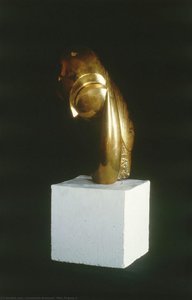
In the realm of modern sculpture, few works possess the ethereal magnetism of Mlle. Pogany II. Created in 1920 by the Romanian master Constantin Brâncuși, this exquisite piece serves as a profound testament to the power of simplification. At first glance, the viewer is met with a silhouette that seems to transcend the physical weight of its medium, offering instead a fluid, rhythmic grace. While many artists of the early 20th century were preoccupied with the intricate anatomical details of the human form, Brâncuși sought something far more elusive: the spiritual essence of his subject. Through a masterful reduction of detail, he captures not just a likeness, but an aura, inviting the observer into a meditative dialogue with pure shape and light.
The sculpture is a triumph of technique and material choice, rendered in a striking gold finish that catches the light with every subtle movement of the eye. This use of gold does more than provide a luxurious luster; it imbues the work with a divine, almost sacred quality, reminiscent of the Byzantine icons and Romanian folk traditions that deeply informed Brâncuși’s early sensibilities. The smooth, polished surfaces act as mirrors for the surrounding environment, allowing the piece to breathe and change alongside the light of the room. For the discerning collector or interior designer, this interplay between the sculpture's metallic sheen and its minimalist geometry makes it a versatile centerpiece, capable of anchoring a contemporary gallery space or adding a touch of timeless sophistication to a classic study.
A Legacy of Modernist Innovation
To understand Mlle. Pogany II is to understand the seismic shift Brâncuși brought to the art world. Moving away from the heavy, academic realism of the past, he pioneered a language of abstraction that would define the 20th century. This particular work sits at a pivotal moment in his career, where his fascination with organic smoothness began to merge with a highly stylized, almost geometric precision. The sculpture does not merely represent a woman; it represents the concept of beauty itself—stripped of the ephemeral and reduced to its most permanent, indestructible form. It is this pursuit of the "essential" that gives the piece such enduring emotional impact.
For those looking to integrate such a masterpiece into their personal collections, a high-quality reproduction offers a rare opportunity to live with the spirit of modernism every day. The sculpture’s compact dimensions—measuring approximately 19 x 43 cm—allow it to command attention on a mantel, a desk, or a curated bookshelf without overwhelming the space. It serves as a constant reminder of the beauty found in restraint and the profound strength found in simplicity. Owning a piece that echoes Brâncuși’s genius is not merely about decoration; it is about surrounding oneself with an object of deep intellectual and aesthetic resonance.
Questions & Answers
From which era does "Mlle. Pogany II" date?
"Mlle. Pogany II" belongs to the Modern era.
Who sells hand-painted copies of "Mlle. Pogany II" by Constantin Brâncuși?
"Mlle. Pogany II" is available as a hand-painted oil reproduction on linen canvas. The order can be placed on its Hand-Painted Reproduction page, with a choice of sizes.
What is "Mlle. Pogany II" made with, and in which style?
"Mlle. Pogany II" is made in gold, in the Modernism style.
More about this painting
 Send
Send Share
Share
 Details
 Guide
Guide

 Download
 Similars
 Diaporama
 Q&A
Q&A Stats
Stats