Send
Send Share
Share
 Details
 Guide
Guide

 Download
 Similars
 Diaporama
 Q&A
Q&A Stats
StatsIndustrial Architecture

- 26.0 x 36.0 cm


 Read More
The artwork displayed on this page is protected by copyright law, which means we cannot legally create or sell an identical reproduction. This protection is enforced under international agreements such as the Berne Convention and by national laws, including those outlined by the U.S. Copyright Law - Title 17.
This method fully complies with copyright regulations because it does not involve copying or duplicating the protected artwork. Instead, it is a creative reinterpretation - a new painting that is influenced by the original but not identical to it.
Giclée / Art Print
Museum-quality giclée or canvas print with fast production and flexible finish options. ( Buy Hand Made Painting Switch to Digital Image)




































Pick from our preset sizes that match the artwork's original proportions.

Type the width and the height you need, to fit your frame or your wall. A print can only be cut, never made bigger than the picture, so a size with a different shape loses a part of the image. We send you a digital mockup to approve before we print anything. The picture shown on this page does not show the real cut — only the mockup does.
Worldwide Delivery () in 2 weeks instead of standard 4/5 weeks. (6 November)

Free Worldwide Express Shipping

High-Quality Linen Canvas

Full Shipping Insurance

Customs Tax Refund Guarantee

True Color Matching Guarantee

100-Day Return Policy (Defects Only)

100% Money-Back Guarantee

Bulk Discount Offer
 Glass option is only available in size under 110 CM

Industrial Architecture
Giclée / Art Print
Reproduction Size
-


Total Price
$ 81
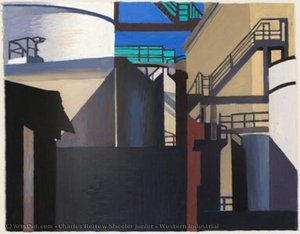
Charles Sheeler's "Industrial Architecture": A Precisionist Masterpiece
This meticulously crafted hand-painted reproduction captures Charles Sheeler’s seminal work, “Industrial Architecture,” a pivotal piece in the development of American Precisionism. Executed in 1931, this image transcends a simple depiction of an industrial site; it's a carefully constructed meditation on modernity, industry, and the burgeoning relationship between humanity and machine. The photograph, originally taken by Sheeler himself, serves as the foundation for this stunning artistic interpretation, showcasing his keen eye for geometric forms and stark contrasts that would become hallmarks of his style.
The Precisionist Vision
Born in Philadelphia in 1883, Charles Sheeler’s artistic journey was shaped by a rigorous education – initially at the Pennsylvania Museum School of Industrial Art and subsequently at the Pennsylvania Academy of Fine Arts. This training instilled within him a disciplined approach to observation and representation, culminating in his development of Precisionism. Unlike Impressionism's focus on fleeting moments, or Post-Impressionism’s emotional expression, Sheeler sought to depict subjects with an almost photographic clarity, emphasizing precise lines, sharp angles, and the inherent order found within industrial landscapes. The influence of European masters like Giotto, Masaccio, and Piero della Francesca is subtly present in his work, particularly in the careful rendering of form and space – a testament to his deep understanding of classical composition.
- Geometric Forms: The dominant motif is the precise arrangement of rectilinear shapes—the building’s walls, windows, and the imposing crane—creating a dynamic visual rhythm.
- Monochromatic Palette: The use of black and white amplifies the starkness and emphasizes the industrial subject matter, mirroring the austerity often associated with early 20th-century factories and urban environments.
- Sharp Detail: Sheeler’s meticulous attention to detail is evident in every element, from the texture of the metal crane to the reflections on the building's surface.
Symbolism and Context – A Reflection of Modernity
“Industrial Architecture” was created during a period of rapid industrialization and urbanization in America. The image powerfully reflects this era, capturing the rise of factories, railroads, and other technological advancements that were transforming American society. The crane itself is a potent symbol—representing progress, power, and the relentless drive for efficiency. The presence of the human figure, a solitary observer within the vast industrial landscape, adds another layer of interpretation, suggesting humanity’s role as both participant and witness to this transformative period. Sheeler's interest in architecture stemmed from his work documenting buildings for architects, demonstrating a fascination with structure and form.
Artistic Technique & Reproduction Details
This hand-painted reproduction is created using traditional techniques, meticulously replicating Sheeler’s original vision. Skilled artisans have painstakingly recreated the image, capturing not only the visual elements but also the subtle nuances of light and shadow that define his style. The resulting artwork boasts exceptional detail and color fidelity, ensuring a faithful representation of the original photograph. The size of 26 x 36 cm makes it ideal for a variety of interior design settings – from modern apartments to corporate offices. This reproduction is more than just an image; it’s a tangible connection to a significant moment in American art history.
Size: 26 x 36 cm
Date: 1931
Artist: Charles Sheeler Junior
Questions & Answers
How was "Industrial Architecture" made, and how big is it?
The original "Industrial Architecture" by Charles Rettew Sheeler Junior is a giclée print work measuring 26 x 36 cm. Technique and size describe the original object.
What atmosphere would a reproduction of "Industrial Architecture" by Charles Rettew Sheeler Junior bring to a room?
With its industrial mood, "Industrial Architecture" is suggested for an office.
From which era does "Industrial Architecture" date?
"Industrial Architecture" by Charles Rettew Sheeler Junior dates from the 19th-Century period. The period gives the historical context of the work.
Artist Biography
early life and education
charles rettew sheeler junior, an american painter and photographer, was born in philadelphia in 1883. he attended the pennsylvania museum school of industrial art from 1900 to 1903, followed by a traditional training in drawing and painting at the pennsylvania academy of fine arts (1903-6). this education laid the foundation for his future success as a pioneer of precisionism.career and influences
sheeler's early work was influenced by his travels to europe, where he developed an interest in the italian painters of the late middle ages, particularly giotto, masaccio, and piero della francesca. in 1909, he visited the paris home of michael and sarah stein, early patrons of picasso and braque, which inspired him to work in a cubist style. this exposure to various artistic movements shaped his unique precisionist approach.photography and precisionism
sheeler taught himself photography, initially documenting local buildings for architects. he later photographed the interior of his own house, shaping its rough-hewn spaces with light and shadow. his work in photography led to the development of precisionism, a style characterized by its focus on precision and accuracy.notable works and legacy
some of sheeler's notable works include:- stairway at the farm, doylestown, showcasing his mastery of light and composition.
- photographs of local vernacular architecture, highlighting the beauty in functional design.
- works featured in various exhibitions, including those at the museum of modern art (moma) and the metropolitan museum of art.
explore more on OriginalUniqueArt.com
- view sheeler's artworks: https://OriginalUniqueArt.com/@/charles-rettew-sheeler-junior
- discover other precisionist artists: /en/art/show/art-93pvdx-en/
- july 16, 1883: born in philadelphia, pennsylvania
- may 7, 1965: passed away in dobbs ferry, new york
references
- the metropolitan museum of art: charles sheeler (1883–1965)
- wikipedia: charles sheeler ### links from OriginalUniqueArt.com: - /en/art/list/ - https://OriginalUniqueArt.com/@/charles-rettew-sheeler-junior

Charles Rettew Sheeler Junior
1883 - 1965 , United States of America
Quick Facts
- Full Name: Charles Rettew Sheeler Jr.
- Nationality: American
- Date Of Birth: 1883
- Date Of Death: 1965
- Place Of Birth: Philadelphia, United States of America
- Notable Artworks:
- Stairway at the Farm, Doylestown
- Stacks in Celebration
- On the theme of farm buildings -2
- Artistic Movement Or Style: Precisionism
- Artists Who Influenced This Artist:
- Giotto
- Masaccio
- Piero della Francesca
- Artists Or Movements Influenced By This Artist: ['Cubism']
Related Articles

Giclée Prints: Archival Quality & Aesthetic Nuances for the Discerning Collector
Explore the world of giclée prints with OriginalUniqueArt. Learn about archival quality, aesthetic nuances & investment potential. Expert guidance for discerning art collectors seeking museum-quality reproductions and lasting value.

Beyond Color: The Timeless Power and Artistry of Black and White Photography
Explore the profound artistry of black and white photography. From the chemistry of gelatin silver to the chiaroscuro of the Old Masters, discover how monochrome captures the eternal essence of light, form, and emotion for the discerning art collector.

White on Canvas: 10 Masterpieces & Timeless Elegance for Your Home Decor
Explore 10 iconic white paintings by Monet, Whistler & Rothko! Discover the stories behind these serene masterpieces and their impact on art history. Find museum-quality reproductions for your home decor at .

Dark Masterpieces: 10 Iconic Paintings Dominated by Black Tones |
Explore 10 iconic paintings dominated by black tones, from Rembrandt’s chiaroscuro to Goya's dark expressions. Discover the stories behind these masterpieces & find museum-quality art reproductions for your home at .
Charles Sheeler Jr.: Precisionism, Industrial Aesthetics & the American Modernist Vision
Explore the groundbreaking work of Charles Sheeler Jr., a pivotal figure in American Precisionism. Discover his iconic industrial landscapes, photographic studies & lasting influence on modernist art. Expert insights for collectors.