Preview
 Send
Send Share
Share
 Details

 Download
 Similars
 X-Ray
X-Ray Diaporama
 Stats
StatsVault decoration


 Read More
Giclée / Art Print
Museum-quality giclée or canvas print with fast production and flexible finish options. ( Buy Hand Made Painting Switch to Digital Image)




P118B $10

P118H $10

P118W $10

P438Z $10

P508JH $12

P508YH $12

P805H $10

P805Z $10

P919BZ $10

P919G $10

P919XJ $10

P959ZH $10

P968JZ $12

W106C $8

W218G $10

W218JH $8

W218Y $10

W307PJ $10

W316G $10

W316PJ $8

W316Y $10

W398PJ $8

W4111J $10

W500HY $15

W500JH $15

W692G $12

W849H $8

W940BG $15

W953PJ $8




Pick from our preset sizes that match the artwork's original proportions.

You may enter your own dimensions to fit a specific frame or space. If your selected size does not match the original image's proportions, we will either crop the artwork or extend the image with a mirrored or solid-fill edge. A digital mockup will be sent for your approval before production begins.
Please note that the on-screen preview does not reflect the actual cropping or extension. Only the mockup will accurately show the final composition.
While custom sizes are available, we recommend selecting a dimension from the predefined list to preserve the original proportions.
Worldwide Delivery () in 2 weeks instead of standard 4/5 weeks. (8 September)

Free Worldwide Express Shipping

High-Quality Linen Canvas

Full Shipping Insurance

Customs Tax Refund Guarantee

True Color Matching Guarantee

100-Day Return Policy (Defects Only)

100% Money-Back Guarantee

Bulk Discount Offer
 Glass option is only available in size under 110 CM

Vault decoration
Giclée / Art Print
Reproduction Size
-


Total Price
$ 81
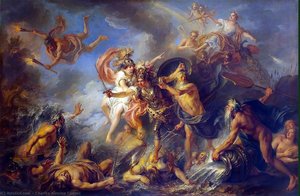
A Celestial Tapestry: Unveiling Coypel’s Vault Decoration at Versailles
The Chapel of the Château at Versailles stands as a testament to the opulent ambitions and artistic prowess of Louis XIV, and within its walls resides one of the most breathtaking achievements of the Baroque era: Charles-Antoine Coypel's vault decoration, completed in 1709. More than just a ceiling painting, it’s an immersive experience—a carefully orchestrated illusion designed to transport viewers into a realm of divine splendor and royal authority. This monumental fresco isn’t merely decorative; it’s a profound statement about the power of art to shape perception and embody the ideals of the French monarchy.
The Architectonic Dream: A Roman Baroque Revival
Coypel, deeply influenced by the grandeur of Rome, deliberately rejected the prevailing classical restraint of his time. He embraced a style reminiscent of Andrea Pozzo’s ceiling in Sant'Ignazio in Rome – a technique known as *quadrature*, or ‘four-square’. This involved creating an illusion of depth and perspective through carefully positioned architectural elements, mimicking the effect of looking up at a real vault. The fresco isn’t simply painted; it appears to be built into the space itself, with meticulously rendered columns, pilasters, and arches that recede into the distance, drawing the eye upwards towards the central focal point.
- The Central Scene: At the heart of the vault lies a dramatic depiction of God the Father enthroned in glory. Surrounded by radiant angels and celestial figures, he embodies divine power and benevolence.
- Allegorical Figures: Flanking the central figure are allegorical representations of virtues – Justice, Prudence, Fortitude, and Temperance – each rendered with a dignified and serene expression. These figures serve as moral guides for the viewer, reinforcing the themes of piety and righteousness.
- Theatrical Depth: Coypel masterfully employs *trompe-l'oeil* techniques to create an astonishing sense of depth. The use of light and shadow, combined with carefully calibrated perspective, makes it appear as if one is gazing upon a real, three-dimensional vault.
Technique and Materials: A Masterclass in Illusionism
Coypel’s skill lies not only in his compositional vision but also in his technical execution. He employed a complex layering of pigments, utilizing thin glazes to build up the illusion of volume and texture. The use of gold leaf adds an undeniable sense of luxury and reinforces the celestial theme. Crucially, Coypel understood that the success of this ambitious project hinged on meticulous preparation – he spent years studying the architecture of the chapel and creating detailed preparatory drawings before embarking on the fresco itself. The entire surface was prepared with a layer of gesso to create a smooth, reflective base for the paint.
Symbolism and Royal Propaganda
Beyond its aesthetic beauty, Coypel’s vault decoration served as potent propaganda for the French monarchy. By associating Louis XIV with divine authority through this spectacular visual spectacle, Coypel reinforced the king's image as a god-like figure—the “Sun King”—and legitimized his rule. The carefully chosen allegorical figures and the overall composition conveyed messages of piety, justice, and prosperity, aligning the monarchy with traditional values and reinforcing its claim to divine favor. The fresco’s enduring appeal lies in its ability to simultaneously delight and instruct, offering a glimpse into the artistic and ideological world of 18th-century France.
Artist Biography
The Legacy of Charles Antoine Coypel: A Bridge Between Eras
In the grand tapestry of French art history, few figures embody the delicate transition from the heavy grandeur of the Baroque to the lighthearted elegance of the Rococo as gracefully as Charles Antoine Coypel. Born in Paris in 1694 into a lineage of artistic distinction, Coypel was destined for greatness. As the son of the celebrated Antoine Coypel and the grandson of Noël Coypel, his very existence was steeped in the traditions of the Académie Royale. This familial heritage provided him with more than just a name; it offered an intimate apprenticeship to the masters of his time, allowing him to inherit a profound understanding of classical composition and the dramatic flair required by the French court.
Coypel’s early training under Nicolas Frémiet equipped him with a versatile technical repertoire, ranging from the precision of etching to the fluid mastery of oil painting. This versatility became the cornerstone of his career, enabling him to navigate the shifting aesthetic tides of the early 18th century. While his foundations were firmly rooted in the monumental and often theatrical style of the late Baroque, he possessed a unique sensitivity to the emerging Rococo spirit. He began to infuse his works with a newfound lightness, utilizing delicate pastel palettes, asymmetrical arrangements, and an ornamental charm that would soon define the French aesthetic for decades to come.
A Master of Narrative and Royal Commission
The zenith of Coypel’s professional life was marked by his prestigious appointment as Premier Peintre du Roi (First Painter to the King). Serving the court of Louis XIV and his successors, he became a primary visual storyteller for the French monarchy. His talent extended far beyond the canvas; he was a visionary designer who understood how art could animate entire architectural spaces. One of his most breathtaking achievements can be found in his contributions to the Versailles Chapel, where his fresco work—such as the depiction of God the Father in Glory—utilized masterful trompe-l'oeil techniques to create celestial perspectives that seemed to dissolve the very ceiling into the heavens.
Beyond the walls of royal chapels, Coypel’s influence permeated the decorative arts through his extensive collaborations with the Gobelins Manufactory. He possessed a rare ability to translate epic narratives into monumental tapestry designs. His work on series inspired by Homer’s Iliad and Odyssey demonstrated a profound command of color and movement, turning woven threads into epic poems of light and shadow. Perhaps his most daring and revolutionary undertaking was his illustrated series for Miguel de Cervantes' Don Quixote. In this project, Coypel moved away from rigid formality to embrace a more dynamic, character-driven approach to storytelling, effectively bridging the gap between classical illustration and modern narrative art.
Artistic Significance and Enduring Influence
The historical significance of Charles Antoine Coypel lies in his role as an artistic mediator. He did not merely witness the transition from one era to another; he actively shaped it. By blending the structural integrity and dramatic weight of the Baroque with the whimsical, airy grace of the Rococo, he provided a stylistic continuity that allowed French art to evolve without losing its sense of majesty. His portraits, such as the evocative Democritus, continue to captivate viewers with their ability to balance regal dignity with an intimate, psychological depth.
Though his life was cut short in 1752, the impact of his work remains etched in the history of European painting. His legacy is found in:
- The evolution of French portraiture: Moving from stiff formality toward a more expressive and emotive representation of the subject.
- Tapestry and Decorative Design: Elevating large-scale textile works to the status of high narrative art through his Gobelins commissions.
- The integration of styles: Successfully synthesizing the monumental scale of the 17th century with the intimate, decorative sensibilities of the 18th century.
Today, the works of Coypel serve as a window into a transformative period of human creativity, reminding us of a time when art was used to bridge the gap between the earthly splendor of kings and the divine aspirations of the soul.

charles antoine coypel
1694 - 1752 , France
Quick Facts
- Artistic Movement Or Style: Baroque Rococo
- Artists Who Influenced This Artist:
- Antoine Coypel
- Noël Coypel
- Date Of Birth: 1694 Paris France
- Date Of Death: 1752
- Full Name: Charles Antoine Coypel
- Nationality: French
- Notable Artworks:
- Don Quixote series
- Portrait De Philippe Coypel
- A Picture Of Philippe Coypel With His Wife
- Place Of Birth: Paris France
Related Articles

The Enduring Legacy of Fresco: Technique, History & Artistic Expression Across Cultures
Explore the rich history & enduring legacy of fresco painting! Discover ancient techniques, Giotto's masterpieces, and modern applications. Expert insights for art lovers & professionals.
Art That Lives With You: The Emotional Power of a Custom Interior Fresco
Discover the emotional power & timeless beauty of custom interior frescoes. Explore history, design tips & expert guidance from – creating lasting legacies.
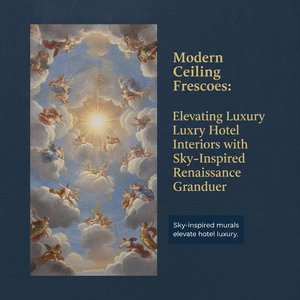
The Modern Ceiling Fresco: Reimagining Renaissance Grandeur for Contemporary Spaces
Discover the resurgence of ceiling frescoes! Explore historical traditions & modern interpretations for luxury spaces. OriginalUniqueArt.com's expert artists create custom, hand-painted masterpieces.

The Fresco as Family Legacy: Preserving Heritage Through Wall Art
Explore the rich history & enduring legacy of fresco painting. Discover how to preserve family heritage through stunning wall art. Expert insights & restoration guidance.
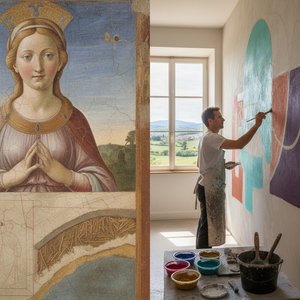
The Enduring Legacy of Fresco Painting: Techniques, History & Contemporary Relevance
Explore the rich history & enduring artistry of fresco painting – from Giotto to Michelangelo! Discover techniques, conservation efforts, & modern applications. Learn how OriginalUniqueArt brings this timeless art form to your home.