Preview
 Send
Send Share
Share
 Details
 Guide
Guide

 Download
 Similars
 X-Ray
X-Ray Diaporama
 Stats
StatsHalcyon
 Oil On Canvas
- WallArt
- Symbolism
 1927
1927 51.0 x 66.0 cm
 Norwich Castle Museum And Art Gallery
 Read More
Giclée / Art Print
Museum-quality giclée or canvas print with fast production and flexible finish options. ( Buy Hand Made Painting Switch to Digital Image)




P118B $10

P118H $10

P118W $10

P438Z $10

P508JH $12

P508YH $12

P805H $10

P805Z $10

P919BZ $10

P919G $10

P919XJ $10

P959ZH $10

P968JZ $12

W106C $8

W218G $10

W218JH $8

W218Y $10

W307PJ $10

W316G $10

W316PJ $8

W316Y $10

W398PJ $8

W4111J $10

W500HY $15

W500JH $15

W692G $12

W849H $8

W940BG $15

W953PJ $8




Pick from our preset sizes that match the artwork's original proportions.

You may enter your own dimensions to fit a specific frame or space. If your selected size does not match the original image's proportions, we will either crop the artwork or extend the image with a mirrored or solid-fill edge. A digital mockup will be sent for your approval before production begins.
Please note that the on-screen preview does not reflect the actual cropping or extension. Only the mockup will accurately show the final composition.
While custom sizes are available, we recommend selecting a dimension from the predefined list to preserve the original proportions.
Worldwide Delivery () in 2 weeks instead of standard 4/5 weeks. (27 September)

Free Worldwide Express Shipping

High-Quality Linen Canvas

Full Shipping Insurance

Customs Tax Refund Guarantee

True Color Matching Guarantee

100-Day Return Policy (Defects Only)

100% Money-Back Guarantee

Bulk Discount Offer
 Glass option is only available in size under 110 CM

Halcyon
Giclée / Art Print
Reproduction Size
-


Total Price
$ 81
The Enigmatic Beauty of Cedric Lockwood Morris’s Halcyon
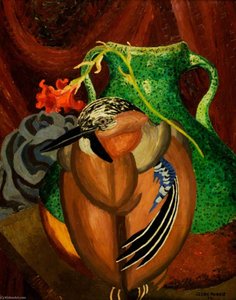
Cedric Lockwood Morris's Halcyon, painted in 1927, isn’t merely a depiction of a beach scene; it’s an arresting meditation on the delicate balance between beauty and danger, tranquility and predation. This oil-on-canvas masterpiece, currently residing within the Norwich Castle Museum & Art Gallery, immediately draws the viewer into its dreamlike atmosphere – a hazy expanse of sand, sea, and sky rendered with a remarkable sensitivity to light and texture. The painting’s power lies not in photographic realism but in Morris's masterful manipulation of color and form to evoke a profound emotional response.
At first glance, the composition appears deceptively simple: a woman reclining gracefully on the beach, her limbs spread languidly, seemingly lost in blissful repose. However, a closer examination reveals a subtle tension beneath this surface serenity. The central figure, bathed in soft, diffused light, possesses an almost ethereal quality, yet her posture—a slight tilt of the head, a barely perceptible curve of the lips—suggests a quiet awareness, a hint of vulnerability. Above her, poised and predatory, is a magnificent kingfisher, its vibrant blue plumage contrasting sharply with the muted tones of the sand and sea. This bird isn’t merely an accessory; it's a potent symbol – a representation of both beauty and threat, innocence and impending danger.
Decoding Symbolism: Nature, Humanity, and Mortality
Morris, a British artist known for his unique blend of realism and fantasy, frequently explored themes of nature, landscapes, and the human condition. Halcyon exemplifies this approach, layering symbolic meaning within a seemingly straightforward scene. The beach itself represents a liminal space – a transition zone between land and sea, reality and dream. The woman’s reclining pose can be interpreted as an invitation to contemplation, a surrender to the allure of nature's beauty. Yet, the kingfisher’s presence introduces a darker element, hinting at the precariousness of this idyllic state. The bird is often associated with transformation, but in this context, it carries a more ominous connotation – a reminder of mortality and the inevitability of predation.
Furthermore, the painting's style—rooted in early 20th-century Symbolism and Expressionism—contributes to its evocative power. The flattened perspective, loose brushstrokes, and emphasis on emotional expression rather than precise representation create a dreamlike quality, inviting viewers to project their own interpretations onto the scene. Morris’s use of oil paint allows for rich textures and subtle gradations of color, adding depth and luminosity to the canvas. The rough texture suggests an immediacy, as if the artist captured a fleeting moment in time.
Technique and Artistic Context
Morris's technical skill is evident in every detail of Halcyon. The careful rendering of light and shadow creates a sense of atmosphere, while the vibrant colors—particularly the striking blue of the kingfisher—draw the eye to the focal point of the composition. The painting’s dimensions – 51 x 66 cm – are perfectly suited to capture the intimacy and drama of the scene. It's important to note that Morris was a prominent figure in the British art world, known for his exhibitions and teaching roles. His work reflects a broader artistic movement that sought to explore subjective experience and emotional truth.
Considering its creation in 1927, during a period of significant social and cultural change, Halcyon offers a poignant reflection on the relationship between humanity and nature. It’s a captivating artwork that continues to resonate with viewers today, prompting questions about beauty, danger, and the enduring mysteries of the human psyche.
Artist Biography
A Life Rooted in Colour: The World of Cedric Lockwood Morris
Sir Cedric Lockwood Morris, born December 11, 1889, in Sketty, Swansea, was a figure who defied easy categorization. Descended from a lineage connected to the founders of the Dulwich Picture Gallery, his early life hinted at privilege and tradition, yet he embarked on a path that led him far from conventional expectations. The son of George Lockwood Morris, an industrialist and celebrated rugby international, and Wilhelmina Cory, Cedric’s upbringing was steeped in both physical prowess and artistic sensibility – a duality that would profoundly shape his creative journey. Initial attempts at a military commission proved unsuccessful, leading to periods of wandering and work across Canada and New York City before he ultimately found himself drawn towards the burgeoning art scene of early 20th-century Paris. A brief foray into musical studies at the Royal College of Music in London was quickly superseded by an undeniable calling to paint, marking a pivotal shift in his life’s direction.From Parisian Studios to East Anglian Landscapes
Morris's formal artistic training began at the Académie Delécluse in Montparnasse in 1914, a period of intense creative ferment. The outbreak of World War I interrupted this study; deemed unfit for combat due to a childhood operation, he served with the Artists’ Rifles before being assigned to train horses – an experience that undoubtedly honed his keen observation of animal form and movement. It was in 1918 that a defining relationship blossomed: his partnership with Arthur Lett-Haines. This artistic and personal alliance would prove central to Morris's life and work, fostering a collaborative spirit that extended beyond their individual canvases. Early influences were drawn from Impressionism and Post-Impressionism, visible in his initial landscapes and portraits, but these foundations soon gave way to a uniquely expressive style. The vibrant hues and bold brushwork that would become his signature began to emerge as he increasingly focused on the natural world around him, particularly the East Anglian countryside after settling there with Lett-Haines. He wasn’t merely depicting what he saw; he was conveying its *feeling*, its essence.A Celebration of Flora and a Legacy of Teaching
Cedric Lockwood Morris is perhaps best remembered for his captivating flower paintings. These weren't botanical illustrations in the traditional sense, but rather intensely personal interpretations of blooms – explosions of colour and texture that captured their fleeting beauty with remarkable vitality. Critics often likened his work to that of Van Gogh or Utrillo, but accessible to a wider audience— “a Van Gogh or Utrillo for those of modest means,” as one commentator noted. Beyond flowers, Morris produced numerous portraits, revealing a talent for capturing the character and personality of his sitters, and landscapes imbued with an expressive energy. A significant chapter in his career unfolded in 1935 when he was commissioned to paint large-scale flower murals aboard the luxurious ocean liner Queen Mary, bringing his vibrant vision to a wider public. However, perhaps his most enduring legacy lies in co-founding the East Anglian School of Painting and Drawing at Benton End, Suffolk, with Lett-Haines in 1937. This school became a haven for aspiring artists, including luminaries such as Lucian Freud and Maggi Hambling, emphasizing feeling and personal expression over strict academic representation – a philosophy that profoundly influenced a generation of British artists.Later Years and Rediscovered Recognition
Despite his earlier successes, Morris experienced a period of relative obscurity following World War II. However, in the later years of his life, a renewed appreciation for his work began to emerge. His political activism with the Hadleigh Labour Party in the late 1930s reflected a broader engagement with social issues, adding another layer to his complex persona. He died on February 8, 1982, in Hadleigh, Suffolk, leaving behind a body of work that continues to captivate and inspire. Today, Cedric Lockwood Morris is recognized as a significant figure in British art of the 20th century – a unique blend of observation, expression, and an unwavering commitment to his artistic vision. His influence extends beyond his paintings; through the East Anglian School, he fostered a spirit of experimentation and individuality that continues to resonate within the British art world.Key Facts & Enduring Influence
- Titles: Sir (1947), 9th Baronet
- Nationality: British
- Movement: Associated with Modern British Art
- Media: Oil paint, watercolor

Cedric Lockwood Morris
1889 - 1982 , United Kingdom
Quick Facts
- Artistic Movement Or Style: Modern British Art
- Artists Or Movements Influenced By This Artist:
- Lucian Freud
- Maggi Hambling
- Artists Who Influenced This Artist:
- Impressionism
- Post-Impressionism
- Date Of Birth: December 11, 1889
- Date Of Death: February 8, 1982
- Full Name: Cedric Lockwood Morris
- Nationality: British
- Notable Artworks:
- Near Cagnes
- Halcyon
- Monchique Foothills
- Place Of Birth: Sketty, UK
Related Articles

The Enduring Power of Painting: A Historical & Contemporary Exploration of Form and Emotion
Explore the rich history & enduring techniques of oil painting with OriginalUniqueArt. Discover masterpieces, learn about art collecting, and find authentic handmade reproductions crafted by skilled artists.

Oil on Canvas: A Historical & Technical Exploration of a Timeless Artistic Medium
Explore the rich history & enduring techniques of oil painting on canvas. Discover the science behind its longevity, conservation practices, and contemporary relevance. Expert insights for art enthusiasts.

The Enduring Legacy of Oil on Canvas: Technique, History & Aesthetic Impact
Explore the rich history & techniques of oil painting – from Renaissance masters to Impressionism. Discover pigments, layering methods, and why this timeless medium endures. Expert insights for artists & art enthusiasts.
The Timeless Charm of Oil on Board: Reimagining Texture and Light through the Impressionist Lens
Discover the profound intimacy of oil on panel. Explore how Impressionist masters used rigid supports to capture light, texture, and impasto depth through exquisite, handmade oil reproductions for discerning collectors.

The Enduring Legacy of Oil on Canvas: Technique, History & Contemporary Practice
Explore the rich history & enduring techniques of oil painting on canvas. Discover the science behind its longevity, conservation practices, and contemporary relevance. Expert insights for art enthusiasts.