Geometric Abstraction · 1950
Untitled (Carlos Santiago Mérida, 1950)
Carlos Santiago Mérida (1891–1984) made Untitled. It dates from 1950. It belongs to the Geometric Abstraction movement. It is made in acrylic on canvas. It is kept at Inter-American Development Bank in Washington, D.C., United States of America.
- 1950
- Acrylic On Canvas
- Inter-American Development Bank, Washington, D.C.

 Preview

 Hand Made Oil Painting
 Send
 Share
 Fact sheet


 Download
 Similars
 X-Ray
 Diaporama
 Q&A

 Stats
Untitled, in brief
- Title
- Untitled
- Artist
- Carlos Santiago Mérida (1891–1984)
- Artist born in
- Guatemala City, Guatemala
- Date
- 1950
- Medium
- Acrylic On Canvas
- Where to see it
- Inter-American Development Bank, Washington, D.C., United States of America
- Movement
- Geometric Abstraction
- Subject
- geometric design, abstract forms, color blocking, modern art, grid structure, mexican style
What does Untitled depict?
A Dialogue Between Tradition and Modernity: Exploring Carlos Mérida’s Untitled
Carlos Mérida stands as an emblem of Latin American artistic innovation, a figure who dared to forge his own path amidst the currents of European avant-garde movements while simultaneously grounding his vision in the profound heritage of Mesoamerican culture. His seminal work, “Untitled,” exemplifies this remarkable fusion—a testament to his ability to synthesize seemingly disparate influences into a singularly compelling aesthetic experience. Painted in 1950, this piece transcends mere geometric abstraction; it embodies a philosophical exploration of order and structure, mirroring the spirit of Constructivism and echoing the stylistic nuances of Joan Miró’s groundbreaking explorations.Geometric Precision and Mayan Resonance
The artwork's dominant characteristic is its uncompromising geometric rigor. A meticulously crafted grid serves as the foundational element, overlaid with intersecting dark grey, black, and beige shapes that create a dynamic interplay of positive and negative space. These forms aren’t randomly arranged; they adhere to precise angular edges and contribute to an overall sense of controlled visual organization—a hallmark of Constructivist principles championed by artists like Vladimir Tatlin. However, Mérida doesn't abandon the spirit of experimentation entirely. Subtle hints of Mayan iconography permeate the composition, particularly in the tessellated surfaces that evoke the intricate patterns found in ancient Maya murals and textiles. This deliberate juxtaposition speaks to Mérida’s desire to honor his Guatemalan roots while simultaneously embracing the transformative power of modern artistic language.Technique and Texture: Building Layers of Meaning
Mérida's masterful technique involves layering paint onto textured paper, a decision that imbues the artwork with palpable materiality. The careful application of acrylic or oil paints builds up complex shapes and patterns, resulting in a surface that invites tactile engagement—a characteristic often found in Surrealist painters like Miró who similarly utilized texture to convey emotional depth. The bold colors – primarily shades of beige, grey, and black – are deployed strategically to heighten visual impact and contribute to the artwork’s contemplative mood. These hues aren't merely decorative; they serve as conduits for conveying ideas about balance, harmony, and perhaps even a hint of melancholy—themes frequently explored in Mérida’s oeuvre.Historical Context: The Vanguard of Guatemalan Modernism
“Untitled” emerged during a pivotal moment in Latin American art history – the mid-1950s – coinciding with a surge of artistic experimentation across the continent. Mérida was actively engaged in dialogues with fellow artists and intellectuals who sought to redefine artistic expression, rejecting traditional representational conventions in favor of abstract forms that prioritized conceptual content over visual realism. This commitment to abstraction aligns him squarely within the broader Constructivist movement, which originated in Russia shortly before World War II and championed a radical reimagining of art’s role as a tool for social transformation. Yet, Mérida's work distinguishes itself through its grounding in Mesoamerican traditions—a deliberate gesture toward reclaiming cultural identity amidst the pressures of globalization.Emotional Impact: A Meditation on Order and Silence
Ultimately, “Untitled” invites contemplation rather than immediate gratification. Its austere aesthetic – characterized by simplicity, precision, and muted color palettes – fosters a sense of stillness and invites viewers to engage in an internal dialogue about fundamental questions concerning order, balance, and the relationship between form and content. Like Miró’s work, Mérida's piece speaks to the subconscious mind, tapping into primal visual rhythms that resonate with universal human experience. It stands as a powerful reminder that art can transcend mere decoration—it can serve as a conduit for conveying profound philosophical ideas and fostering a deeper appreciation of artistic craftsmanship.Which museum holds Untitled?
Inter-American Development Bank
Washington, D.C., United States of America
A Vibrant Tapestry of Latin American Voices: Exploring the Inter-American Development Bank ArtLAC Gallery Nestled within the imposing headquarters of the Inter-American Development Bank in Washington, D.C., lies a surprisingly intimate and profoundly moving space – the ArtLAC Gallery. More than just a collection of artworks, it’s a deliberate attempt to bridge the gap between economic development, cultural expression, and social progress, offering a unique lens through which to view the complexities of Latin America and the Caribbean. Established initially as a cultural center fostering understanding between the U.S.


High-resolution images of Untitled

Protected by copyright: these files are for personal reference, not a licence to republish.
Carlos Santiago Mérida, Untitled (1950), Inter-American Development Bank.
Questions on Untitled, answered
Where is "Untitled" by Carlos Santiago Mérida on display today?
The original "Untitled" by Carlos Santiago Mérida is held at the Inter-American Development Bank, Washington, D.C., United States of America. A reproduction allows the work to be displayed at home.
When was "Untitled" made?
"Untitled" dates from 1950. The date places the work within Carlos Santiago Mérida's career and its era.
What technique was used for "Untitled" by Carlos Santiago Mérida?
"Untitled" is executed in acrylic on canvas.
What subjects appear in "Untitled" by Carlos Santiago Mérida?
The themes present in "Untitled" by Carlos Santiago Mérida include geometric design, abstract forms, color blocking, modern art, grid structure, mexican style, linear patterns. Together they summarize the artwork's subject matter.
Is "Untitled" by Carlos Santiago Mérida in the public domain?
"Untitled" by Carlos Santiago Mérida is still protected by copyright. This status governs how the image of the work may be reproduced.
Who is the artist behind "Untitled"?
"Untitled" is attributed to Carlos Santiago Mérida.
Which artistic current is "Untitled" by Carlos Santiago Mérida part of?
The movement associated with "Untitled" by Carlos Santiago Mérida is Geometric Abstraction. This classification situates the work among related artists and artworks.
Where does "Untitled" fall in Carlos Santiago Mérida's career?
Within Carlos Santiago Mérida's career, "Untitled" falls in the 1950s Style. The phase helps compare it with the artist's other works.
At what age did Carlos Santiago Mérida make "Untitled"?
Carlos Santiago Mérida was 59 years old when creating "Untitled" in 1950. The age is computed from the artist's birth year, 1891.
About the artist, Carlos Santiago Mérida
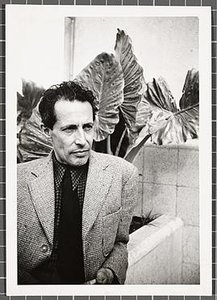
1891–1984, Guatemala
Carlos Santiago Mérida
A Fusion of Worlds: The Life and Art of Carlos Mérida Carlos Mérida, born Carlos Santiago Ortega in Guatemala City in 1891, stands as a pivotal figure in the narrative of Latin American modern art. His journey was one of constant exploration—a compelling synthesis of European avant-garde sensibilities with the rich cultural heritage of his Guatemalan roots and, later, the vibrant artistic landscape of Mexico. Initially drawn to music, Mérida’s path shifted due to hearing loss, a circumstance that unexpectedly steered him toward painting under his father's encouragement. This redirection proved fortuitous, unlocking a talent that would blossom across continents and redefine artistic boundaries.
About Carlos Santiago Mérida Notable works by Carlos Santiago Mérida
Also by Carlos Santiago Mérida
 Madre Terra, (Mother Earth)1970
 Carnaval1974
 Dancers of Tlaxcala1951
 Xochipilli and the God1949
Essays around Untitled
 Geometry with Purpose: Distinguishing Suprematism from ConstructivismMaster the differences between Suprematism and Constructivism with our expert guide. Discover the soul of the Russian avant-garde now.
 Spontaneity and Matter: Distinguishing CoBrA from Art InformelMaster the differences between CoBrA and Art Informel with our expert guide. Learn to identify these post-war movements today.
 10 Iconic Graphite Masterpieces That Redefined the Art WorldExplore 10 iconic graphite masterpieces that redefined art history. Discover museum-quality legends on OriginalUniqueArt.com.