Send
Send Share
Share
 Details
 Guide
Guide

 Download
 Similars
 Diaporama
 Stats
StatsJupiter


 Read More
Giclée / Art Print
Museum-quality giclée or canvas print with fast production and flexible finish options. ( Buy Hand Made Painting Switch to Digital Image)




































Pick from our preset sizes that match the artwork's original proportions.

Type the width and the height you need, to fit your frame or your wall. A print can only be cut, never made bigger than the picture, so a size with a different shape loses a part of the image. We send you a digital mockup to approve before we print anything. The picture shown on this page does not show the real cut — only the mockup does.
Worldwide Delivery () in 2 weeks instead of standard 4/5 weeks. (24 October)

Free Worldwide Express Shipping

High-Quality Linen Canvas

Full Shipping Insurance

Customs Tax Refund Guarantee

True Color Matching Guarantee

100-Day Return Policy (Defects Only)

100% Money-Back Guarantee

Bulk Discount Offer
 Glass option is only available in size under 110 CM

Jupiter
Giclée / Art Print
Reproduction Size
-


Total Price
$ 81
A Vision of Divine Tenderness
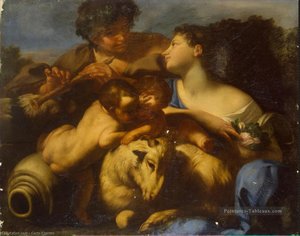
In the breathtaking expanse of the Hall of Loves of Jupiter, a profound sense of intimacy emerges from the grandeur of the Baroque era. Carlo Cignani’s Jupiter serves as a captivating window into a world where the celestial and the terrestrial intertwine through the lens of maternal grace. This particular detail, captured within a magnificent fresco, presents us with a tender tableau of three women gathered in a moment of quiet connection. At the heart of the composition, one woman cradles an infant, while her companions are depicted in the sacred, nurturing act of breastfeeding. The scene is far more than a mere mythological depiction; it is a celebration of life’s most fundamental bonds, rendered with a softness that invites the viewer into their private, serene circle.
The atmosphere is further enriched by the delicate presence of birds, strategically placed throughout the composition to guide the eye and add a layer of natural vitality. One bird rests near the upper periphery, another drifts through the center-left, and a third settles in the lower corner, creating a rhythmic movement that mirrors the breathing pulse of the scene itself. This careful arrangement of elements ensures that while the subject is deeply intimate, the composition remains expansive and dynamic, much like the larger architectural setting for which it was originally conceived.
The Mastery of the Bolognese Manner
To behold this work is to witness the pinnacle of the Bolognese classicism. Carlo Cignani, a master who bridged the dramatic intensity of the High Baroque with the emerging elegance of the Rococo, employs a technique often referred to as his "new manner." Unlike the more aggressive and turbulent styles of his contemporaries, Cignani’s brushwork in this fresco possesses a refined, luminous quality. He utilizes light not merely to define form, but to bathe the figures in an ethereal glow that softens edges and evokes a sense of profound peace.
The technique reflects a sophisticated command over color and texture, where the skin tones of the women appear almost translucent, suggesting a warmth that radiates from within. This mastery of light and shadow—the subtle chiaroscuro—serves to elevate the mundane act of nursing into something divine. For collectors and interior designers, this piece offers a rare opportunity to possess a fragment of history that embodies both intellectual depth and aesthetic grace. A high-quality reproduction of this work brings not just a decorative element to a room, but a sophisticated dialogue between classical mythology and human emotion.
Symbolism and the Triumph of Love
The historical context of this artwork is deeply rooted in the concept of Omnia Vincet Amor—Love Conquers Everything. As part of a larger decorative program involving Agostino Carracci and Giovanni Bosco, the imagery of Jupiter and his various loves serves as an allegory for the irresistible power of affection and the natural order of the universe. The presence of the nursing mothers symbolizes fertility, continuity, and the nurturing strength that sustains all living things under the gaze of the gods.
For those seeking to curate a space of inspiration, this artwork provides a powerful emotional anchor. It speaks to themes of protection, legacy, and the enduring nature of care. Whether placed in a grand salon or a quiet study, the painting acts as a meditative piece, reminding the observer of the gentle forces that shape our world. Owning a reproduction of Cignani’s vision allows one to surround themselves with the timeless elegance of the Italian Baroque, fostering an environment of reflected beauty and historical significance.
Questions & Answers
What mood and emotion does "Jupiter" by Carlo Cignani express?
The recorded mood of "Jupiter" by Carlo Cignani is romantic, and its emotional tone is romantic.
Is "Jupiter" by Carlo Cignani kept in the artist's home country?
Yes - the artwork is kept in the artist's home country. The birth country of Carlo Cignani is Italy, and the museum holding the original of "Jupiter" is in Italy.
How does "Jupiter" balance light and dark?
"Jupiter" is balanced overall, and its luminance is soft shadow.
Artist Biography
A Legacy of Gentle Baroque: The Life and Art of Carlo Cignani
Carlo Cignani, born in Bologna around 1630, stands as a fascinating figure bridging the High Baroque and the emerging Rococo styles. He wasn’t a revolutionary like some of his contemporaries, but rather a masterful consolidator, the last great exponent of the Bolognese classicism that had flourished for generations. His art embodies a ‘new manner,’ as it was known – a softening of the dramatic intensity favored by earlier Baroque masters, replaced with an intimate and reflective quality that subtly influenced artists like Guido Reni and Guercino. Cignani’s path wasn't one of radical innovation, but rather of refined elegance and intellectual depth, securing his place as a significant, if sometimes overlooked, figure in 17th-century Italian painting. Details surrounding his early life remain somewhat scarce; we know he came from a noble, though modestly resourced family, and that he would later have both a son, Felice Cignani, also a painter, and a nephew, Paolo Cignani, who followed in the family tradition.Formative Years and Artistic Development
Cignani’s artistic journey began under the tutelage of Battista Cairo, but it was his apprenticeship with Francesco Albani that truly shaped his foundational style. He absorbed Albani's meticulous technique, his vibrant use of color, and his commitment to a polished finish. However, Cignani didn’t simply mimic his master; he possessed an intellectual curiosity that led him to explore other influences. The frescoes of Correggio in the Parma Cathedral profoundly impacted his understanding of composition and chromatic harmony, while Melozzo da Forlì's mastery of perspective ignited his interest in creating illusionistic space. This synthesis of influences allowed Cignani to develop a distinctive voice – one characterized by graceful forms, balanced compositions, and a subtle emotional resonance. He established an *accademia del nudo* in Bologna, demonstrating a dedication to anatomical study and providing instruction to promising young artists, including Giuseppe Maria Crespi, who would become a celebrated painter in his own right.Major Works and Artistic Flourishes
Cignani’s career spanned several decades, producing a diverse body of work encompassing religious scenes, mythological narratives, and portraits. The *Assumption of Saint Rose of Lima*, painted for the church in Forlì, is arguably his most celebrated achievement. This monumental fresco showcases his ability to create dramatic compositions within architectural settings, echoing Correggio’s influence while establishing his own unique style. Other notable works include the *Entry of Paul III into Bologna*, a historical depiction imbued with intellectual gravitas, and *Francis I Touching for Kings Evil*, which demonstrates his skill in portraying royal figures with dignity and sensitivity. He also excelled at ceiling paintings, as evidenced by *The Power of Love*, created in collaboration with Agostino Carracci. His *Adam and Eve* gained international recognition through exhibitions in Dresden and Copenhagen, highlighting the growing demand for his work beyond Italy. Multiple versions of *Joseph and Potiphar's Wife* exist, a testament to the enduring appeal of this biblical theme within his oeuvre.A Lasting Influence on Bolognese Art
Carlo Cignani’s historical significance lies not only in his artistic output but also in his role as a preserver and transmitter of the Bolognese painting tradition. He represented the culmination of a school renowned for its classicism, intellectual rigor, and technical mastery. His commitment to anatomical study, evidenced by his *accademia del nudo*, helped maintain high standards of craftsmanship among aspiring artists. Beyond Crespi, he mentored Paolo Antonio Paderna and Sante Vandi, further contributing to the development of Bolognese art. His work found a home in prominent collections across Europe, including Dresden and Copenhagen, solidifying his international reputation. Today, several of his paintings are preserved in the Pinacoteca Civica in Forlì, ensuring that future generations can appreciate his artistry. Though he may not be as widely recognized as some of his Baroque contemporaries, Carlo Cignani remains a vital figure in art history – a master of gentle Baroque whose legacy continues to inspire and captivate. His later years were spent continuing to work diligently, including painting the *Aurora* at Circolo della Scranna in Forlì, and completing the *Incoronazione di Santa Rosa (Coronation of Saint Rose of Lima)* for the Pinacoteca Civica before his death sometime after 1719.
Carlo Cignani
1628 - 1719 , Italy
Quick Facts
- Artistic Movement Or Style: Baroque
- Artists Or Movements Influenced By This Artist:
- Crespi
- Paderna
- Vandi
- Artists Who Influenced This Artist:
- Correggio
- Melozzo da Forlì
- Albani
- Carracci
- Date Of Birth: 1628
- Date Of Death: 1719
- Full Name: Carlo Cignani
- Nationality: Italian
- Notable Artworks:
- Assumption of Saint Rose
- Entry of Paul III
- Francis I Touching
- Power of Love
- Adam and Eve
- Joseph & Potiphar's Wife
- Place Of Birth: Bologna, Italy
Related Articles

Art That Lives With You: The Emotional Power of a Custom Interior Fresco
Discover the emotional power & timeless beauty of custom interior frescoes. Explore history, design tips & expert guidance from – creating lasting legacies.

Baroque Classicism: The Grandeur of Order and Drama in 17th-Century Art History
Explore the profound elegance of Baroque Classicism. Discover how 17th-century masters synthesized dramatic emotion with classical order through the lens of the Counter-Reformation and the works of legends like Carlo Maratta and Andrea Sacchi.

Baroque Classicism: Reconciling Drama & Order in 17th-Century Art
Explore the captivating world of Baroque Classicism! Discover its history, key artists like Caravaggio & Rubens, and defining characteristics. Expert insights & high-quality reproductions at OriginalUniqueArt.
The Fresco as Family Legacy: Preserving Heritage Through Wall Art
Explore the rich history & enduring legacy of fresco painting. Discover how to preserve family heritage through stunning wall art. Expert insights & restoration guidance.
The Enduring Legacy of Fresco Painting: Techniques, History & Contemporary Relevance
Explore the rich history & enduring artistry of fresco painting – from Giotto to Michelangelo! Discover techniques, conservation efforts, & modern applications. Learn how OriginalUniqueArt brings this timeless art form to your home.