Preview
 Send
Send Share
Share
 Details
 Guide
Guide

 Download
 Similars
 X-Ray
X-Ray Diaporama
 Stats
StatsApparition To A Saint

 Read More
Hand Made Oil Reproduction
Hand-painted oil on canvas in your size and frame, made to order by our artists. ( Switch to Print Switch to Digital Image)




































Pick from our preset sizes that match the artwork's original proportions.

Type the width and the height you need, to fit your frame or your wall. This is hand-painted, so for a size with a different shape the artist can paint a bit more around the picture, or cut a bit — you choose. We send you a digital mockup to approve before the painting starts. The picture shown on this page does not show the real result — only the mockup does.
After order, OriginalUniqueArt.com team will email client for instructions and provide a mockup preview
Worldwide Delivery () in 3/4 weeks instead of standard 5 weeks. (24 October). No compromise on quality.

Free Worldwide Express Shipping

High-Quality Linen Canvas

Full Shipping Insurance

Customs Tax Refund Guarantee

True Color Matching Guarantee

100-Day Return Policy (Defects Only)

100% Money-Back Guarantee

Bulk Discount Offer
 Glass option is only available in size under 110 CM

Apparition To A Saint
Reproduction Medium
Reproduction Size
-


Total Price
$ 300
Apparition To A Saint: A Glimpse of Divine Encounter
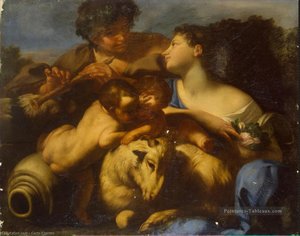
- Subject & Narrative: This striking monochromatic drawing depicts a pivotal religious moment – an apparition of an angel interacting with a kneeling man, likely a saint or supplicant. The scene unfolds outdoors, suggested by the rocky terrain and stone fragment at the base, creating a sense of immediacy and vulnerability.
- Style & Influences: Carlo Cignani’s work is characterized as belonging to the Mannerist style, evident in the elongated forms and expressive gestures within this drawing. It also reflects elements of Renaissance and Baroque art through its dramatic lighting and detailed figures. The pyramidal composition, with the angel at the apex and the man forming the base, adds a sense of balance and grandeur.
The Artist: Carlo Cignani – A Gentle Innovator
- Biography: Carlo Cignani (1628-1719) was an Italian painter born in Bologna. He is renowned for his "new manner," a gentle and intimate style that marked a departure from the more energetic classicism of the Bolognese School. This innovative approach influenced later artists like Guido Reni and Guercino.
- Training & Early Works: Cignani studied under Battista Cairo and later Francesco Albani, remaining closely allied with his mentor. His early commissions included a notable work for the Church of Gesù in Bologna, demonstrating his burgeoning talent and establishing him as a promising artist within the Bolognese art scene.
- A Reflective Style: Cignani's style was characterized by a reflective mood and an emphasis on detail, setting him apart from his contemporaries. He drew inspiration from masters like Correggio and Melozzo da Forlì, incorporating their techniques into his own unique artistic vision.
Technical Mastery & Artistic Technique
- Dry Point with Pen and Ink: The artwork is meticulously rendered using dry point and pen and ink on paper. This technique allows for exceptional detail and a delicate effect, capturing the textures of fabric, skin, and stone with remarkable precision.
- Dramatic Lighting & Shading: A single light source illuminates the angel from above, creating dramatic contrasts and highlighting key features. The extensive use of hatching and cross-hatching builds tonal values and adds depth to the composition, enhancing the sense of volume and realism.
- Perspective & Depth: While perspective is somewhat flattened, typical of drawings rather than fully realized paintings, depth is suggested through skillful shading and overlapping forms. This creates a compelling illusion of space within the two-dimensional artwork.
Symbolism & Emotional Impact
- Religious Significance: The subject matter centers on a profound religious narrative – an encounter between an angel and a supplicant, conveying themes of divine intervention, humility, and faith.
- Symbolic Elements: The angel's wings represent divine power and celestial grace, while the man’s kneeling posture signifies humility and supplication before a higher power.
- Emotional Resonance: The artwork evokes a sense of awe, reverence, and perhaps vulnerability. The dramatic lighting and expressive gestures contribute to an emotionally charged scene that invites contemplation and reflection.
Questions & Answers
Who is the artist behind "Apparition To A Saint"?
"Apparition To A Saint" was created by Carlo Cignani. The information on this page describes Carlo Cignani's original work.
Are the colors of "Apparition To A Saint" by Carlo Cignani saturated or muted?
"Apparition To A Saint" by Carlo Cignani is recorded with a muted saturation.
How do I preview a reproduction of "Apparition To A Saint" by Carlo Cignani?
A preview of "Apparition To A Saint" by Carlo Cignani is available on the artwork's Preview page.
Artist Biography
A Legacy of Gentle Baroque: The Life and Art of Carlo Cignani
Carlo Cignani, born in Bologna around 1630, stands as a fascinating figure bridging the High Baroque and the emerging Rococo styles. He wasn’t a revolutionary like some of his contemporaries, but rather a masterful consolidator, the last great exponent of the Bolognese classicism that had flourished for generations. His art embodies a ‘new manner,’ as it was known – a softening of the dramatic intensity favored by earlier Baroque masters, replaced with an intimate and reflective quality that subtly influenced artists like Guido Reni and Guercino. Cignani’s path wasn't one of radical innovation, but rather of refined elegance and intellectual depth, securing his place as a significant, if sometimes overlooked, figure in 17th-century Italian painting. Details surrounding his early life remain somewhat scarce; we know he came from a noble, though modestly resourced family, and that he would later have both a son, Felice Cignani, also a painter, and a nephew, Paolo Cignani, who followed in the family tradition.Formative Years and Artistic Development
Cignani’s artistic journey began under the tutelage of Battista Cairo, but it was his apprenticeship with Francesco Albani that truly shaped his foundational style. He absorbed Albani's meticulous technique, his vibrant use of color, and his commitment to a polished finish. However, Cignani didn’t simply mimic his master; he possessed an intellectual curiosity that led him to explore other influences. The frescoes of Correggio in the Parma Cathedral profoundly impacted his understanding of composition and chromatic harmony, while Melozzo da Forlì's mastery of perspective ignited his interest in creating illusionistic space. This synthesis of influences allowed Cignani to develop a distinctive voice – one characterized by graceful forms, balanced compositions, and a subtle emotional resonance. He established an *accademia del nudo* in Bologna, demonstrating a dedication to anatomical study and providing instruction to promising young artists, including Giuseppe Maria Crespi, who would become a celebrated painter in his own right.Major Works and Artistic Flourishes
Cignani’s career spanned several decades, producing a diverse body of work encompassing religious scenes, mythological narratives, and portraits. The *Assumption of Saint Rose of Lima*, painted for the church in Forlì, is arguably his most celebrated achievement. This monumental fresco showcases his ability to create dramatic compositions within architectural settings, echoing Correggio’s influence while establishing his own unique style. Other notable works include the *Entry of Paul III into Bologna*, a historical depiction imbued with intellectual gravitas, and *Francis I Touching for Kings Evil*, which demonstrates his skill in portraying royal figures with dignity and sensitivity. He also excelled at ceiling paintings, as evidenced by *The Power of Love*, created in collaboration with Agostino Carracci. His *Adam and Eve* gained international recognition through exhibitions in Dresden and Copenhagen, highlighting the growing demand for his work beyond Italy. Multiple versions of *Joseph and Potiphar's Wife* exist, a testament to the enduring appeal of this biblical theme within his oeuvre.A Lasting Influence on Bolognese Art
Carlo Cignani’s historical significance lies not only in his artistic output but also in his role as a preserver and transmitter of the Bolognese painting tradition. He represented the culmination of a school renowned for its classicism, intellectual rigor, and technical mastery. His commitment to anatomical study, evidenced by his *accademia del nudo*, helped maintain high standards of craftsmanship among aspiring artists. Beyond Crespi, he mentored Paolo Antonio Paderna and Sante Vandi, further contributing to the development of Bolognese art. His work found a home in prominent collections across Europe, including Dresden and Copenhagen, solidifying his international reputation. Today, several of his paintings are preserved in the Pinacoteca Civica in Forlì, ensuring that future generations can appreciate his artistry. Though he may not be as widely recognized as some of his Baroque contemporaries, Carlo Cignani remains a vital figure in art history – a master of gentle Baroque whose legacy continues to inspire and captivate. His later years were spent continuing to work diligently, including painting the *Aurora* at Circolo della Scranna in Forlì, and completing the *Incoronazione di Santa Rosa (Coronation of Saint Rose of Lima)* for the Pinacoteca Civica before his death sometime after 1719.
Carlo Cignani
1628 - 1719 , Italy
Quick Facts
- Artistic Movement Or Style: Baroque
- Artists Or Movements Influenced By This Artist:
- Crespi
- Paderna
- Vandi
- Artists Who Influenced This Artist:
- Correggio
- Melozzo da Forlì
- Albani
- Carracci
- Date Of Birth: 1628
- Date Of Death: 1719
- Full Name: Carlo Cignani
- Nationality: Italian
- Notable Artworks:
- Assumption of Saint Rose
- Entry of Paul III
- Francis I Touching
- Power of Love
- Adam and Eve
- Joseph & Potiphar's Wife
- Place Of Birth: Bologna, Italy
Related Articles
Discover the Divine: Inspiring Saint Anthony Artworks to Elevate Your Home Decor
Transform your home with the profound beauty of Saint Anthony artworks. Explore exquisite Baroque reproductions by Murillo and Zurbarán, hand-painted on 100% cotton canvas to bring divine serenity and timeless elegance to your interior design.

Saint George in Art: A Scholarly Exploration of Iconic Masterpieces and Eternal Legends
Delve into the profound legacy of Saint George through art history. Explore iconic masterpieces by Raphael and Dürer, decoding the iconography of the dragon legend. Discover scholarly insights and bring these timeless tales to life with our museum-quality, hand-painted oil reproductions.

Celestial Messengers: A Comprehensive Exploration of Angelic Representation in Art History
Explore the captivating history of angels in art! Discover symbolism, iconic Renaissance masterpieces & renowned artists. Expert insights for art lovers & collectors at OriginalUniqueArt.

Celestial Messengers: Angels in Painting – A Historical & Artistic Exploration
Explore the captivating history of angels in painting! Discover symbolism, iconic Renaissance & Byzantine masterpieces, and renowned artists. Expert insights for art lovers & collectors at OriginalUniqueArt.

The Nuances of Graphite: Exploring Emotional Depth & Technical Mastery in Pencil Drawing
Explore the captivating world of graphite drawing! Discover its rich history, master essential techniques like chiaroscuro, and learn how artists evoke emotion through this timeless medium. Expert insights for art enthusiasts.