

 Preview
 Send
Send Share
Share
 Details

 Download
 Similars
 X-Ray
X-Ray Diaporama
The Lost Trail
 1856
1856 50.0 x 78.0 cm
 Museo Thyssen-Bornemisza
 Read More
Hand Made Oil Reproduction
Hand-painted oil on canvas in your size and frame, made to order by our artists. ( Buy Print Buy Image)




































Pick from our preset sizes that match the artwork's original proportions.

You may enter your own dimensions to fit a specific frame or space. If your selected size does not match the original image's proportions, we will either crop the artwork or extend the painting with additional hand-painted elements. A digital mockup will be sent for your approval before production begins.
Please note that the on-screen preview does not reflect the actual cropping or extension. Only the mockup will accurately show the final composition.
While custom sizes are available, we recommend selecting a dimension from the predefined list to preserve the original proportions.
After order, OriginalUniqueArt.com team will email client for instructions and provide a mockup preview
Worldwide Delivery () in 3/4 weeks instead of standard 5 weeks. (29 August). No compromise on quality.

Free Worldwide Express Shipping

High-Quality Linen Canvas

Full Shipping Insurance

Customs Tax Refund Guarantee

True Color Matching Guarantee

60-Day Return Policy (Defects Only)

100% Money-Back Guarantee

Bulk Discount Offer
 Glass option is only available in size under 110 CM

The Lost Trail
Reproduction Medium
Reproduction Size
-


Total Price
$ 300
Artist Biography
The Chronicler of the American Frontier: The Life and Vision of Carl Wimar
Karl Ferdinand Wimar, known to many as Charles Wimar, occupied a unique and vital space in the mid-19th-century art world, acting as a visual bridge between the disciplined traditions of European academies and the raw, untamed spirit of the American West. Born in 1828 in Siegburg, Prussia, Wimar’s journey was one of profound geographical and artistic transformation. After emigrating to St. Louis at the tender age of fifteen, he found himself immersed in the burgeoning frontier culture of Missouri. This early exposure to the vastness of the American landscape would later become the heartbeat of his creative output. His formal education, however, remained deeply rooted in the prestigious traditions of the Old World. By enrolling at the Düsseldorf Academy in 1852, Wimar placed himself under the tutelage of Emanuel Leutze, a master of Romanticism. This mentorship was transformative, instilling in him a rigorous dedication to realism and a penchant for dramatic, narrative-driven compositions that would define his later masterpieces.Expeditions into the Heart of the Great Plains
The true essence of Wimar’s artistry was forged not in the quiet studios of Germany, but along the winding currents of the Missouri and Mississippi Rivers. During the pivotal expeditions of 1858 and 1859, Wimar transitioned from a student of technique to an intrepid observer of life. Driven by an insatiable curiosity, he ventured deep into the Great Plains, documenting the rhythmic, nomadic existence of Native American tribes with an eye for both ethnographic detail and emotional resonance. He did not merely paint landscapes; he captured the pulse of a disappearing era. His canvases became windows into the daily rituals of indigenous peoples, the thunderous movement of massive buffalo herds, and the precarious encounters between migrating pioneer wagon trains and the original inhabitants of the land. Through his meticulous observation, Wimar imbued his subjects with a dignity and vitality that transcended simple documentation, elevating frontier life to the realm of high art.Legacy and Artistic Significance
Wimar’s body of work is characterized by a remarkable synthesis of Realism and Symbolism. While his technical execution relied on the precision learned at Düsseldorf, his thematic focus often touched upon the profound tensions of the colonial era. One of his most celebrated early achievements, The Abduction of Boone's Daughter by the Indians, serves as a hauntingly beautiful example of his ability to weave historical incident with dramatic tension. Beyond his individual canvases, Wimar’s contribution to American visual identity was cemented through large-scale projects, such as the magnificent murals he painted in 1861 for the Rotunda of the St. Louis Court House. Though his life was tragically short, ending in 1862, the impact of his vision remains indelible. He remains a foundational figure for anyone seeking to understand the complex, often turbulent, beauty of the American frontier through the lens of a master painter who saw both the majesty and the tragedy of a changing world.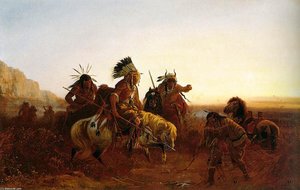
carl wimar
1828 - 1862 , Germany
Quick Facts
- Artistic Movement Or Style: Romanticism
- Artists Or Movements Influenced By This Artist: ['Düsseldorf School']
- Artists Who Influenced This Artist: ['Emanuel Leutze']
- Date Of Birth: February 20, 1828
- Full Name: Karl Ferdinand Wimar
- Nationality: German-American
- Notable Artworks:
- The Abduction of Boone's Daughter by the Indians
- The Lost Trail
- Place Of Birth: Siegburg, Germany


