Preview
 Send
Send Share
Share
 Details

 Download
 Similars
 X-Ray
X-Ray Diaporama
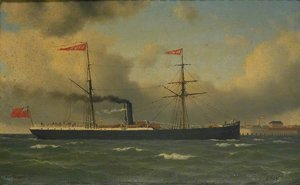
SS 'Gertrude'
 1859
1859 87.0 x 121.0 cm
 Read More
Giclée / Art Print
Museum-quality giclée or canvas print with fast production and flexible finish options. ( Buy Hand Made Painting Buy Image)




































Pick from our preset sizes that match the artwork's original proportions.

You may enter your own dimensions to fit a specific frame or space. If your selected size does not match the original image's proportions, we will either crop the artwork or extend the image with a mirrored or solid-fill edge. A digital mockup will be sent for your approval before production begins.
Please note that the on-screen preview does not reflect the actual cropping or extension. Only the mockup will accurately show the final composition.
While custom sizes are available, we recommend selecting a dimension from the predefined list to preserve the original proportions.
Worldwide Delivery () in 2 weeks instead of standard 4/5 weeks. (28 August)

Free Worldwide Express Shipping

High-Quality Linen Canvas

Full Shipping Insurance

Customs Tax Refund Guarantee

True Color Matching Guarantee

60-Day Return Policy (Defects Only)

100% Money-Back Guarantee

Bulk Discount Offer
 Glass option is only available in size under 110 CM

SS 'Gertrude'
Giclée / Art Print
Reproduction Size
-


Total Price
$ 81
Artist Biography
The Soul of the Nordic Sea: The Life and Art of Carl Emil Baagøe
To gaze upon a seascape by Carl Emil Baagøe is to enter a realm of profound stillness, where the boundary between the sky and the salt spray dissolves into a singular moment of quietude. Born in Copenhagen in 1829 to a family deeply rooted in maritime tradition, Baagøe was destined to become one of Denmark’s most evocative marine painters. His father, a sailing master, provided him with an intimate, early education in the rhythms of the ocean—a foundation that would later allow him to translate the complex language of waves and wind onto canvas with unparalleled authenticity. While his formal training at the Royal Danish Academy of Fine Arts equipped him with the technical precision required for classical realism, it was his lived experience among the dockyards and salt-crusted vessels that truly defined his artistic spirit.
Baagøe’s journey toward mastery was marked by a period of romanticized struggle. In his youth, while working as a journeyman decorative painter, he famously chose to embrace a life of near-poverty, frequenting the bustling dockyards not for wages, but for inspiration. He sought the raw, unvarnished reality of seafaring life, observing the grit and grace of fishermen and the heavy, rhythmic labor of the maritime industry. This period of immersion allowed him to move beyond mere imitation; he began to understand the weight of a ship’s hull in the water and the specific, translucent quality of light as it hits a calm Nordic bay. By 1855, having refined his craft through both academic rigor and street-level observation, he began exhibiting the seascapes that would eventually earn him international acclaim.
Voyages of Light and Atmosphere
The true expansion of Baagøe’s visual vocabulary occurred during his extensive expeditions across the North. His travels to Iceland in 1855 and subsequent voyages to the rugged coasts of Norway in the 1860s acted as profound catalysts for his development. These landscapes, characterized by dramatic coastlines and an ethereal, often melancholic light, provided him with a limitless palette of textures and tones. In these works, one can witness his remarkable ability to render the subtle gradations of a twilight sky or the glistening, wet surfaces of weathered rocks. Unlike many of his contemporaries who sought to capture the violent, heroic drama of shipwreks or naval battles, Baagøe found his greatest strength in the tranquil and the sublime.
His technique was a masterclass in atmospheric realism. He favored a palette of muted, sophisticated tones—deep greens, slate grays, and soft cerulean blues—which served to emphasize the mood rather than the spectacle. Through meticulous brushwork, he could convey the heavy movement of a steamship like the SS Sultan or the delicate, intricate rigging of a sailing vessel such as the SS Lion. There is a palpable sense of weight and moisture in his paintings; one can almost feel the dampness of the Norwegian mist or the rhythmic pulse of a tide receding from a pebbled shore. This sensitivity to light allowed him to transform simple maritime scenes into profound meditations on nature’s enduring peace.
A Lasting Maritime Legacy
The historical significance of Carl Emil Baagøe lies in his ability to elevate marine painting from mere documentation to high art. While his works were immensely popular in England, where collectors admired his technical prowess and atmospheric depth, his true legacy is found in the emotional resonance of his compositions. He captured a vanishing era of maritime life—a time when the relationship between man and sea was defined by a quiet, respectful coexistence rather than industrial conquest.
Even as the world moved toward more modern, fragmented styles of art, Baagøe remained a steadfast guardian of the classical marine tradition. His contributions to the Illustreret Tidende and his presence in major collections like the Hull Maritime Museum ensure that his vision of the Nordic coast remains accessible to future generations. To study his work is to revisit a period of maritime history through a lens of serenity, finding beauty in the stillness of the water and the enduring majesty of the sea.

carl emil baagøe
1829 - 1902
Quick Facts
- Artistic Movement Or Style: Marine Painting
- Artists Or Movements Influenced By This Artist: ['Romanticism']
- Artists Who Influenced This Artist:
- Thomas Thornycroft
- William Blake
- Date Of Birth: 1829
- Date Of Death: 1902
- Full Name: Carl Emil Baagøe
- Nationality: Danish
- Notable Artworks:
- The Calm Sea
- Fishing Boats
- Place Of Birth: Denmark