Preview
 Send
Send Share
Share
 Details
 Guide
Guide

 Download
 Similars
 X-Ray
X-Ray Diaporama
 Stats
Statsnot identified

 Read More
Hand Made Oil Reproduction
Hand-painted oil on canvas in your size and frame, made to order by our artists. ( Switch to Print Switch to Digital Image)




P118B $10

P118H $10

P118W $10

P438Z $10

P508JH $12

P508YH $12

P805H $10

P805Z $10

P919BZ $10

P919G $10

P919XJ $10

P959ZH $10

P968JZ $12

W106C $8

W218G $10

W218JH $8

W218Y $10

W307PJ $10

W316G $10

W316PJ $8

W316Y $10

W398PJ $8

W4111J $10

W500HY $15

W500JH $15

W692G $12

W849H $8

W940BG $15

W953PJ $8




Pick from our preset sizes that match the artwork's original proportions.

Type the width and the height you need, to fit your frame or your wall. This is hand-painted, so for a size with a different shape the artist can paint a bit more around the picture, or cut a bit — you choose. We send you a digital mockup to approve before the painting starts. The picture shown on this page does not show the real result — only the mockup does.
After order, OriginalUniqueArt.com team will email client for instructions and provide a mockup preview
Worldwide Delivery () in 3/4 weeks instead of standard 5 weeks. (22 October). No compromise on quality.

Free Worldwide Express Shipping

High-Quality Linen Canvas

Full Shipping Insurance

Customs Tax Refund Guarantee

True Color Matching Guarantee

100-Day Return Policy (Defects Only)

100% Money-Back Guarantee

Bulk Discount Offer
 Glass option is only available in size under 110 CM

not identified
Reproduction Medium
Reproduction Size
-


Total Price
$ 300
A Study in Abundance: A Caravaggio Still Life
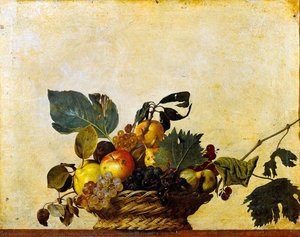
This captivating still life, attributed to the masterful hand of Michelangelo Merisi da Caravaggio, presents a scene brimming with both earthly bounty and profound emotional resonance. The composition immediately draws the eye to a monumental pumpkin – a dominant presence that speaks volumes about the harvest’s richness and the transient nature of beauty. Scattered around this central figure are a carefully arranged collection of apples, their crimson skins offering a vibrant counterpoint to the earthy tones of the vegetables and fruit. A solitary human form, subtly placed on the right side of the canvas, introduces an element of narrative, perhaps suggesting contemplation or interaction with this opulent display.
- Subject Matter: The painting’s subject is a classic still life – a meticulously rendered collection of fruits and vegetables. However, Caravaggio elevates this genre through his dramatic use of light and shadow, transforming the mundane into something deeply evocative.
- Style & Technique: This work exemplifies Caravaggio's signature *tenebrism*, a technique characterized by stark contrasts between intensely dark areas and dramatically illuminated subjects. The strong directional light not only reveals the textures and forms of the objects but also serves to heighten their emotional impact, creating a sense of theatrical drama. The artist’s brushwork is loose and expressive, contributing to the painting's raw energy and immediacy.
Historical Context & Caravaggio’s Innovation
Created during the tumultuous period of the Baroque era (roughly 1600-1750), this still life reflects a shift in artistic sensibilities away from the idealized forms of the Renaissance towards a more realistic and emotionally charged approach. Caravaggio, working primarily in Rome, was a revolutionary figure who challenged the established conventions of his time. He rejected the polished surfaces and classical allegories favored by many of his contemporaries, instead choosing to depict everyday subjects – often religious scenes – with unflinching honesty and a deep understanding of human psychology. His use of ordinary people as models, rather than idealized figures, further contributed to this revolutionary spirit.
Born in Milan in 1571, Caravaggio’s early life was marked by tragedy—the deaths of his father and grandfather from the plague. This experience profoundly shaped his artistic vision, fueling a preoccupation with themes of mortality, suffering, and redemption. His time in Rome, though initially challenging, provided him with the freedom to develop his unique style, which would ultimately influence generations of artists.
Symbolism & Emotional Impact
- The Pumpkin: The oversized pumpkin is often interpreted as a symbol of abundance, fertility, and even mortality – a reminder of the cyclical nature of life and death.
- Apples: Apples frequently represent temptation, knowledge, or beauty in Western art. Their placement strategically draws attention to specific areas of the composition.
- The Human Figure: The presence of the human figure adds an element of mystery and invites the viewer to contemplate their role within this scene. It could be interpreted as a representation of humanity’s relationship with nature, or perhaps a meditation on faith and doubt.
Ultimately, this Caravaggio still life transcends its simple subject matter to become a powerful exploration of light, shadow, emotion, and the human condition. Its dramatic intensity and masterful technique continue to captivate viewers centuries later, making it a timeless masterpiece worthy of admiration and preservation.
Questions & Answers
How does the subject of "not identified" relate to Caravaggio's usual themes?
"not identified" depicts still life, caravaggio, fruits, vegetables, pumpkin, abundance, baroque, while Caravaggio's recorded themes are religious symbolism, caravaggio’s style, dramatic chiaroscuro, realism, humanism, social commentary, early baroque influence”, “complex artistic legacy. Comparing the two shows how the work relates to the artist's usual subjects.
What luminance does "not identified" by Caravaggio have?
The luminance recorded for "not identified" by Caravaggio is dark.
What color intensity does "not identified" by Caravaggio have?
The colors in "not identified" by Caravaggio have a monochromatic intensity.
Artist Biography
A Life Forged in Shadow and Light
Milan, 1571. The air is heavy with the scent of plague. Young Michelangelo Merisi watches as death claims his father and grandfather in a single day. He grows up in the grip of poverty, a reality that later finds its way onto his canvases through the faces of ordinary people. By 1584, he begins an apprenticeship under Simone Peterzano, a former pupil of Titian. This training provides the technical foundation, but the spirit of the boy from Milan is already restless.
Rome, around 1592. The city is a crucible of religious fervor and intense competition. Caravaggio arrives without fixed address or provision, a penniless migrant in a landscape of grand ambitions. He finds footing through the patronage of Cardinal Francesco Maria del Monte. In the shadows of the Palazzo Madama, the artist begins to strip away the artificial elegance of Mannerism. He replaces elongated, idealized forms with something far more visceral.
The Architecture of Darkness
He rejects the polished surfaces of his contemporaries. Instead, he embraces tenebrism, a style where darkness is a physical presence rather than a mere absence of light. In works like The Cardsharps, light does not simply illuminate; it strikes. It carves figures out of an impenetrable black void. This technique, often called chiaroscuro, creates a stage-like intensity that forces the viewer to confront the raw textures of silk, skin, and bone.
His method is direct. He works alla prima, applying paint directly to the canvas without the safety net of preparatory drawings. This immediacy allows for a startling realism. He uses the people of the Roman streets—the drunks, the laborers, the outcasts—as models for the sacred. When he paints the Holy Family, they possess the dirt and weariness of the living. The divine becomes profoundly human.
- Tenebrism: The use of violent contrasts between light and dark to command attention.
- Realism: A commitment to depicting the physical and emotional truth of the human condition.
- Direct Observation: Working from live models to capture unadorned, naturalistic detail.
Flight and Finality
The brilliance of his art is matched by the volatility of his temperament. A brawl in 1606 leads to a murder charge and a death sentence. The artist becomes an outlaw. He flees Rome, moving through Naples, Malta, and Sicily. Even in exile, the work continues. In Malta, he joins the Order of St. John, but his turbulent nature leads to imprisonment after a quarrel with a superior.
The end comes in 1610. While traveling from Naples back toward Rome in search of a papal pardon, he dies in Porto Ercole. The cause remains a subject of debate—fever, wounds, or perhaps lead poisoning. He leaves behind a legacy that fundamentally altered the course of Western art. His followers, the Caravaggisti, carry his shadows across Europe, ensuring that the darkness he mastered would never truly fade.

Caravaggio
1571 - 1610 , Spain
Quick Facts
- Artistic Movement Or Style: Baroque, Tenebrism
- Artists Or Movements Influenced By This Artist:
- Caravaggisti
- Rubens
- Jusepe de Ribera
- Gerrit van Honthorst
- Artists Who Influenced This Artist: ['Titian']
- Full Name: Michelangelo Merisi da Caravaggio
- Notable Artworks:
- The Taking of Christ
- Saint Francis of Assisi in Ecstasy
- The Fortune Teller
- Supper at Emmaus
- David with the Head of Goliath
- Place Of Birth: Milan, Spain
- Date Of Birth: 1571
- Date Of Death: 1610
Related Articles
Nature's Bounty: The Art History of Fruit Arrangement Masterpieces and the Baroque Still Life Tradition
Explore the profound beauty of fruit arrangement masterpieces. From Dutch Golden Age opulence to Baroque chiaroscuro, discover the art history, symbolism, and timeless elegance of classical still life paintings for the discerning collector.

The Bountiful Still Life: Symbolism & Artistic Representation of Fruit Across Art History
Explore the rich history of still life painting & the symbolism of fruit across art movements. Discover masterpieces from Caravaggio to Cézanne with OriginalUniqueArt – expert guidance & museum-quality reproductions.
The Art of the Vine: Curating Exquisite Masterpieces Featuring Grapes for the Discerning Collector
Embark on a visual journey through the world's most exquisite grape-themed masterpieces. Discover the technical brilliance of Baroque masters and learn how to curate timeless, hand-painted oil reproductions for your luxury collection with OriginalUniqueArt.com.
Baroque Painting's Greatest Hits: 10 Masterpieces for Your Home | OriginalUniqueArt
Journey through Baroque painting's glory! Explore 10 masterpieces by Caravaggio, Rembrandt & Vermeer. Discover dramatic lighting, rich colors & timeless stories. Find museum-quality art reproductions for your home at OriginalUniqueArt.com.

Baroque Masterpieces: 10 Paintings That Defined an Era |
Journey through the drama & grandeur of Baroque art! Explore 10 masterpieces by Caravaggio, Rembrandt, Rubens & more. Discover stunning oil paintings, rich colors & timeless stories. Find museum-quality reproductions at .