Preview
 Send
Send Share
Share
 Details

 Download
 Similars
 X-Ray
X-Ray Diaporama
Untitled (539)

 Read More
Giclée / Art Print
Museum-quality giclée or canvas print with fast production and flexible finish options. ( Buy Hand Made Painting Buy Image)




P118B $10

P118H $10

P118W $10

P438Z $10

P508JH $12

P508YH $12

P805H $10

P805Z $10

P919BZ $10

P919G $10

P919XJ $10

P959ZH $10

P968JZ $12

W106C $8

W218G $10

W218JH $8

W218Y $10

W307PJ $10

W316G $10

W316PJ $8

W316Y $10

W398PJ $8

W4111J $10

W500HY $15

W500JH $15

W692G $12

W849H $8

W940BG $15

W953PJ $8




Pick from our preset sizes that match the artwork's original proportions.

You may enter your own dimensions to fit a specific frame or space. If your selected size does not match the original image's proportions, we will either crop the artwork or extend the image with a mirrored or solid-fill edge. A digital mockup will be sent for your approval before production begins.
Please note that the on-screen preview does not reflect the actual cropping or extension. Only the mockup will accurately show the final composition.
While custom sizes are available, we recommend selecting a dimension from the predefined list to preserve the original proportions.
Worldwide Delivery () in 2 weeks instead of standard 4/5 weeks. (23 August)

Free Worldwide Express Shipping

High-Quality Linen Canvas

Full Shipping Insurance

Customs Tax Refund Guarantee

True Color Matching Guarantee

60-Day Return Policy (Defects Only)

100% Money-Back Guarantee

Bulk Discount Offer
 Glass option is only available in size under 110 CM

Untitled (539)
Giclée / Art Print
Reproduction Size
-


Total Price
$ 81
Collectible Description
A Burst of Provencal Sunshine: Exploring Bernard Cathelin’s Abstract Floral Still Life
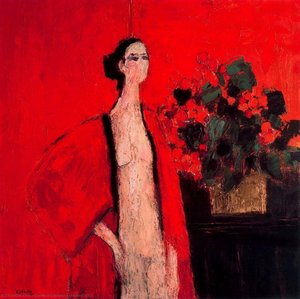
This captivating artwork by French painter Bernard Cathelin is a vibrant explosion of color and texture, an abstract interpretation of a classic still life subject – the bouquet. While titled simply “Untitled (539),” this piece speaks volumes through its energetic brushwork and bold chromatic choices. It’s a testament to Cathelin's mastery of oil paint and his ability to convey emotion through purely formal means.Style & Influences: Fauvism Meets Abstract Expressionism
Cathelin, a member of the esteemed *School of Paris* alongside luminaries like Matisse and de Buffet, occupies an interesting stylistic space. This work demonstrates clear influences from Fauvism, particularly in its unrestrained use of color – the dominant yellows and oranges are not descriptive but expressive, used to evoke feeling rather than replicate reality. However, the thick impasto application and dynamic composition also hint at Abstract Expressionism. Cathelin doesn’t merely depict flowers; he *expresses* their essence—their vitality and fleeting beauty—through a gestural and intensely personal visual language.Technique & Materials: A Tactile Experience
The painting is demonstrably executed in oil paint, applied with a generous hand and likely utilizing a palette knife to build up the rich, tactile surface. This impasto technique isn’t just about visual impact; it invites the viewer to imagine the physicality of the paint itself – its weight, texture, and responsiveness to Cathelin's touch. The lack of precise lines and blending further emphasizes this textural quality, creating a sense of immediacy and spontaneity.Subject & Symbolism: Beyond Representation
While ostensibly a still life of flowers in a ceramic pot, the artwork transcends simple representation. Cathelin strips away detail, focusing instead on form, color, and energy. Flowers have long held symbolic meaning – often representing beauty, fragility, and the ephemeral nature of life. Here, however, the symbolism is less about specific floral meanings and more about the universal joy and exuberance associated with blossoming life. The vibrant hues suggest warmth, optimism, and a celebration of natural vitality.Historical Context & Cathelin’s Oeuvre
Born in Paris in 1919, Bernard Cathelin lived through a period of significant artistic upheaval and innovation. His work reflects this dynamism, blending established traditions with emerging modern styles. He was deeply connected to his French heritage, particularly the landscapes of the Drôme region in Provence – a connection that informed much of his work throughout his career. While known for still lifes, landscapes, and portraits of women, Cathelin consistently explored themes of color, texture, and emotional expression across all his subjects. His extensive travels—to Mexico, Russia, Japan, Italy, and Spain—also broadened his artistic horizons and contributed to the richness of his visual vocabulary.Emotional Impact & Interior Design
This painting is an instant mood-lifter. Its warm palette and energetic brushwork evoke feelings of joy, optimism, and vitality. It’s a piece that would bring a sense of sunshine and warmth to any interior space. The abstract nature allows it to complement a wide range of décor styles – from modern minimalist settings to more traditional interiors seeking a pop of color and texture. Its bold presence makes it a focal point, while its underlying emotional resonance adds depth and sophistication.Collecting Cathelin
Bernard Cathelin’s work is increasingly sought after by collectors who appreciate his unique blend of tradition and modernity. His paintings offer a compelling visual experience and a lasting testament to the power of color and texture in abstract art. A reproduction of this piece would be an excellent addition to any collection, bringing a touch of Provencal sunshine into your home or office.Artist Biography
The Vibrant Soul of the School of Paris: The Life of Bernard Cathelin
Born in the heart of Paris in 1919, Bernard Cathelin emerged as a luminous figure within the prestigious School of Paris, an artistic movement that bridged the gap between classical tradition and the bold experimentation of the post-war era. His journey was one of profound dedication; though he garnered critical acclaim as early as 1950, the reality of a professional artist's life meant he did not achieve full financial independence through his brush until 1955. This period of perseverance only served to deepen his connection to his craft. Cathelin’s artistic lineage is deeply intertwined with the masters of color, having studied under Maurice Brianchon at the École Nationale Supérieure des Arts Décoratifs. Through this mentorship, he absorbed the vibrant, colorist traditions of Henri Matisse, a legacy that would later manifest in his own ability to marry tones through striking contrasts and delicate proximities.
Cathelin’s work is far more than a mere depiction of subjects; it is an exploration of light and substance. He did not simply paint a bouquet or a landscape; he orchestrated colors to evoke a specific emotional resonance. His technique, often involving the skillful application of oil on canvas using both brushes and knives, allowed him to create a subtle richness of texture that gave his works a physical presence. This tactile quality extended even to his lithographs, where he sought to replicate the density and material weight found in his paintings. For Cathelin, color was the protagonist—the very heart of his creative universe.
A Tapestry of Landscapes and Light
The geography of Cathelin’s soul was shaped by both his ancestral roots and his global wanderings. While he was a child of Paris, his heart remained tethered to the Drôme region in Provence, the cradle of his maternal origins. The serene landscapes of this region provided him with a constant source of solace and artistic impetus, appearing frequently in his oeuvre as symbols of peace and continuity. However, his vision was significantly expanded by his extensive travels across the globe. From the vibrant cultural textures of Mexico and the architectural elegance of Japan to the historic vistas of Russia, Italy, and Spain, each destination contributed a new layer of inspiration to his palette.
This global perspective allowed him to weave diverse cultural influences into his recurring themes:
- Still Lifes: His exquisite bouquets of flowers, such as anemones and roses, serve as quiet meditations on beauty and the ephemeral nature of life.
- Portraits: His depictions of women are characterized by a profound sensitivity, capturing nuance and grace through the interplay of light and shadow.
- Landscapes: Whether capturing the sun-drenched fields of Provence or the architectural inspirations found in his later years, his landscapes remain deeply rooted in an appreciation for natural harmony.
Legacy and Recognition
The significance of Bernard Cathelin’s contribution to modern art is reflected in the widespread recognition he received during his lifetime and beyond. His ability to maintain a unique, recognizable style while participating in the broader currents of the School of Paris earned him a place among the respected figurative artists of the 20th century. His achievements were marked by prestigious honors, most notably being elected to the Legion of Honour by French President François Mitterrand in 1995, a testament to his cultural impact on France.
Cathelin’s international reach was further solidified through major retrospective exhibitions, including a landmark event at the Musée de Valence in 1997 and a grand celebration of forty years of work at the Shanghai Art Museum in 2000. Even after his passing in 2004, his influence persists through the enduring vitality of his colors. He remains an artist whose work continues to invite viewers into a world where color is not just seen, but felt—a world where every stroke of the knife and every layer of oil serves to celebrate the profound beauty of the natural and human experience.

Bernard Cathelin
1919 - 2004 , France
Quick Facts
- Artistic Movement Or Style: School of Paris
- Artists Or Movements Influenced By This Artist: ['Expressionism']
- Artists Who Influenced This Artist:
- Matisse
- de Buffet
- Brianchon
- Date Of Birth: May 20, 1919
- Date Of Death: April 17, 2004
- Full Name: Bernard Cathelin
- Nationality: French
- Notable Artworks:
- Untitled (827)
- Untitled (852)
- Untitled (750)
- Place Of Birth: Paris, France
Related Articles

Abstract Expressionism's 10 Defining Masterpieces |
Explore 10 defining Abstract Expressionism masterpieces by Pollock, Rothko & de Kooning. Discover the stories behind these iconic paintings and find museum-quality art reproductions to elevate your home decor on .

Kandinsky's Masterpieces: 25 Paintings That Define Abstract Art | OriginalUniqueArt
Journey through Wassily Kandinsky's 25 most iconic abstract paintings. Explore his revolutionary use of color, form & spiritual expressionism. Find museum-quality Kandinsky reproductions and elevate your home decor with OriginalUniqueArt.com. Discover all masterpieces on OriginalUniqueArt.com!
Clyfford Still's Abstract Expressionism: A Study of Color, Form & the Existential Landscape
Explore the profound world of Clyfford Still's Abstract Expressionism with OriginalUniqueArt. Discover his unique style, existential themes & investment potential. Expert analysis for discerning collectors.
The Soul of Color: A Journey into the Emotional Resonance of Lyrical Abstraction
Embark on a cultural journey through Lyrical Abstraction. Explore how masters like Kandinsky used color and motion to translate emotion into visual poetry. Discover the profound beauty of abstract expressionism and learn to curate emotional resonance in your own art collection.
Lyrical Abstraction: The Emotional Power of Color and Form in Modern Art History
Explore the profound emotional depth of Lyrical Abstraction. Discover how masters like Raymond Parker used color and form to bridge Impressionism and Abstract Expressionism. Learn about this pivotal movement through our expert-led art history guide.