Send
Send Share
Share
 Details
 Guide
Guide

 Download
 Similars
 Diaporama
 Stats
StatsInvolute II


 Read More
The artwork displayed on this page is protected by copyright law, which means we cannot legally create or sell an identical reproduction. This protection is enforced under international agreements such as the Berne Convention and by national laws, including those outlined by the U.S. Copyright Law - Title 17.
This method fully complies with copyright regulations because it does not involve copying or duplicating the protected artwork. Instead, it is a creative reinterpretation - a new painting that is influenced by the original but not identical to it.
Giclée / Art Print
Museum-quality giclée or canvas print with fast production and flexible finish options. ( Buy Hand Made Painting Switch to Digital Image)




































Pick from our preset sizes that match the artwork's original proportions.

Type the width and the height you need, to fit your frame or your wall. A print can only be cut, never made bigger than the picture, so a size with a different shape loses a part of the image. We send you a digital mockup to approve before we print anything. The picture shown on this page does not show the real cut — only the mockup does.
Worldwide Delivery () in 2 weeks instead of standard 4/5 weeks. (21 October)

Free Worldwide Express Shipping

High-Quality Linen Canvas

Full Shipping Insurance

Customs Tax Refund Guarantee

True Color Matching Guarantee

100-Day Return Policy (Defects Only)

100% Money-Back Guarantee

Bulk Discount Offer
 Glass option is only available in size under 110 CM

Involute II
Giclée / Art Print
Reproduction Size
-


Total Price
$ 81
Involute II: A Dance of Form and Void by Barbara Hepworth
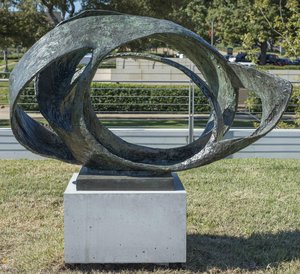
Dame Barbara Hepworth’s Involute II, created in 1956, is more than just a sculpture; it's an invitation to contemplate the relationship between form, space, and the very essence of movement. This remarkable bronze piece, currently available as a meticulously hand-painted reproduction from OriginalUniqueArt.com, embodies Hepworth’s signature approach – a profound exploration of abstraction rooted in a deep understanding of natural forms. The sculpture itself is deceptively simple: a large, smoothly rendered sphere pierced by a carefully considered hole. Yet, within this apparent minimalism lies a complex interplay of visual and emotional resonance.
Hepworth's fascination with the ‘hole’ – introduced in her work as early as 1931 – wasn’t merely a stylistic choice; it represented a fundamental shift in sculptural thinking. She sought to move beyond static representation, embracing instead the concept of an internal space, a void that simultaneously defines and disrupts the external form. Involute II exemplifies this perfectly. The sphere itself suggests wholeness, containment, and perhaps even the cosmos – while the aperture invites us to consider what lies beyond, creating a dynamic tension between interiority and exteriority.
The Language of Form: Hepworth’s Technique
Hepworth's technique was characterized by an extraordinary combination of direct carving and indirect methods. She began with rough blocks of stone or wood, meticulously shaping them using hand tools before transferring the forms to a plaster model. This process allowed her to refine the initial idea while retaining a tactile connection to the material. The bronze casting itself demanded immense skill – achieving the smooth, polished surface of Involute II required careful control over temperature and pressure during the molten metal process. The subtle variations in texture, achieved through abrasives and polishing, are testament to her dedication to capturing the nuances of form.
Notably, Hepworth’s work was deeply influenced by her time in St Ives, Cornwall, where she collaborated with Ben Nicholson and other artists. This environment fostered a spirit of experimentation and a shared interest in exploring new ways of representing reality through abstraction. The Cornish landscape – its rugged coastline, swirling seas, and dramatic light – undoubtedly informed Hepworth’s artistic vision, contributing to the sense of dynamism and movement that permeates her sculptures.
Symbolism and Emotional Impact
The title itself, “Involute,” refers to a mathematical term describing a spiral curve—a concept that resonates powerfully with the sculpture's form. The spiraling shape evokes notions of growth, evolution, and the cyclical nature of life. The hole, then, isn’t simply an absence; it’s an active element, suggesting potential, transformation, and a connection to something beyond our immediate perception. It invites contemplation on themes of openness, vulnerability, and the search for meaning.
Involute II is not merely a visually striking object; it's a deeply evocative work that speaks to the human condition. Its smooth surfaces and subtle textures invite tactile engagement, while its open form encourages introspection. As a reproduction from OriginalUniqueArt.com, this piece retains the essence of Hepworth’s original vision – offering a beautiful and thought-provoking addition to any collection or interior space. The hand-painted detail ensures that every curve and texture is faithfully reproduced, capturing the spirit and artistry of this iconic sculpture.
Bringing Involute II into Your Space
Consider how Involute II might interact with your existing décor. Its neutral tones and flowing form will complement a wide range of styles, from minimalist modern to mid-century contemporary. The sculpture’s inherent dynamism can serve as a focal point in a room, drawing the eye and stimulating conversation. Whether displayed on a pedestal or integrated into a larger composition, Involute II is sure to become a cherished piece – a testament to Barbara Hepworth's enduring legacy and her profound understanding of the power of abstract form.
Questions & Answers
How do I preview a reproduction of "Involute II" by Barbara Hepworth?
To preview a reproduction of "Involute II" by Barbara Hepworth, open the artwork's Preview page.
Is "Involute II" held in the country of its creator?
Yes - the artwork is kept in the artist's home country. "Involute II" is held in United Kingdom, while Barbara Hepworth was born in United Kingdom.
What mood does "Involute II" by Barbara Hepworth express within Modern Sculpture?
Within the Modern Sculpture movement, "Involute II" is recorded with a tranquil tone.
Artist Biography
early life and education
dame barbara hepworth, a renowned english artist and sculptor, was born on january 10, 1903, in wakefield, yorkshire. she attended the leeds school of art from 1920 and later won a county scholarship to study at the royal college of art (rca) in london from 1921 until she was awarded the diploma in 1924.artistic career
- dame barbara hepworth's work exemplifies modernism, particularly modern sculpture. she was one of the few female artists to achieve international prominence.
- in 1933, she co-founded the unit one art movement with ben nicholson, paul nash, and others, seeking to unite surrealism and abstraction in british art.
- hepworth's early work was characterized by abstraction and her involvement with the paris-based art movement, abstraction-création.
notable works and exhibitions
- oval form (trezion), a bronze sculpture, is part of the kimbell art museum collection in fort worth, united states. (view on OriginalUniqueArt)
- two forms, a sculpture, is exhibited at the hepworth wakefield in wakefield, united kingdom. (view on OriginalUniqueArt)
- totem, a marble sculpture, is also part of the collection at the hepworth wakefield. (view on OriginalUniqueArt)
legacy and museum collections
barbara hepworth's work is widely recognized, with her sculptures and paintings forming part of various museum collections worldwide. the hepworth wakefield, named after the artist, houses numerous masterpieces from renowned artists, including hepworth's own works. (discover more about the hepworth wakefield on OriginalUniqueArt)conclusion
dame barbara hepworth's pioneering work in modern british sculpture has left an indelible mark on the art world. her legacy continues to inspire artists and art enthusiasts alike, with her works remaining a testament to her innovative spirit and artistic genius. more about barbara hepworth on wikipedia
Barbara Hepworth
1903 - 1975 , United Kingdom
Quick Facts
- Full Name: Barbara Hepworth
- Nationality: British
- Date Of Birth: 1903
- Date Of Death: 1975
- Place Of Birth: Wakefield, United Kingdom
- Notable Artworks:
- Oval Form (Trezion)
- Two Forms
- Totem
- Artistic Movement Or Style: Modernism, Abstraction
- Artists Who Influenced This Artist:
- Henry Moore
- Ben Nicholson
- Artists Or Movements Influenced By This Artist:
- Abstraction-Création
- Unit One
Related Articles

The Enduring Legacy of Bronze: A Historical & Artistic Exploration for the Collector
Explore the rich history & enduring appeal of bronze sculpture with expert insights for collectors at OriginalUniqueArt. Learn about casting techniques, iconic artists, collecting tips & contemporary interpretations.

The Enduring Legacy of Bronze Sculpture: A Collector's Guide to Form & Cultural Significance
Explore the rich history & enduring appeal of bronze sculpture with expert insights for collectors at OriginalUniqueArt. Learn about casting techniques, iconic artists, and collecting tips to build a discerning art collection.

Bronze Sculptures That Defined Art History | OriginalUniqueArt
Journey through art history with our Top 10 bronze sculptures! Explore masterpieces by Rodin, Michelangelo & more. Discover stories behind iconic statues and find museum-quality reproductions for your home decor at OriginalUniqueArt.com.
Barbara Hepworth: A Sculptural Dialogue with Form, Space & the Human Condition
Explore the profound world of Barbara Hepworth's sculpture. Discover her artistic evolution, iconic forms, and lasting influence on modern art. A guide for collectors & enthusiasts.

Bronze Age to Modern Masters: 10 Sculptures That Redefined Art | OriginalUniqueArt
Journey through art history with 10 legendary bronze sculptures – from Michelangelo's David to Rodin’s Thinker. Explore the stories, techniques & timeless beauty of these masterpieces. Find museum-quality reproductions & elevate your home decor on OriginalUniqueArt.com.